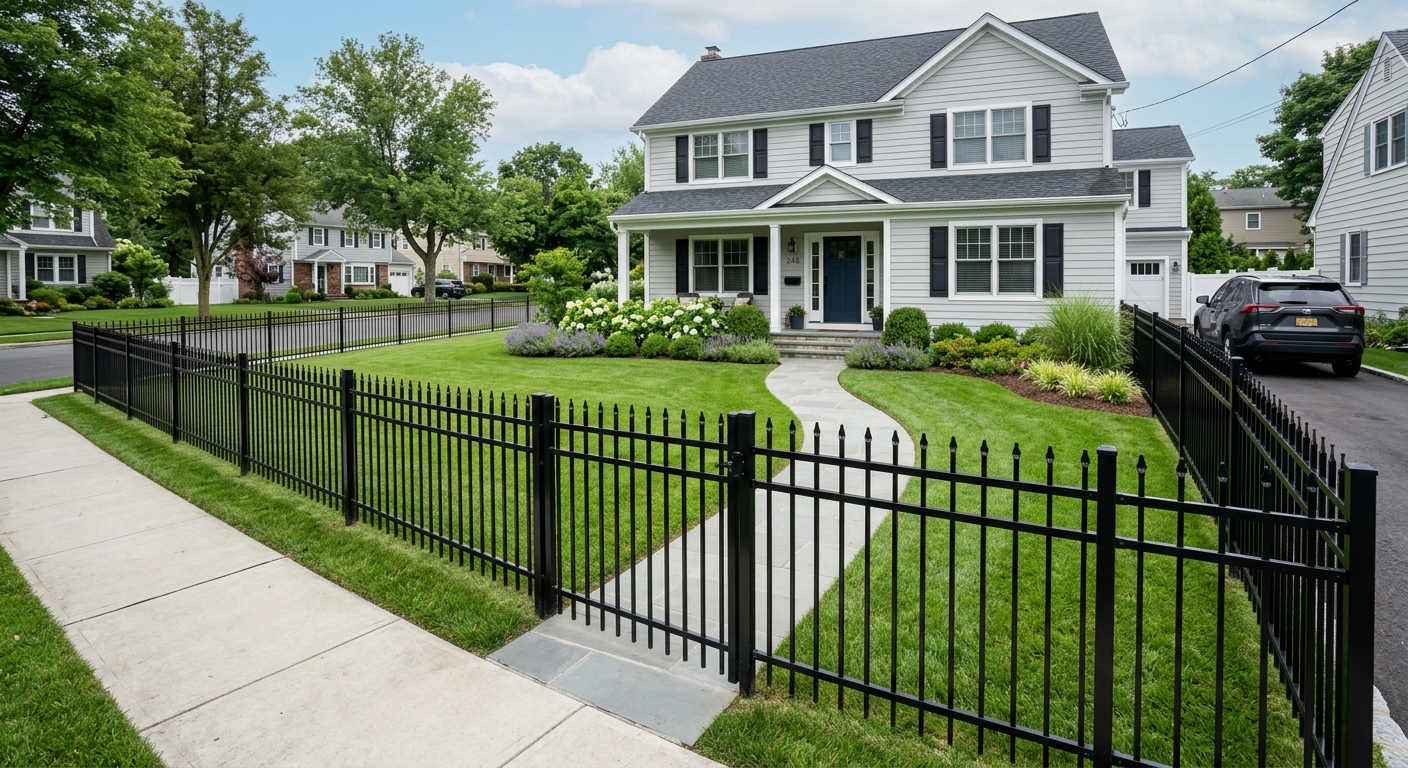
Fencing options and costs in Fernie
Fernie homeowners often ask the same question first: “What will a fence cost here?” With a population of 6,320 and about 72.1% of households owning homes (Statistics Canada, 2021 Census), fencing demand tends to track steady owner-occupied growth—especially where yards are visible from main roads and trails. In Fernie, 62.4% of dwellings are single-detached, so many projects are built around private outdoor space: backyards, side yards, and property edges that need long-term weather resistance.
In the Kootenays, the big cost drivers are the frost line and freeze–thaw cycles. Southern British Columbia frost depths are typically around 1.2–1.5 m, so fence posts generally need to be set close to or below that level (often 4–6 inches into the design frost zone) instead of the shorter “milder region” practice you may hear about. That means deeper augers, more excavation time, and more concrete per post—particularly for corners and gate posts where uplift forces are highest.
Fernie also has microclimates: cold snaps in valley locations can keep soils frozen longer, pushing many contractors toward concrete-set footings rather than gravel backfill. At the same time, exposed ridges and windy property lines can increase the need for tighter post spacing and stronger rails to prevent racking in winter storms. You’ll often see this demand around neighbourhoods like West Fernie and the older residential pockets closer to the downtown core, where many homes were built before 1981 (59.6%—Statistics Canada, 2021 Census) and fences are being replaced to match updated yard layouts and privacy needs.
Below is a quick comparison to help you budget before we talk site measurements.
| Material |
Lifespan |
Maintenance |
Privacy Rating |
Price per Linear Foot |
Price Range |
| Pressure-treated pine (standard wood) |
10–15 years |
Stain/seal every 2–3 years |
High (solid panels) |
$16–$22 |
$2,200–$4,000 |
| Cedar (natural rot resistance) |
15–25 years |
Annual inspection; re-stain as needed (about every 3–4 years) |
High (solid panels) |
$20–$30 |
$2,800–$5,200 |
| Vinyl / PVC (no-maintenance) |
20–30 years |
Rinse as needed; rare repairs |
High (solid privacy styles) |
$24–$36 |
$3,200–$6,200 |
| Chain-link (galvanized steel) |
25–35 years |
Occasional tension/fastener checks |
Low–Medium (open mesh) |
$15–$24 |
$1,600–$3,100 |
| Aluminum ornamental |
25–40 years |
Wash periodically |
Low (decorative pickets) |
$26–$45 |
$2,700–$5,600 |
| Composite / recycled material |
20–30 years |
Low; occasional cleaning |
Medium–High (solid/composite boards) |
$28–$42 |
$3,400–$7,000 |
Prices are estimates only and vary by project scope, site access and material selection.
What affects the price of fencing in Fernie
In Fernie and across the Kootenays, two quotes for the “same fence” can easily swing by 30–50% once you factor in post depth, concrete volume, and how contractors handle corners, gates, and difficult ground. The reason is simple: fencing isn’t just materials—it’s excavation and structural design. In British Columbia, frost and soil movement push a lot of cost into the groundwork. Even if your choice of wood or vinyl looks similar to a quote elsewhere in Canada, the local frost-depth requirement can change labour hours and the amount of concrete used per post.
Frost depth sets how deep posts must be. In this region, posts typically need to be set about 4–6 inches below the design frost depth to reduce frost heave risk. That’s why, compared to milder areas where shorter “tamp and go” installs sometimes pass inspection, Fernie jobs often require deeper augering, longer posts, and more concrete setting. When contractors build bell-shaped or widened footings below frost depth, you’ll see higher material and labour costs—especially for structural corners and double-gate openings.
Local examples that raise cost in Fernie include: (1) sloped driveways needing stepped rails and additional labour for accurate alignment; (2) rocky soil near older properties, where auger time increases and concrete volumes can change; and (3) wind-exposed lines, where tighter post spacing or thicker rails add materials. Cost can lower when a straight run is available with clear access for a skid steer and you’re replacing an old fence without major grade changes.
If you’re budgeting, many wood installations land in the $45–$75 range for labour/material depending on the design, while vinyl/PVC commonly trends toward the $70–$110 band for Fernie projects. Chain-link tends to stay lower (often $30–$55), but it can rise if you add privacy slats or tensioning for longer runs.
| Price Factor |
Why It Matters |
Cost Impact |
| Fence length in linear feet |
Most costs scale directly with footage (posts, rails, labour hours) |
Highest impact (can change the total by 2×) |
| Post depth required |
Frost line determines how long posts must be and how deep the holes go |
Large impact; deeper setting increases concrete and auger time |
| Post setting method |
Concrete vs. gravel pack vs. driven posts affects both durability and labour |
Concrete-set typically costs more than gravel pack |
| Material choice |
Vinyl/PVC and cedar generally cost more than pressure-treated pine; chain-link is lower |
Medium to large; affects both unit price and longevity |
| Gate count and type |
Drive-through double gates require heavier frames, stronger hardware, and more bracing |
Medium to very high for double gates |
| Grade and terrain |
Sloped yards require stepped or raked panels and careful measurement |
Medium; adds labour and sometimes extra rails/posts |
| Old fence removal and disposal |
Hauling and dump fees, plus time to dismantle and separate materials |
Low to medium; can become medium in long installs |
| Permit fees and survey / property line locate |
Verification reduces encroachment risk; locating can be needed before digging |
Low to medium; sometimes increases total by a few hundred to over $1,000 |
Permits & regulations in British Columbia
In British Columbia, fence permitting can depend on location and height. As a practical rule of thumb, fences above a threshold—often around 2.0 m (rear) and roughly 1.0–1.2 m (front or corner)—may require a building permit in many communities. Regardless of height, all fences must respect property lines and any municipal setback bylaws that apply on your parcel.
Before any digging, utility locates are mandatory. Call BC 1 Call (or the appropriate regional service) before you trench or auger so crews can mark buried lines. Then, verify your boundary—either with a survey or by locating your property pins—because a “close enough” fence line is a common source of disputes in older neighbourhoods of Fernie where boundaries may not be visibly marked.
For contractor verification in Fernie, ask for three items and check them yourself: (1) Provincial business licensing where applicable for the type of work; (2) liability insurance—request a certificate of insurance listing the insured party and coverage limits; and (3) WCB coverage (WorkSafeBC) for workers who will be on-site. You can typically verify WCB clearance and licensing details through online registries and the clearance certificate paperwork they provide, and you should also confirm the certificate is current (not expired).
What typically does not require a permit: replacing like-for-like fences on the same footprint and within common height limits, provided you stay on your property and meet local setbacks. What does require a permit: taller fences above the threshold, corner visibility fences that affect sightlines, and any project that involves changing the footprint or height in a way that triggers local bylaw thresholds.
Choosing the right fence material for Fernie
Choosing the right fence material for Fernie is about matching your priorities—privacy, low maintenance, lifespan, and upfront budget—to the reality of Kootenay weather. Frost heave pressure and freeze–thaw cycling reward solid post support, while cold snaps can punish materials that crack or become brittle. Pressure-treated pine is usually the lowest upfront option, but it needs staining or sealing about every 2–3 years to avoid grey weathering and surface degradation. Cedar costs more but resists rot naturally and often looks better as it weathers; you still should plan for periodic maintenance to keep colour even and protect surface exposure.
Vinyl/PVC offers the most “set it and forget it” experience—low maintenance, good appearance, and long service life. The trade-off is that in extreme cold it can be more prone to cracking if panel fit, post spacing, or rail alignment isn’t correct, so the installation quality matters as much as the material. Chain-link is typically the cheapest per linear foot and lasts a long time, but privacy is limited unless you add privacy slats (which changes cost and airflow). Aluminum ornamental looks great and won’t rust, but it’s also not a privacy solution by design. Composite/recycled materials can be a middle-to-higher investment with low upkeep, but final pricing varies a lot by board style and system.
Post-depth remains key regardless of material. In this region, concrete-set posts are commonly used because deeper frost conditions mean you want stable footing beneath the frost zone; this is where you can feel the “Fernie premium” compared with milder provinces. For example, if wood is priced around the $45–$75 band and vinyl lands near the $70–$110 band, the difference can be justified if you want long-term appearance with minimal annual work—especially when you’re replacing a fence in an area you use year-round.
| Material |
Cold Tolerance |
Lifespan |
Annual Maintenance |
Best For |
Price Band |
| Pressure-treated pine |
Good if posts are properly set and boards are kept sealed |
10–15 years |
1–2 sessions (stain/seal planning every 2–3 years) |
Budget privacy with a willingness to maintain |
$45–$75 |
| Cedar |
Very good in cold climates when ventilated and maintained |
15–25 years |
Light inspection; re-stain about every 3–4 years |
Natural look + better rot resistance |
$55–$95 |
| Vinyl / PVC |
Good; installation quality affects cold-crack risk |
20–30 years |
Minimal (wash/inspect 1× per year) |
Low maintenance privacy |
$70–$110 |
| Chain-link |
Excellent in freeze–thaw with proper tensioning |
25–35 years |
Minimal (check tension and fasteners) |
Security on a budget |
$30–$55 |
| Aluminum ornamental |
Excellent (no rust; stable in cold) |
25–40 years |
Minimal (wash/inspect 1× per year) |
Attractive front-yard definition |
$80–$140 |
| Composite / recycled |
Good; depends on board system and spacing |
20–30 years |
Low (cleaning and periodic hardware checks) |
Privacy with low upkeep |
$90–$150 |
How to choose a fencing contractor in Fernie
When you hire a fencing contractor in Fernie, verify three things first: licensing/eligibility, liability insurance, and WorkSafeBC (WCB) coverage. Ask for the certificate of insurance (COI) and confirm it’s current, lists the right named insured, and shows coverage for general liability (and whether they carry additional insured wording if required). For WorkSafeBC, request proof of clearance or a WCB account/clearance document; you can also check online using the business details they provide. If the contractor is operating as a business, confirm they’re eligible to do the work in British Columbia (and that their business information matches the quote and invoice).
Next, get 2–3 written, itemised quotes. Good quotes break out labour and materials separately (posts, rails, gates, hardware, concrete, disposal, and any survey/property line locate costs). Make sure the scope is explicit: what’s excluded (for example, rock removal beyond a certain limit, site grading, or any replacement of landscaping), whether permit pulling is included, and whether old fence removal and hauling are part of the price.
Warranty matters in Fernie because post-setting quality is what survives frost cycles. Ask for: a workmanship warranty length, the manufacturer warranty for materials, and whether warranties are transferable if you sell your home. Payment schedules should be conservative—never pay more than about 10–15% upfront. Hold back the remainder until the final inspection and walk-through are complete, with any punch-list items addressed.
Finally, demand a start date and completion estimate in writing. If a contractor can’t provide a timeline for a basic install, that’s usually a sign the planning—and jobsite coordination—won’t be reliable once excavation starts.
- Confirm liability insurance COI is current and matches the legal name on the quote.
- Check WorkSafeBC clearance/proof before work begins.
- Verify the contractor has experience with deep frost-set posts (ask how they design corners/gates).
- Require a written, itemised quote with labour and materials separated.
- Confirm whether permit pulling is included or your responsibility.
- Ask whether utility locates and property pin/survey verification are handled by the contractor.
- Review the post spacing and rail configuration for wind and snow load durability.
- Get a detailed gate hardware list (hinges, latch type, bracing) in the quote.
- Ask what happens if they find bedrock—what’s the change-order trigger?
- Confirm disposal and dump fees for the old fence are included (or not).
- Check warranty terms for workmanship and materials, and whether it’s transferable.
- Use a payment schedule with a small deposit and holdback until final completion.
Red flags I see in Fernie include: (1) quotes that don’t specify post depth, concrete setting, or footing approach; (2) “cash-only” or large upfront payments; (3) missing COIs or unclear WorkSafeBC status; (4) vague scope language like “fence supplied and installed” without a material list; and (5) no timeline in writing or refusal to include exclusions and change-order conditions.
Frequently asked questions — fencing in Fernie
How much does a fence cost in Fernie?
In Fernie, total fence cost usually depends on linear feet, post depth for frost conditions, gate count, and whether concrete setting and old fence removal are included. As a budgeting guide, wood privacy installations often fall within the $45–$75 range, while vinyl/PVC commonly sits around $70–$110 in this market. Chain-link typically ranges lower, often $30–$55, but privacy upgrades (like slats) can increase the total. Because Kootenay soils experience freeze–thaw and posts generally need to be set close to/below design frost depth, two “similar” fences can still differ significantly. For an accurate figure, ask for an itemised quote showing posts, concrete volume, rails, and gate hardware.
How deep should fence posts be for Fernie's frost?
For Fernie’s frost conditions in southern British Columbia, fence posts are typically set deeper than the common 2 ft rule-of-thumb used in milder regions. Contractors generally set posts about 4–6 inches into/at the design frost zone to reduce frost heave risk, which often means deeper augering and longer posts than you might expect. In practice, that usually translates to posts installed close to or below roughly 1.2–1.5 m frost-depth expectations (exact depth depends on the engineer/contractor’s frost design and your specific site). Corners and gate posts are especially important because they see higher lateral forces, so they’re commonly reinforced with thicker concrete footings or designed bell-shaped/expanded bases for uplift resistance.
Wood vs vinyl vs aluminum fence — which is best?
“Best” depends on what you value most. If you want the lowest upfront cost for privacy, pressure-treated wood is usually the budget choice (often associated with the $45–$75 band), but you should plan for staining or sealing every 2–3 years to keep it looking good. Cedar is a step up for appearance and rot resistance, while still requiring maintenance. Vinyl/PVC is a strong choice for low maintenance and long-term looks; it often sits in the $70–$110 range and, when installed correctly with proper post spacing and alignment, performs well in cold weather. Aluminum is great for front-yard definition and won’t rust, but it’s not ideal if you want full privacy since ornamental pickets are open. In Fernie, the installation quality and correct post setting matter as much as the material pick.
Do I need a permit to build a fence in British Columbia?
Sometimes yes. In British Columbia, permits are commonly required for fences above certain height thresholds—often around 2.0 m at the rear and roughly 1.0–1.2 m at the front or corner—plus any fencing that may affect visibility or setbacks. Even when a permit isn’t required, your fence must still respect property lines and local setback bylaws. Before digging, you must call for utility locates and verify your boundary (a survey or property pin locate is the safest approach). In Fernie, many older lots have fewer visible markers, so confirm the line before posts go in. If you hire a contractor, ask whether they handle permits and verify your scope in writing.
How long does a wood fence last in Fernie?
With proper installation in Fernie, wood fences typically last about 10–15 years for pressure-treated pine and 15–25 years for cedar, assuming good post setting for freeze–thaw and routine maintenance. The biggest risk to lifespan is not just the wood species—it’s post support. If posts aren’t set near or below frost depth, frost heave can lift and rack sections, which accelerates damage to rails and fasteners. Wind exposure and snow load also add stress on tall panels, so tighter spacing and sturdy framing make a meaningful difference. Home maintenance matters too: staining or sealing every 2–3 years for pressure-treated lumber helps slow surface breakdown in Fernie’s wet/cold swings.
Who owns and maintains a shared fence?
In British Columbia, shared fence responsibility can be governed by provincial line-fences rules, but the practical answer for homeowners is: ownership and maintenance often depends on the boundary agreement and who installed or replaced the fence historically. If you share a boundary fence, determine ownership by reviewing how the fence was built and whether there’s a written agreement. If ownership is shared, both sides usually share costs for maintenance or replacement decisions, though the details can vary based on local circumstances and the nature of the dispute. In Fernie, it’s wise to document existing conditions with photos, confirm the boundary line (especially on older properties), and get clarity in writing before repairs or upgrades. A good contractor can also help separate what is “maintaining” vs “upgrading” since that can affect cost discussions.