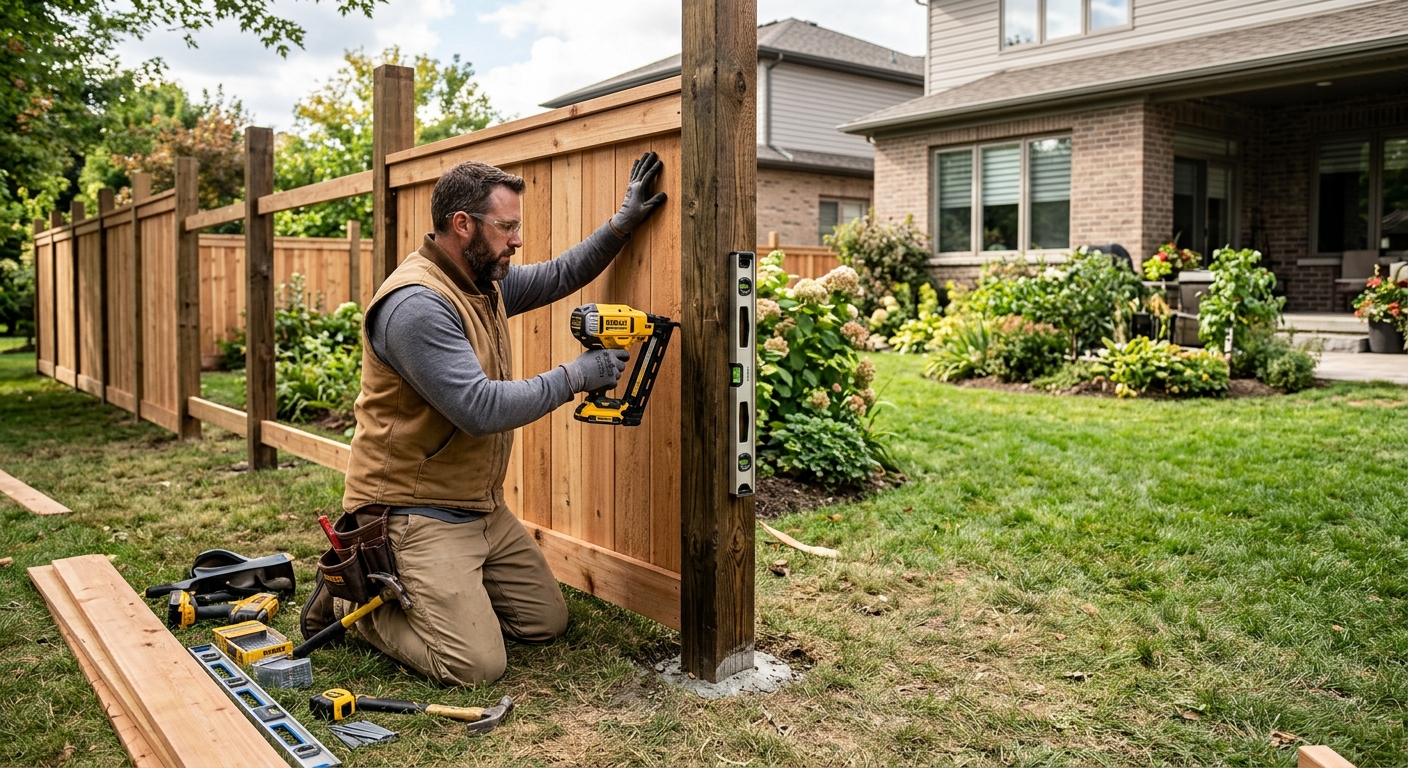
Fencing options and costs in Belvedere
In Belvedere, Alberta, homeowners typically want fences that can handle Prairie freeze–thaw swings and strong wind. With a 2021 population of 5,018 (Statistics Canada, 2021 Census), the community is small enough that contractors often book earlier, especially for summer installs in high-demand pockets such as the residential streets around the newer developments near 96 Ave SE and surrounding neighbourhood lanes. Demand is also supported by the sheer number of individual lots attached to single-detached homes—each boundary is a potential fencing project, which keeps replacement work steady (Statistics Canada, 2021 Census).
In the Calgary economic region, the main cost drivers are frost protection and wind loading. Local expectations generally set posts about 4 ft (≈120 cm) deep to get below the regional frost line and reduce heaving, and this pushes excavation time and concrete volume higher than milder parts of Canada. Privacy panels also tend to be more engineered for racking, so solid wood and vinyl usually land mid-to-upper pricing, while chain-link stays closer to the lower end because it breathes in wind.
Price ranges in Belvedere usually track the wider Calgary band: wood and vinyl often fall mid-range, chain-link tends to be the value option, and ornamental aluminum is a premium look. If you’re comparing materials, it’s easiest to start with lifespan and maintenance, then sanity-check the installed cost against your yard access and the number of gates. Use the table below to benchmark typical installed options before you request itemised quotes.
| Material |
Lifespan |
Maintenance |
Privacy Rating |
Price per Linear Foot |
| Pressure-treated pine (standard wood) |
10–18 years |
Stain/seal every 2–3 years to reduce grey weathering and splintering |
High (solid panels) |
$40–$75 |
| Cedar (natural rot resistance) |
18–25 years |
Light oil or stain 2–4 years (helps appearance more than rot prevention) |
High (solid panels) |
$55–$95 |
| Vinyl / PVC (no-maintenance) |
20–30 years |
Rinse as needed; check brackets and gate hardware after severe cold snaps |
High (solid privacy styles) |
$45–$90 |
| Chain-link (galvanized steel) |
25–40 years |
Occasional tightening and coating touch-ups; vegetation trimming |
Low (see-through) |
$25–$55 |
| Aluminum ornamental |
25–40 years |
Wash annually or as needed; inspect for gate alignment |
Low–Moderate (decorative pickets) |
$70–$120 |
| Composite / recycled material |
20–30 years |
Minimal (wash/inspect); avoid impact damage |
Moderate–High (depends on slat design) |
$60–$105 |
Prices are estimates only and vary by project scope, site access and material selection.
What affects the price of fencing in Belvedere
Fence quotes for the same “6 ft privacy fence” can vary by 30–50% across Calgary-area communities and even within Alberta because labour intensity changes with ground conditions, wind-exposed runs, and the amount of concrete setting required. In the Calgary region, frost protection is a consistent premium driver: posts are typically set about 4 ft (≈120 cm) deep, and the design requirement is often framed as placing posts roughly 4–6 inches below the design frost depth to prevent heaving. That means longer posts, deeper auger holes, more concrete (or more specialised installation), and more time per section.
Wind exposure also matters. Prairie yards can behave like wind tunnels, so solid wood and vinyl privacy styles usually require tighter post spacing and sturdier hardware to prevent racking. Chain-link fencing, by contrast, tends to cost less because airflow reduces the lateral force on the system—so even when it has similar post depth, the overall build is often lighter. Climate comparisons help explain this: coastal BC’s mild temperatures but frequent wetting can accelerate wood rot without proper treatment, while Belvedere’s cycle of freezing and thawing mainly punishes posts and footings if they’re not set below the frost line.
Two practical Belvedere examples that change pricing: (1) a north-facing, open lot often needs stronger bracing and closer post spacing, nudging solid wood pricing toward the mid–upper band (roughly $40–$80/linear foot for wood). (2) a sheltered backyard with easy access and fewer gate openings can keep labour efficient, and vinyl projects may land closer to the lower-mid range of the local band (about $45–$90/linear foot). Similarly, older fences that include rotted posts or buried sections generally cost more to remove and dispose of, and that can add noticeable dollars even before materials.
| Price Factor |
Why It Matters |
Cost Impact |
| Fence length in linear feet |
More footage means more posts, rails, pickets/panels, and labour hours |
Major (directly scales total cost) |
| Post depth required |
Frost line sets hole depth and post length to reduce heaving |
High (can add concrete and excavation time) |
| Post setting method |
Concrete setting is stronger for windy runs; gravel pack/driven options vary by site |
High (concrete and labour increase cost) |
| Material choice |
Vinyl/cedar cost more upfront than chain-link; structural requirements can differ |
Medium to major (shifts price band) |
| Gate count and type |
Drive-through double gates require heavier frames and alignment work |
Medium to major (gates cost disproportionately) |
| Grade and terrain |
Sloped yards need stepped or raked panels to keep top lines consistent |
Medium (extra layout and materials) |
| Old fence removal and disposal |
Demolition, loading, and hauling add labour and dump fees |
Medium (often overlooked) |
| Permit fees and survey / property line locate |
Locates and line determinations prevent encroachment and redesign |
Variable (can be minor or meaningful) |
Permits & regulations in Alberta
In Alberta, whether you need a building permit commonly depends on fence height and location relative to the street. As a practical rule of thumb, fences above about 2.0 m (6.5 ft) at the rear and above about 1.0–1.2 m (3–4 ft) at the front or corner often trigger a permit requirement. Even when a permit isn’t needed, your fence still must respect property lines and municipal setback bylaws, which is where disputes usually start if the line isn’t verified.
Before digging any post hole, arrange utility locates so you don’t strike buried services. Homeowners typically call the provincial utility locating service via Alberta One-Call (and you should do this before excavation begins). Next, confirm your property boundary using a survey or property pin locate. A pin locate is especially helpful in Belvedere where lot boundaries can be hard to “see” on the ground, and a small offset can force changes to your layout and rework.
Shared fence responsibilities are governed by Alberta’s line-fences legislation, so it’s smart to document what portion is shared and what each neighbour maintains. For contractor selection in Belvedere, verify your fence company is appropriately licensed, carries liability insurance, and has proper WCB coverage where required. Ask for: (1) licence details from the appropriate online business registry, (2) a current certificate of insurance naming you as additionally insured (where applicable), and (3) evidence of WCB/WCB clearance for the workers on your site.
Choosing the right fence material for Belvedere
Choosing the right fence material in Belvedere is mostly about matching your priorities—privacy, low maintenance, upfront budget, and lifespan—to Alberta’s Prairie freeze–thaw cycle and wind. Pressure-treated pine is usually the budget-friendly route, but it needs ongoing staining or sealing every 2–3 years to limit grey weathering and splintering in our sun and temperature swings. Cedar has better natural rot resistance and an attractive look, but it’s not “zero maintenance”—it still benefits from periodic staining/oiling to keep colour and reduce surface checking. Vinyl/PVC offers low maintenance and typically performs well in cold climates when installed with proper hardware, although extreme cold can make brackets and gate alignment more noticeable if hardware isn’t sized correctly. Chain-link is the lowest-cost option and typically lasts a long time, but it doesn’t provide privacy unless you add slats/mesh (which can affect airflow and wind load).
For Calgary-area frost protection, the post depth requirement remains the real foundation cost regardless of material. Because posts are often set about 4 ft (≈120 cm) deep to get below the regional frost line, the “big” expense is the footing and labour, not just the material price. Wind and snow loads also push you toward sturdy posts and secure rails for solid wood or vinyl privacy styles. If you’re on an open, windy yard exposure, that structural requirement is what justifies the mid-to-upper bands.
A good budget example: if pressure-treated wood privacy fencing is around $40–$75 per linear foot, and vinyl privacy is around $45–$90 per linear foot, the extra cost of vinyl is most justified when you want fewer maintenance trips and longer-term appearance stability. But if you’re comfortable with periodic staining and you’re protecting the fence with proper concrete-set posts, wood can be a very strong value.
| Material |
Cold Tolerance |
Lifespan |
Annual Maintenance |
Best For |
Price Band |
| Pressure-treated pine |
Good (with proper sealing and hardware) |
10–18 years |
Visual inspection; plan stain/seal every 2–3 years |
Lower upfront cost with solid privacy |
$40–$80 |
| Cedar |
Good (natural resistance to rot) |
18–25 years |
Light oil/stain as needed; tighten hardware |
Natural look and better rot resistance |
$55–$95 |
| Vinyl / PVC |
Good (installed with appropriate brackets) |
20–30 years |
Rinse as needed; check gate alignment after storms |
Low maintenance privacy in windy zones |
$45–$90 |
| Chain-link |
Excellent (galvanized steel) |
25–40 years |
Occasional tightening and trimming |
Security with maximum airflow |
$25–$55 |
| Aluminum ornamental |
Excellent (won’t rust like steel) |
25–40 years |
Wash annually or as needed |
Attractive curb appeal and light security |
$70–$120 |
| Composite / recycled |
Good (but avoid impact damage) |
20–30 years |
Minimal; rinse and inspect fasteners |
All-weather look with low upkeep |
$60–$105 |
How to choose a fencing contractor in Belvedere
When hiring a fencing contractor in Belvedere, you want proof—not promises—on licensing, insurance, and worker coverage. In Alberta, verify the contractor’s business registration and licence details through the appropriate online registry. Ask for liability insurance documentation and review the certificate of insurance for coverage limits that make sense for excavation and gate installation work. Also request evidence of WCB/WCB coverage (or clearance) for workers performing the install; don’t accept a verbal “yes,” and don’t rely on subcontractors you’re not told about. If you can’t get documentation quickly, that’s a warning sign.
Next, collect 2–3 itemised written quotes, not lump-sum estimates. You want line items for labour, materials, excavation, post setting (including concrete quantities), gate hardware, and disposal/removal of your old fence. Read the scope carefully: confirm whether permits are included (if required), whether survey/property line locate work is offered or your responsibility, and what happens with delays caused by locates or weather.
Warranty matters too. Ask for the workmanship warranty length, the manufacturer warranty (for posts/panels/hardware), and whether the warranty transfers if you sell the home. Payment scheduling should protect you: never pay more than about 10–15% upfront, and hold back a portion until completion and cleanup are verified. Finally, request a start date and a completion estimate in writing, including weather-based contingency for drilling and curing.
- Verify Alberta business registration and request licence details in writing.
- Request a current certificate of liability insurance (review dates and limits).
- Confirm WCB/WCB clearance for installers and include it in the paperwork.
- Get 2–3 itemised quotes showing labour and materials separately.
- Ensure post depth, post spacing, and post-setting method are explicitly stated.
- Confirm concrete footing spec (amount/type) for windy, open runs.
- Ask whether gate framing and latching hardware are included and which model.
- Confirm if old fence removal and disposal are included (dump fees vary).
- Ask who pulls permits/arranges locates (and whether it’s included in price).
- Check warranty: workmanship duration and manufacturer terms for materials.
- Confirm payment schedule (max 10–15% upfront; holdback until completion).
- Request timeline details, including how delays from locates/weather are handled.
Red flags to watch in Belvedere: a quote that doesn’t specify post depth or setting method; installers who can’t show proof of insurance or WCB coverage; “no-extras” pricing with vague exclusions (especially removal, disposal, and grade adjustments); pressure to pay most of the cost upfront; and refusing to put the scope and warranty terms in writing.
Frequently asked questions — fencing in Belvedere
How deep should fence posts be for Belvedere's frost?
For Belvedere and the wider Calgary region, the safest guidance is to set posts about 4 ft (≈120 cm) deep so they sit below the regional frost line and reduce heaving during freeze–thaw cycles. In many projects, contractors follow the concept of placing posts roughly 4–6 inches below the design frost depth, then using concrete footings—especially for 6 ft privacy fences and gate posts. That depth increases excavation time and concrete volume, which is a major reason solid wood or vinyl typically costs more than airy systems like chain-link. If you’re receiving a quote, ensure it explicitly states hole depth, post type, and whether concrete is used for every post line, not just corners. (Alberta’s cold seasons make post stability the first priority.)
Wood vs vinyl vs aluminum fence — which is best?
“Best” depends on your goals in Belvedere. Wood (pressure-treated pine) is often the budget choice with strong privacy when built as solid panels, and local installed pricing commonly sits around $40–$80 per linear foot. Vinyl/PVC is typically mid-range to upper-mid (often $45–$90) and is chosen for low maintenance and a consistent look, though it still needs proper hardware and concrete-set posts for wind-heavy yards. Aluminum ornamental is usually a premium curb-appeal option (often $70–$120) with good longevity, but it doesn’t deliver the same privacy as solid wood or vinyl. If you want privacy plus minimal upkeep, vinyl is usually the best match; if you want classic appearance and can maintain it, cedar or pressure-treated pine can be an excellent value.
Do I need a permit to build a fence in Alberta?
In Alberta, permits are commonly required based on fence height and location. A common guideline is that fences above about 2.0 m (6.5 ft) at the rear and above about 1.0–1.2 m (3–4 ft) at the front or corner often trigger a building permit requirement. Even when a permit isn’t required, you must still follow municipal setback bylaws and respect property lines. Before installing, get utility locates through Alberta One-Call, and confirm your boundary using pins or a survey to avoid encroachment disputes. When you request quotes in Belvedere, ask whether the contractor includes permit pulling (if required), because that can change both timeline and total project cost.
How long does a wood fence last in Belvedere?
A wood fence in Belvedere can often last about 10–18 years for pressure-treated pine when it’s installed with proper post depth below the frost line and periodic maintenance. Cedar generally lasts longer—often around 18–25 years—because it resists rot better and keeps its appearance better with maintenance. The biggest durability wins in our climate come from correct concrete-set footing or approved post setting, solid rail connections, and staining/sealing on a realistic schedule. If a fence is built with posts set too shallow, you may see heaving and misalignment sooner after freeze–thaw cycles, which shortens service life. When comparing quotes, don’t only compare the sticker price—ask about post setting specs, board grade, and how they plan for wind racking in open yards.
Who owns and maintains a shared fence?
In Alberta, shared fence ownership and maintenance responsibilities are governed by the line-fences legislation. Practically, this means you should clarify which portion is on the boundary and whether both neighbours share responsibility for upkeep and replacement. In Belvedere, the best approach is to document the agreement in writing (even a simple signed note) and confirm who pays for repairs or upgrades, particularly if you’re replacing a fence that’s aging or has structural issues. Before construction, confirm your property line with pins or a locate, because building “on the wrong side” can shift responsibilities. If there’s disagreement, a survey or boundary locate can prevent costly rework and disputes.
How do I find my property line before fencing?
To find your property line before fencing in Belvedere, start with an official boundary locate: use a survey (best accuracy) or locate the property pins based on your land title information. A visual guess from a sidewalk edge or landscaping line is risky, especially when fencing must meet setback requirements and when neighbours rely on consistent boundaries. Also complete utility locates before any digging; Alberta One-Call will help mark buried services so you can plan post holes safely. For contractors, ask if they include a property line locate/survey step in the quote or if it’s your responsibility. A clear boundary plan helps keep the project within scope and avoids reinstallation costs. A well-planned locate can also prevent delays that would push your start date.