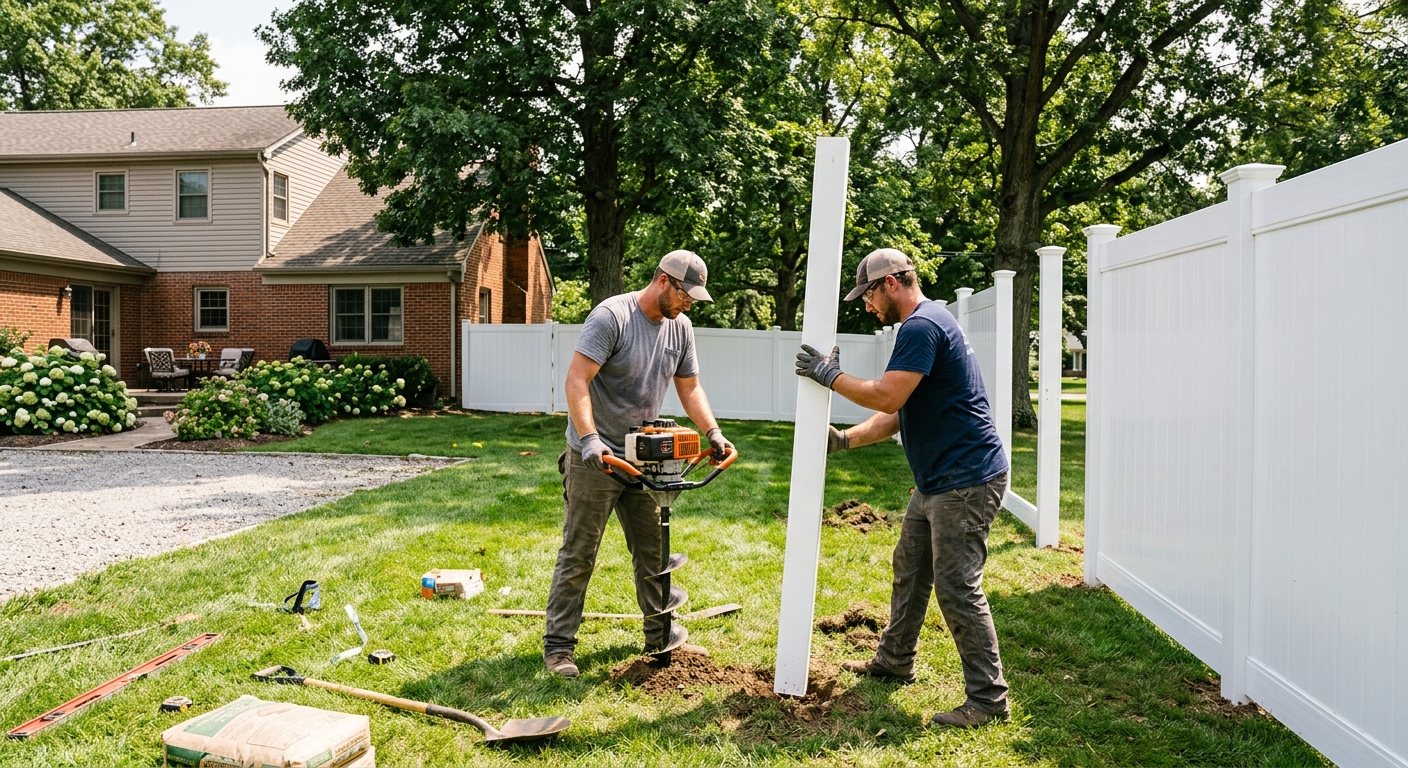
Fencing options and costs in Falher
In Falher, choosing the right fence starts with knowing who needs it. With 69.5% of households owning their homes and 63.0% of local dwellings being single-detached, many properties are long-term family homes where backyard perimeter and pet containment upgrades come up repeatedly. Just as importantly, 64.6% of homes were built before 1981, which often means older boundary fences (or none at all) are replaced with modern systems that can handle today’s wind and freeze–thaw conditions.
In the Athabasca–Grande Prairie–Peace River economic region, winter frost can push the frost line to about 4–6 feet. That affects fencing costs because posts often need to be set deeper and frequently concreted to reduce frost heave, prevent leaning, and keep spacing true after multiple freeze cycles. Prairie winds are also a major factor: heavier privacy boards (wood or vinyl) need tighter post spacing and sturdier rails, while more open styles like chain-link can safely span farther. Contractor availability can influence price too—when crews are busy across the region (Grande Prairie, Greenview, Mackenzie County), mobilization and site access time can push bids toward the higher end of the typical Alberta ranges.
We see especially strong demand in older residential pockets near Main Street where lots are developed and access is straightforward for augers and pickup trucks, keeping install time predictable. Below is a practical side-by-side so you can compare life expectancy, maintenance effort, and typical installed cost per linear foot.
| Material |
Lifespan |
Maintenance |
Privacy Rating |
Price per Linear Foot |
| Pressure-treated pine (standard wood) |
10–15 years |
Stain/paint every 2–3 years |
High (solid panel) |
$35–$55 |
| Cedar (natural rot resistance) |
15–20 years |
Seal or stain every 3–4 years |
High (solid panel) |
$45–$70 |
| Vinyl / PVC (no-maintenance) |
20–30 years |
Rinse as needed (no painting) |
Medium-High (solid pickets/boards) |
$40–$80 |
| Chain-link (galvanized steel) |
20–30 years |
Occasional tension/repairs |
Low (open mesh) |
$25–$50 |
| Aluminum ornamental |
25–35 years |
Minimal (wash debris off) |
Low-Medium (decorative spacing) |
$45–$90 |
| Composite / recycled material |
20–30 years |
Wash occasionally; avoid impact damage |
High (board-style) |
$55–$95 |
Prices are estimates only and vary by project scope, site access and material selection.
What affects the price of fencing in Falher
In the Athabasca–Grande Prairie–Peace River region, two “similar” fence projects can land 30–50% apart in cost even when the homeowner chooses the same height. The biggest reasons are how deep posts must be set for winter conditions, how open the site is to wind, and what the ground is like where we dig. In Falher’s part of Alberta, longer freeze–thaw cycles and colder soils tend to increase the labour and footing requirements compared with milder areas, and that labour is a real line item when crews are drilling deeper holes and carrying more concrete and hardware.
Frost line depth drives post length and hole depth. A practical rule contractors follow is setting posts about 4–6 inches below the design frost depth zone, which commonly results in posts needing to be roughly 1.5–2.0 m down in Alberta conditions. That typically means more concrete, more time with augers, and sometimes extra labour where clay, gravel pockets, or hardpan slows drilling. Wind exposure across the Prairies also matters: heavier privacy panels need tighter post spacing and stronger rails, and that can push you from the mid to higher end of the wood or vinyl bands (for example, the $35–$70 wood range versus the $40–$80 vinyl range).
Concrete examples from typical Falher jobs: (1) a straight run on compacted, easier-to-auger soil may come closer to the lower end of the chain-link band ($25–$50), because posts can be set efficiently; (2) a backyard fence near a sheltered area with snow drifting can still cost more than expected if we must use sturdier posts and rails to resist loads from wind-driven snow; (3) if you’re removing an older fence with buried posts and mixed debris, disposal and patching time can add noticeable cost even if the new material is economical.
Finally, housing age can indirectly impact fencing scope: many pre-1981 properties have older grade lines, more irregular lot geometry, and mature landscaping that affects access and makes installation slower. With a median household income around $72,000 (Statistics Canada, 2021 Census), most homeowners plan scope carefully—choosing where to spend (privacy boards, post spacing, gates) and where to save (length, style, and replacement vs. new builds).
| Price Factor |
Why It Matters |
Cost Impact |
| Fence length in linear feet |
The longer the run, the more posts, rails, and fittings are required |
High (primary driver) |
| Post depth required |
Frost line determines how deep posts must go to prevent heaving and leaning |
Medium-High (materials + labour) |
| Post setting method |
Concrete vs. gravel pack vs. driven posts changes footing stability |
Medium (concrete typically raises cost) |
| Material choice |
Vinyl/cedar often cost more than chain-link; strength needs differ by style |
High (major swing) |
| Gate count and type |
Drive-through double gates require stronger frames and more hardware |
Medium-High |
| Grade and terrain |
Slopes require stepped panels or raked sections for alignment |
Medium (extra labour/materials) |
| Old fence removal and disposal |
Debris hauling and buried post extraction add time and disposal fees |
Medium (often underestimated) |
| Permit fees and survey / property line locate |
Verification work and documentation can be required depending on height and location |
Low-Medium (but can be critical) |
Permits & regulations in Alberta
In Alberta, fences above a height threshold—commonly around 2.0 m (6.5 ft) at the rear and about 1.0–1.2 m (3–4 ft) at the front or corner—often require a building permit, depending on local bylaws and the fence’s location on the property. Even when a permit isn’t triggered, you still need to respect property lines and municipal setback requirements. For Falher homeowners, the practical takeaway is: confirm the proposed height and placement before any post holes get dug.
Before digging, call for utility locates so you don’t hit buried power, gas, or telecom lines. In Alberta, the call goes through Alberta One-Call. If you want to be extra safe (and avoid future neighbour disputes), obtain a survey or at least have your property pins located and verified by a qualified surveyor before the contractor sets line and string. Shared fence ownership rules are generally governed by provincial line-fences legislation, which means maintenance responsibilities and boundary costs can differ depending on agreements and who installed what originally.
What typically does require a permit: installing a new fence that is above the threshold height, or replacing a fence to exceed those heights in the same general footprint. What typically does not require a permit: small repairs, replacing in-kind fence sections at similar height, and routine maintenance—though it’s still wise to confirm if you’re increasing height or changing location. To verify contractor readiness, ask for the Alberta licence details, certificate of liability insurance, and proof of WSIB/WCB coverage. You can check licence/registry information online, then confirm insurance coverage details directly on the certificate (and request a clearance letter where applicable) before work starts.
Choosing the right fence material for Falher
For Falher homes, the “best” fence material is the one that matches your priorities against our local realities: deep winter frost, prairie wind loading, and year-to-year freeze–thaw. Pressure-treated pine is usually the budget-friendly starting point, but it needs staining or painting about every 2–3 years to prevent grey weathering and cracking around knots. Cedar looks great and naturally resists rot, with maintenance typically every 3–4 years (sealing/staining helps it last), but cedar still isn’t “set and forget.” Vinyl/PVC is the low-maintenance favourite because it doesn’t require painting; however, in extreme cold it can become more brittle at impact points, so you want good post spacing and proper rail strength. Chain-link gives you the longest service life at the lowest cost, but it won’t provide privacy—so it’s best for containment and security rather than screening.
In the Athabasca–Grande Prairie–Peace River region, frost line conditions commonly require deeper posts, often with concrete setting for stability. That means even a chain-link fence benefits from proper footing depth, while solid privacy fences typically need tighter spacing so wind can’t “sail” the panels. Where snow drifting occurs, well-built rails and secure posts matter because drifting can increase load against the fence face.
To put the trade-offs into dollars: if you’re comparing pressure-treated pine to cedar for a similar solid privacy run, pine often lands in the wood band (around $35–$70 per linear foot installed), while cedar typically stretches toward $45–$70 due to material and faster-to-install density requirements on windy runs. That higher cost is usually justified when you want a cleaner, longer-lived finish in full sun and wind exposure.
| Material |
Cold Tolerance |
Lifespan |
Annual Maintenance |
Best For |
Price Band |
| Pressure-treated pine |
Good (with proper staining and regular inspection) |
10–15 years |
Light to moderate (stain/paint every 2–3 years) |
Budget privacy with periodic upkeep |
$35–$70 |
| Cedar |
Good (natural rot resistance helps through freezes) |
15–20 years |
Low to moderate (seal/stain every 3–4 years) |
Premium look with less rot risk |
$45–$70 |
| Vinyl / PVC |
Very good (impact resistance varies in extreme cold) |
20–30 years |
Minimal (rinse as needed) |
Low maintenance privacy or perimeter |
$40–$80 |
| Chain-link |
Good (galvanized coating resists winter corrosion) |
20–30 years |
Minimal (check tension and ties) |
Security and pet containment |
$25–$50 |
| Aluminum ornamental |
Excellent (no rust; stable in cold) |
25–35 years |
Minimal (wash debris off) |
Front yard curb appeal |
$45–$90 |
| Composite / recycled |
Good (solid panels resist rot; avoid heavy impacts) |
20–30 years |
Low (wash/inspect for cracks) |
Long-lived privacy with reduced upkeep |
$55–$95 |
How to choose a fencing contractor in Falher
When you hire a fencing contractor in Falher, Alberta, verify three things before you sign: licensing, liability coverage, and WCB/WSIB coverage. Start by asking for the contractor’s Alberta registration/licence information and checking it through the relevant online registry. Next, request a certificate of liability insurance—make sure the coverage is current and includes general liability for construction activities. For worker protection, confirm WSIB or WCB coverage (depending on the worker/workflow structure) and ask for a clearance letter or proof of coverage that matches the dates of the job. A reputable crew will provide these quickly; hesitation is a red flag.
Then get 2–3 itemised written quotes that separate labour and materials (and ideally line out posts, rails, gates, concrete/footings, and hardware). Be clear about what’s excluded: permit pull support, survey/locates, disposal of the old fence, and any grading/leveling work required. A strong quote should also state whether concrete setting is included for each post type and how they handle rocky ground or hardpan pockets.
Check warranty terms carefully. Look for a workmanship warranty length (how long after install they’ll fix alignment or hardware issues) and a manufacturer warranty for materials like vinyl, cedar components, or chain-link coating. Ask if the warranty is transferable to future homeowners. For payment, never pay more than 10–15% upfront; hold back an agreed amount until you confirm substantial completion. Finally, insist on a written timeline: a start date target and estimated completion date, adjusted for winter access and curing time where concrete footings are used.
- Provides licence/registration details and verifies quickly in the Alberta online registry
- Shows current certificate of liability insurance with matching project details
- Provides WSIB/WCB clearance or proof of coverage for the work period
- Quote is itemised: labour, materials, posts, rails, gates, concrete/footings, hardware
- Scope states whether permit support/pull is included (if required)
- Clarifies what’s included for utility locates coordination (Alberta One-Call)
- Explains post setting method (concrete vs gravel pack) based on frost conditions
- Includes old fence removal and disposal line item (or states it’s excluded)
- Details gate type and hardware quality (latches, hinges, reinforcement)
- Documents how they handle slopes (stepped vs raked sections)
- Provides workmanship warranty and product warranty in writing
- Has a payment schedule with a holdback and a written start/completion estimate
Red flags to watch for in Falher: (1) refusing to provide insurance or proof of coverage; (2) quoting only a lump sum without breaking down posts/footings and gate hardware; (3) guaranteeing fence “will never move” without addressing frost depth and concrete setting; (4) starting excavation without confirming utility locates; (5) asking for large upfront payments (more than 10–15%) or no written timeline.
Frequently asked questions — fencing in Falher
Who owns and maintains a shared fence?
In Falher, when a fence is truly shared (on or effectively between properties), ownership and maintenance responsibilities are generally handled under Alberta line-fence legislation and local neighbour arrangements. In practice, the boundary matters: if a fence is entirely on one owner’s side, that owner typically maintains it. If the fence is shared, both sides may have duties depending on the original agreement and who paid for installation or upgrades. Before spending money on repairs, confirm the property line by locating your pins or getting a survey, especially if you suspect the existing fence is offset. If the shared fence requires major replacement due to rot or leaning after freeze–thaw, keep written documentation (photos, contractor assessments) to support an agreement on cost sharing.
How do I find my property line before fencing?
For fencing in Falher, don’t guess—use your property pins or a survey. Start by locating the boundary pins with a proper locate service (or by using your survey documents). If you don’t have a recent survey, hire a surveyor to mark the property line so your contractor can set string lines correctly before augering. This matters because deeper frost-footing post placement makes correction harder later, and disputes are more expensive than doing it right upfront. If you’re replacing an older fence, verify that the old fence aligns with current pins, since many older installations can drift due to soil movement over decades. After the line is confirmed, utility locates through Alberta One-Call should still happen before digging.
What's the most low-maintenance fence?
For low maintenance in Alberta’s cold and windy conditions, vinyl/PVC and properly installed chain-link are common favourites. Vinyl typically avoids repainting and staining, so homeowners usually just rinse dirt off and check fasteners as seasons change. Chain-link is also very hands-off: you may only need to check tension or replace a damaged section after storms. If you want privacy without frequent upkeep, vinyl with solid panels is usually the best fit, though it does cost more upfront—often within the $40–$80 per linear foot installed band depending on post depth, gate count, and whether concrete footings are included. If budget is tight and privacy isn’t required, chain-link can land closer to $25–$50 per linear foot.
How tall can my fence be in Falher?
Fence height limits in Falher depend on where the fence sits (front/corner versus rear) and whether a permit is required. As a common Alberta guideline, fences above about 2.0 m (6.5 ft) at the rear and around 1.0–1.2 m (3–4 ft) at the front or corner often need a building permit, subject to municipal rules. Even if you’re under the threshold, setbacks from property lines still apply. The safest approach is to confirm your planned height with your contractor and, if needed, obtain permit approval before installation. This is especially important in winter planning, because deeper post holes and concrete setting mean you can’t easily “move” a fence once posts are set.
Should fence posts be set in concrete here?
In the Athabasca–Grande Prairie–Peace River region, concrete setting is often recommended because frost heave is real and the frost line can be around 4–6 feet. For many installations in Alberta conditions, posts are set deeper (commonly about 4–6 inches below the design frost zone) and concrete helps stabilize them against leaning over multiple freeze–thaw cycles. That doesn’t mean every situation requires concrete, but it’s a common deciding factor when you want long-term straight fence lines. If you’re comparing quotes, ask what post setting method is included—concrete vs gravel pack vs driven posts—because the difference affects both cost and long-term performance. If a contractor’s cheaper price comes from not including proper footing depth, you may pay more later for repairs.
What's the best fence for privacy?
For privacy in Falher, the best options are solid-panel styles that resist wind flex—typically wood (pressure-treated pine or cedar) or vinyl/PVC privacy fences. Wind across the Prairies can make lighter rails and wider post spacing fail faster, so the “best” privacy fence isn’t just material—it’s also post spacing and sturdy rails with correct footing depth. Cedar offers a natural, attractive look with better rot resistance, while vinyl can be a very low-maintenance way to maintain privacy without yearly staining. Pricing often explains the choice: pressure-treated pine privacy can land roughly in the $35–$70 per linear foot band, while vinyl privacy is commonly higher within the $40–$80 band. If you want privacy plus reduced maintenance, vinyl is usually the strongest balance; if you want long-term value and don’t mind periodic finishing, cedar can be worth the extra attention.