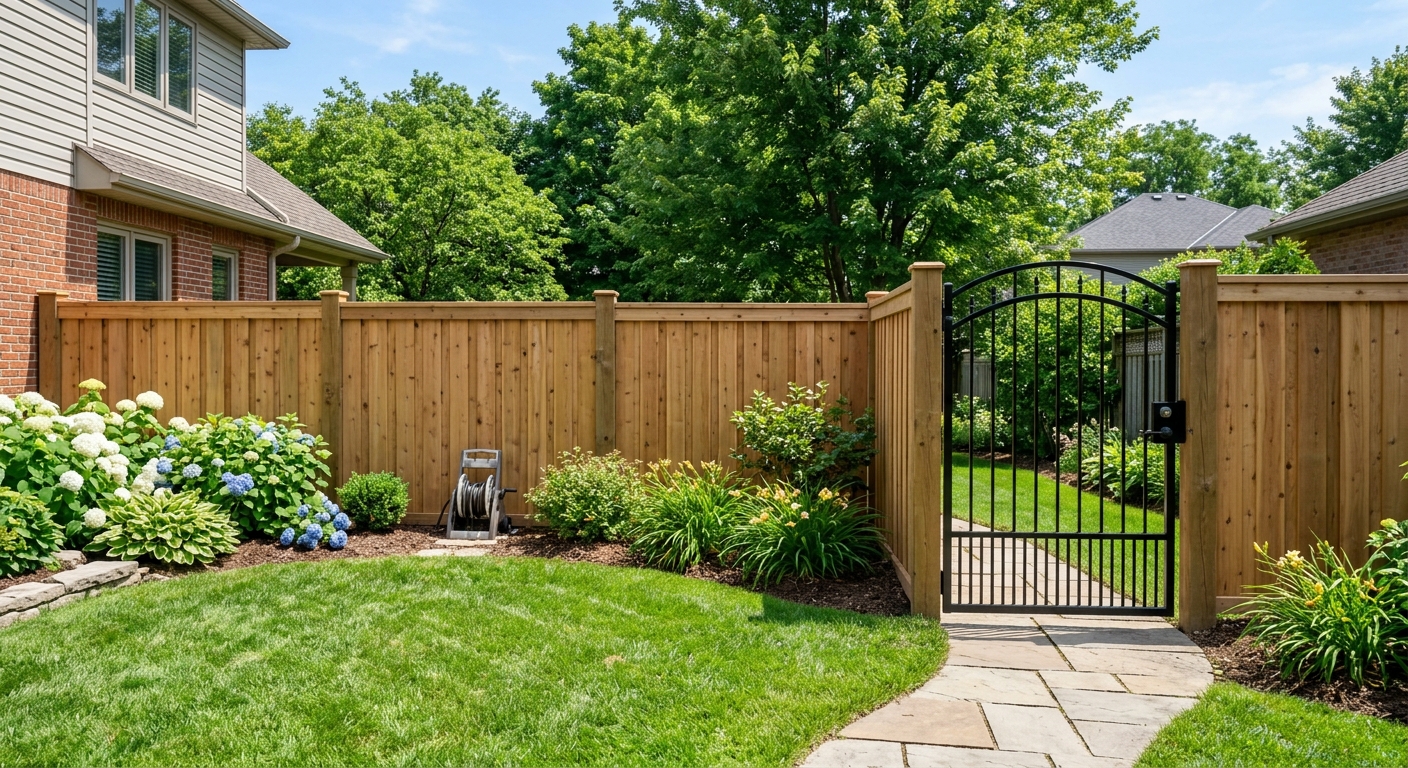
Fencing options and costs in North Glenmore
In North Glenmore, Alberta, fencing is one of those upgrades that’s both practical and visible—especially for homeowners on larger lots where privacy and wind buffering matter. With a 2021 population of 2,435 (Statistics Canada, 2021 Census), the local neighbourhood mix is smaller than Calgary overall, but fencing demand is still steady because many properties are single-detached homes—each one is a potential privacy, boundary, or yard-safety project. (Statistics Canada, 2021 Census). The biggest cost drivers here are Calgary’s Prairie continental freeze–thaw cycles and frequent wind exposure, which increase requirements for post depth, concrete footings, and sturdier panel spacing.
In North Glenmore, solid privacy fences typically need posts set to about 4 ft (approximately 120 cm) down to sit below the regional frost line and reduce heaving. That means more excavation and more concrete (and longer posts), particularly for 6 ft privacy fences and gate posts. Open exposure along windy streets can also increase racking risk, so contractors often tighten post spacing and use heavier rails—pushing labour into the mid-to-upper range compared with lighter chain-link systems. Availability can also affect price: crews who are booked solid during peak fair-weather months may price higher due to scheduling and mobilization.
Neighbourhood demand is especially high around established family pockets close to schools and parks where residents commonly replace older boards with privacy-style fencing. If you’re budgeting for a new boundary fence, use the table below to compare typical options and realistic per-linear-foot pricing in this area.
| Material |
Lifespan |
Maintenance |
Privacy Rating |
Price per Linear Foot |
| Pressure-treated pine (standard wood) |
12–18 years |
Stain/seal every 2–3 years; inspect boards annually |
8/10 (solid) |
$40–$65 |
| Cedar (natural rot resistance) |
18–25 years |
Light sealing every 2–4 years; occasional board replacement |
9/10 (solid) |
$55–$80 |
| Vinyl / PVC (no-maintenance) |
20–30 years |
Rinse annually; no staining |
8.5/10 (solid) |
$50–$85 |
| Chain-link (galvanized steel) |
25–40 years |
Occasional tension checks; wash as needed |
2–4/10 (low privacy) |
$25–$55 |
| Aluminum ornamental |
30–45 years |
Minimal cleaning; check gate hardware |
1.5–3/10 (open) |
$70–$120 |
| Composite / recycled material |
20–30 years |
Rinse and spot-check; follow manufacturer cleaning |
7–9/10 (depends on slat/board type) |
$65–$95 |
Prices are estimates only and vary by project scope, site access and material selection.
What affects the price of fencing in North Glenmore
In North Glenmore, two quotes for the “same” fence can differ by 30–50% because pricing in Calgary reflects how much excavation, structural work, and crew time your specific lot requires—not just the material on paper. The Prairie freeze–thaw cycle drives this: contractors plan for frost protection by setting posts roughly 4–6 inches below the design frost depth to prevent heaving. In Alberta and cold Canadian regions, that typically translates to posts being set about 1.5–2.0 m into the ground, which increases labour, requires longer posts, and often pushes the job toward concrete-set footings.
Wind exposure is another major driver. With more open Prairie exposure, solid wood or vinyl privacy panels need tighter post spacing, heavier rails, and well-braced gate frames to prevent racking. Chain-link, by contrast, allows wind to pass through; it tends to cost less even when the fence is long, which is why you’ll often see chain-link pricing land closer to the lower end of the regional band (for example, the $25–$55 per linear foot range), while privacy wood or vinyl lands more in the mid-to-upper range (often aligned with the $40–$80 or $45–$90 bands).
Local examples that raise cost in North Glenmore include: (1) a yard with soft or uneven subgrade where we need extra backfill compaction around a concrete footing; (2) a windy run near an exposed frontage where the design requires more intermediate posts and stronger rails; and (3) an older fence line where removal exposes damaged buried obstructions, increasing disposal and repair time. On the flip side, costs can be lower when access is straightforward (wide gate, flat grade, minimal obstructions) and when a new fence can reuse a consistent layout with minimal changes to post locations.
Even if your total linear feet stays similar, these Alberta climate realities can shift a “standard” privacy job upward by hundreds to several thousand dollars—especially when gates and corner bracing are involved.
| Price Factor |
Why It Matters |
Cost Impact |
| Fence length in linear feet |
More rails, more posts, more labour time |
Highest single driver; small changes scale quickly |
| Post depth required |
Frost line determines minimum embedment to reduce heaving |
Longer holes and longer posts increase material and excavation |
| Post setting method |
Concrete footings vs gravel pack vs driven posts affects stability |
Concrete jobs typically cost more but reduce future movement |
| Material choice |
Wind and panel stiffness vary by material |
Vinyl/wood usually mid–upper; chain-link lower; aluminum higher |
| Gate count and type |
Gates need heavier frames and hardware alignment |
Each gate adds specialized labour and bracing materials |
| Grade and terrain |
Slopes require stepped sections or raked designs |
More cutting, more posts, and more framing time |
| Old fence removal and disposal |
Demo time and haul-off can be significant |
Often adds a noticeable line item on tight sites |
| Permit fees and survey / property line locate |
Ensures setbacks and avoids boundary disputes |
Varies by project; can add scheduling and professional costs |
Permits & regulations in Alberta
In Alberta, fence permits are commonly required when a fence exceeds certain height thresholds—typically around 2.0 m (6.5 ft) at the rear and about 1.0–1.2 m (3–4 ft) at the front or corner. Even when a permit is not required, all fences must stay within property lines and follow local setback rules. Before you dig any post holes, call for utility locates through Alberta One-Call to mark buried services and prevent dangerous strikes.
Step one for a North Glenmore homeowner: confirm your exact property boundary. Ideally, obtain a survey or at least a professional locate of your property pins before installing. This helps prevent encroachment disputes—especially on older lots where fences may have been built slightly off-line years ago.
Step two: verify your contractor properly. Ask for proof of Alberta registration/licensing where applicable for fencing contracting and ensure they carry liability insurance that covers your property during construction. Also confirm coverage for workers—typically WSIB/WCB (depending on the contractor’s structure). You can check for a licence status through provincial contractor registries where available, and request a certificate of insurance directly; it should show policy limits, effective dates, and your project location. Many reputable contractors can also provide a clearance letter or COI update upon request.
What typically does not require a permit: replacing panels within the same footprint and height limits, or repairs that do not change the overall height/structure. What does commonly require a permit: installing a new fence over the relevant height threshold, changing the fence location relative to the property line, or adding substantial fence structures that may affect setbacks. When in doubt, ask your contractor to confirm permit requirements before work starts.
Choosing the right fence material for North Glenmore
Choosing the right fence material in North Glenmore is mostly about matching your priorities—privacy, low maintenance, budget, and lifespan—to Alberta’s winter conditions and wind-driven wear. Pressure-treated pine is usually the most budget-friendly way into a solid privacy fence, but it needs staining or sealing every 2–3 years to reduce greying and splitting. Cedar offers better natural rot resistance and a premium look, yet it still benefits from periodic sealing to keep boards uniform in colour and to slow surface checks. Vinyl/PVC is genuinely low maintenance—no painting, and easy rinsing—but in extreme cold it can become more brittle at the edges if the system isn’t installed with the correct hardware and spacing. Chain-link is the lowest cost with the longest service life, but it provides minimal privacy unless you add privacy slats or plant screens. Aluminum ornamental looks crisp, won’t rust, and has mid-range pricing, but it’s also open—better for delineation and curb appeal than true backyard privacy.
Post depth matters regardless of material in Calgary’s freeze–thaw climate. For most fence runs, contractors typically set posts around 4 ft (approximately 120 cm) deep to reduce heaving. That often means concrete-set footings for privacy fences and heavier gate posts. When wind exposure is high, sturdier rail design and closer spacing are worth it—particularly for solid wood or vinyl privacy boards where the “sail effect” can rack frames.
A practical budget example: if you compare a wood privacy fence often landing in the $40–$80 per linear foot band to a vinyl fence commonly in the $45–$90 band, spending the extra portion can be justified when you value low maintenance and long-term appearance—especially if you’d otherwise be paying for recurring staining. If budget is the main driver and you’re comfortable maintaining the fence, pressure-treated wood is usually the best first choice.
| Material |
Cold Tolerance |
Lifespan |
Annual Maintenance |
Best For |
Price Band |
| Pressure-treated pine |
Good in freeze–thaw with proper installation |
12–18 years |
Inspect annually; stain/seal every 2–3 years |
Privacy on a tighter budget |
$40–$65 |
| Cedar |
Very good; handles Alberta winters well |
18–25 years |
Inspect annually; seal every 2–4 years |
Premium look with rot resistance |
$55–$80 |
| Vinyl / PVC |
Good; requires correct hardware and detailing in cold |
20–30 years |
Minimal (rinse and check fittings) |
Low maintenance privacy |
$50–$85 |
| Chain-link |
Excellent; minimal seasonal movement |
25–40 years |
Occasional tension/hardware checks |
Security with minimal cost |
$25–$55 |
| Aluminum ornamental |
Excellent; not affected by rot or rust |
30–45 years |
Light cleaning; check gate hardware |
Curb appeal and boundary definition |
$70–$120 |
| Composite / recycled |
Good; performance depends on product design |
20–30 years |
Spot-check; rinse as required |
Long-life privacy boards |
$65–$95 |
How to choose a fencing contractor in North Glenmore
Choosing the right contractor in North Glenmore means verifying three things up front: Alberta compliance, real insurance, and a scope you can hold them to. Start by asking for proof of Alberta licensing/registration where applicable to fencing contracting, plus liability insurance that covers your property during excavation, post setting, and gate installation. Next, confirm workers’ compensation coverage (WSIB/WCB) so you aren’t exposed if someone gets injured on-site. When you ask for documentation, look for clear policy dates and project/location details on the certificate of insurance, and request the most current certificate before work begins.
Then get 2–3 itemised written quotes. You want a breakdown that separates labour (excavation, post setting, framing, rail work), materials (posts, rails, boards/slats/panels, hardware), and extras (concrete, gate frames, fasteners, removal and disposal). A “lump sum” number with vague language is where disputes happen. Read the scope carefully: is disposal included, are utility locates coordinated, is a property line locate/survey included or excluded, and what happens if buried services or obstructions are found?
Warranty matters too. Ask about the workmanship warranty length (for example, post setting, alignment, and hardware adjustments) and the product/manufacturer warranty on materials. Confirm whether the warranty is transferable to you as the homeowner. For payment, never agree to more than 10–15% upfront; a holdback until completion is standard. Finally, require a start date and completion estimate in writing, including weather-related allowances for freeze–thaw disruptions.
- Request their Alberta licence/registration details (where applicable) before scheduling.
- Verify liability insurance with a current certificate of insurance.
- Confirm workers’ compensation coverage (WSIB/WCB) for anyone on your site.
- Ask for 2–3 itemised quotes: labour, materials, concrete, gates, and hardware.
- Ensure post depth and setting method are written into the quote (e.g., concrete-set and approximate embedment).
- Confirm whether utility locates are included or you’re responsible for arranging them.
- Check if removal and disposal of the old fence is included (not just “demo”).
- Verify gate construction details: frame type, hardware, and number of hinges/latches.
- Ask how they handle sloped yards (stepped vs raked panels) in writing.
- Request warranty terms in writing: workmanship vs product warranty.
- Agree on a payment schedule with a 10–15% maximum upfront and a completion holdback.
- Get a dated schedule: start, key milestones, and completion target.
Red flags I see in North Glenmore include: (1) quotes that don’t specify post depth or setting method; (2) no proof of insurance or workers’ comp; (3) “verbal only” scope exclusions like disposal or permits; (4) pushing large upfront deposits; and (5) vague warranties that don’t clearly separate workmanship from materials.
Frequently asked questions — fencing in North Glenmore
How do I handle a fence dispute with a neighbour in Alberta?
Start by staying calm and documenting everything. In Alberta, the key is the property line: if the fence is in dispute, you’ll want a survey or professional locate of the pins to verify the boundary. In North Glenmore and across the Calgary area, fence disputes often arise when an older fence was set off-line during an earlier replacement, or when one party assumes a shared line without confirming it. Next, share your contractor quotes in writing and propose a clear fix (same material, same height, aligned posts) that both sides can agree to. If the neighbours can’t reach an agreement, gather evidence (photos, measurements, survey results) and consider mediation or the appropriate local dispute pathway. While fencing can be a “friendly upgrade,” your best leverage is objective boundary verification first.
What fence style offers the best wind resistance in North Glenmore?
In Alberta’s Prairie conditions, wind resistance is largely about structural stiffness and how much the fence “catches” wind. Solid privacy panels (wood or vinyl) can see higher racking forces because they act like a sail; that’s why the best wind-resistant installations use concrete-set posts, solid bracing at corners, and tighter post spacing. A well-built 6 ft privacy fence with properly aligned rails and correctly sized gate frames will typically perform better than a loosely built “open” design. Chain-link generally handles wind pressure better because it allows airflow, but it won’t give you privacy without added infill. If you want strong wind performance and privacy, prioritize cedar or pressure-treated wood with robust rail design; if you want maximum airflow with minimal cost, chain-link is usually the most forgiving in high wind.
How much does a fence cost in North Glenmore?
For North Glenmore, a realistic planning range is about $25–$55 per linear foot for chain-link, roughly $40–$80 per linear foot for wood privacy, about $45–$90 per linear foot for vinyl, and $70–$120 per linear foot for aluminum/metal. Your exact cost swings with post depth and setting method—Calgary’s freeze–thaw cycles mean posts must be set well below the frost line, often around 4 ft (approximately 120 cm) down, with concrete footings for privacy fences and gate posts. Gates, sloped terrain, and old-fence removal also move the number significantly. If you’re trying to budget quickly: a straight, flat run with one gate and chain-link will usually land toward the lower end of its band, while a 6 ft privacy fence on exposed frontage with full concrete setting tends to land mid-to-upper.
How deep should fence posts be for North Glenmore's frost?
In North Glenmore, you should plan for Alberta’s frost protection needs by setting posts below the regional frost line to reduce heaving. Local Calgary-area practice commonly sets fence posts about 4 ft (approximately 120 cm) deep, and contractors typically design for embedment so the bottom of the post sits roughly 4–6 inches below the design frost depth. That depth is one reason privacy fences cost more here: it requires longer posts and more excavation. For gate posts and corners, stability matters even more, so concrete setting is commonly used to keep alignment through freeze–thaw cycles. Exact depth can vary by soil and final grade, so the best approach is to have your contractor include post depth and setting method in the quote, not just assume “standard depth.”
Wood vs vinyl vs aluminum fence — which is best?
“Best” depends on what you value most in North Glenmore. Wood (pressure-treated pine) is often the best budget route into privacy, typically landing in the $40–$80 per linear foot band, but you’ll need staining/sealing every 2–3 years to slow grey weathering and surface checks. Cedar is usually pricier but brings a nicer look and rot resistance, often in the mid-to-upper range of wood privacy pricing. Vinyl/PVC is the low-maintenance option and commonly falls around the $45–$90 band; it’s especially appealing if you don’t want recurring staining, but it must be installed correctly for cold conditions. Aluminum ornamental (often $70–$120) is excellent for rust resistance and curb appeal, but it won’t give true privacy. If you want backyard privacy through Alberta winters, wood or vinyl privacy is generally the better match than aluminum.
Do I need a permit to build a fence in Alberta?
In Alberta, permits are often triggered by fence height and location. As a rule of thumb, fences above about 2.0 m (6.5 ft) at the rear and above roughly 1.0–1.2 m (3–4 ft) at the front or corner may require a building permit, and setbacks still apply. For North Glenmore homeowners, this matters most with 6 ft privacy fences and corner runs, where you’re more likely to cross the threshold. Regardless of permitting, you must respect property lines and follow municipal setback bylaws. Also remember the practical safety step: call for utility locates before digging. Your contractor should confirm whether a permit is needed for your specific layout and height before scheduling excavation, and your quote should state whether permit pulling is included or excluded.