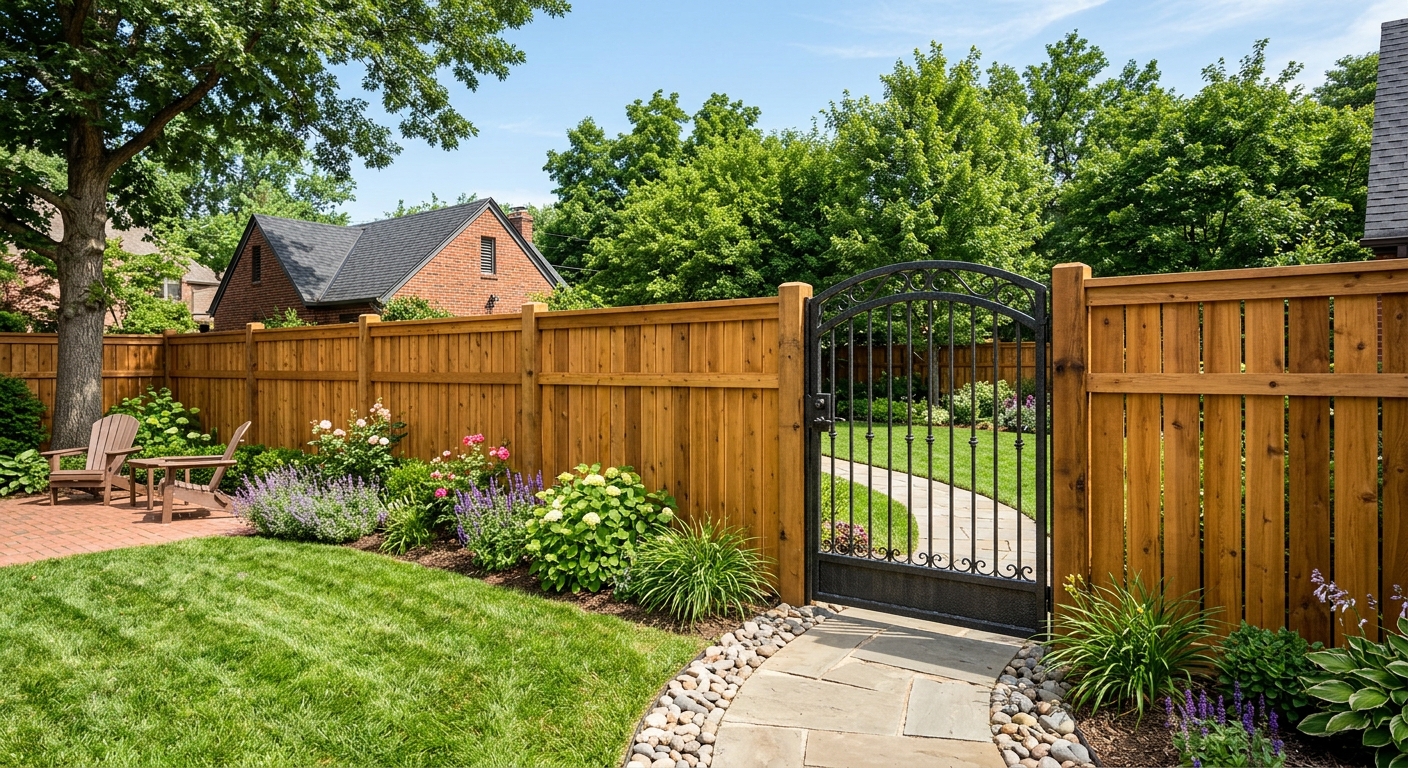
Fencing options and costs in Sage Hill
Sage Hill, Alberta has a steady mix of growing families and established neighbourhoods, and that matters for fencing demand: the community has a population of 9,345 (Statistics Canada, 2021 Census), meaning most blocks are seeing ongoing yard improvements rather than one-time large builds. One-detached-style households also tend to treat fences as “infrastructure” for pets, privacy and wind comfort—each fence line is a potential job for local contractors and suppliers. The demand is especially noticeable around the newer residential pockets near the schools and busier collector roads where homeowners add privacy and define side yards. In these areas, gate installation and post spacing around access points are common sources of added labour.
In the Calgary economic region, the Prairie continental climate drives pricing more than many people expect. Long freeze–thaw cycles increase the importance of frost protection and proper wind-resistant layout. For most privacy fences, contractors typically set posts about 4 ft (≈120 cm) deep (often closer to the regional frost depth requirements) using concrete footings—this increases excavation time, concrete volume and post length versus milder parts of Canada. At the same time, open exposure on the Prairies means panels experience strong wind loading; wood and vinyl often need tighter post spacing and sturdier construction to prevent racking. Availability can also affect pricing—when crews are booked for full-height privacy fence runs across Calgary, turnaround can push labour rates upward.
Below is a practical comparison of common fence materials you’ll see quoted in Sage Hill, including typical lifespan expectations and what most homeowners pay per linear foot.
| Material |
Lifespan |
Maintenance |
Privacy Rating |
Price per Linear Foot |
| Pressure-treated pine (standard wood) |
10–15 years |
Stain or seal every 2–3 years; check posts and rails after freeze–thaw |
High (solid boards) |
$40–$80 |
| Cedar (natural rot resistance) |
15–25 years |
Light staining/finishing every 3–5 years; inspect for loose fasteners |
High (solid boards) |
$55–$95 |
| Vinyl / PVC (no-maintenance) |
20–30 years |
Rinse as needed; replace occasional damaged sections from impacts |
High (solid styles) |
$45–$90 |
| Chain-link (galvanized steel) |
20–35 years |
Rare; rinse and check tension at corners |
Low–Medium (open airflow) |
$25–$55 |
| Aluminum ornamental |
25–40 years |
Wash annually or as needed; check caps and fasteners |
Low–Medium (ornamental pickets) |
$70–$120 |
| Composite / recycled material |
20–30 years |
Minimal; periodic cleaning and occasional hardware replacement |
High (solid boards) |
$80–$130 |
Prices are estimates only and vary by project scope, site access and material selection.
What affects the price of fencing in Sage Hill
In Sage Hill and across the Calgary economic region, two homeowners can receive prices that differ by 30–50% for what seems like the “same fence” because the cost drivers stack up differently: access, excavation difficulty, post depth requirements, wind loading design choices and how much of the work includes removals, locates and disposal. Even when the material price is similar, the build method—especially how deep and how securely posts are set—can change labour and concrete quantities enough to move the total by thousands.
Frost line depth is a major driver in Alberta. In cold regions, posts typically need to be set about 4–6 inches (≈10–15 cm) below the design frost depth to prevent heaving; in practical Calgary-area terms, that often means posts going roughly 1.5–2.0 m into the ground, with concrete setting and longer posts. That increases hole excavation time and concrete volume. Wind exposure on the Prairies is the other big one: open exposure increases racking forces, so solid wood or vinyl panels often require closer post spacing and fully concreted footings. Coastal BC may have fewer freeze–thaw swings, but higher moisture can accelerate rot without proper treatment—here in Sage Hill, the freeze–thaw cycle is the problem to solve through frost protection and hardware durability.
Concrete examples from typical Sage Hill projects: (1) a 6 ft privacy fence often lands closer to the $40–$80 wood or mid-range vinyl band because of deeper post holes and heavier panel bracing; (2) switching to chain-link may reduce cost since it needs less solid-panel structure and often needs less intense wind-resistant framing, commonly aligning with the $25–$55 range; (3) a fence running through uneven grade can add labour for stepped panels and extra rails, which can be more expensive than homeowners expect. Local housing stock that is older or has mature landscaping can also mean more roots and harder digging—slightly longer excavation times add up fast when every post hole is deeper than average.
| Price Factor |
Why It Matters |
Cost Impact |
| Fence length in linear feet |
Every additional foot adds posts, rails and material and increases installation time |
Largest multiplier on total cost (can change by thousands) |
| Post depth required |
Frost line determines how long posts must be and how deep the hole needs to be |
Deeper holes raise concrete and excavation labour significantly |
| Post setting method |
Concrete provides stability in freeze–thaw; gravel pack or driven methods change performance |
Concrete-set posts typically cost more but reduce heaving risk |
| Material choice |
Vinyl/cedar wood/chain-link/metal behave differently in wind, cold and impacts |
Material price swings often move you into different $/ft bands |
| Gate count and type |
Gates need stronger frames, hinges and latching; drive-through gates require extra structure |
Can add substantial labour and hardware costs |
| Grade and terrain |
Slope requires stepped or raked panels and sometimes custom rail layouts |
Adds fitting time; may require more rails/post work |
| Old fence removal and disposal |
Hauling, dump fees and salvage handling affect time and contractor overhead |
Often adds a noticeable surcharge beyond “new install” |
| Permit fees and survey / property line locate |
Some fence heights trigger permits; locating lines prevents encroachment disputes |
Can add administrative cost and scheduling time |
Permits & regulations in Alberta
In Alberta, fences above typical height thresholds often require a building permit—commonly around 2.0 m (6.5 ft) for rear yard fencing, and roughly 1.0–1.2 m (3–4 ft) near front yards or corners—depending on your lot location and local municipal rules. Regardless of height, your fence must respect property lines and any municipal setback bylaws that apply to your specific site. In addition, before you dig any post holes, always arrange utility locates through Alberta One-Call to reduce the risk of striking underground services.
For Sage Hill homeowners, a practical workflow is: (1) confirm your property line using an up-to-date survey or locate your pins before installing; (2) verify the fence height and placement relative to setbacks, then ask your contractor whether your project triggers a permit; and (3) document approval steps so you’re not surprised mid-schedule. Typically, a like-for-like repair or replacing a fence on the same footprint and height may be simpler, but a new fence (or raising height, changing alignment, or adding solid privacy panels near thresholds) is the work that most often requires a permit.
When hiring a contractor, you can protect yourself by verifying: Alberta licence/eligibility online (through the appropriate provincial registry), liability insurance with certificate proof, and workers’ compensation coverage (WSIB/WCB coverage as applicable). Ask for the certificate of insurance before work starts and keep it on file. A clearance letter—where provided by the contractor’s coverage provider—helps confirm the coverage status for their crews.
Choosing the right fence material for Sage Hill
Choosing the right fence material in Sage Hill is about matching your priorities—privacy, low maintenance, budget and lifespan—to Prairie weather realities. Pressure-treated pine is the common budget choice, but you should plan on staining or sealing every 2–3 years to slow grey weathering and protect the wood through repeated freeze–thaw. Cedar is naturally more resistant to rot and often looks better over time, though it still benefits from periodic finishing and hardware checks. Vinyl/PVC is popular for low maintenance because it doesn’t require staining, but in extreme cold it can be more brittle if the system is poorly installed (for example, without proper tolerances and rigid bracing). Chain-link is usually the lowest cost and longest service life, but it won’t deliver privacy unless you add a screen or slats. Aluminum ornamental looks great, won’t rust, and is mid-to-upper cost—just note it provides low-to-medium privacy because of the open picket design.
Post depth matters in the Calgary area. For most privacy and wind-loaded solid fences, posts need to be set below the regional frost influence, and concrete-set footings are commonly used to prevent heaving and racking. If you choose a solid panel system in an open yard exposure, plan for more robust framing and closer post spacing—this is why a quality wood or vinyl privacy fence can land in the mid-range of the $40–$80 to $45–$90 per-foot bands. A realistic example: paying toward cedar (or better-built wood) can be justified when you want a 15–25 year look with fewer board replacements, whereas chain-link may not make sense if privacy is your goal—even though it often sits around $25–$55 per linear foot.
| Material |
Cold Tolerance |
Lifespan |
Annual Maintenance |
Best For |
Price Band |
| Pressure-treated pine |
Good with correct sealant and robust post setting |
10–15 years |
Inspection + minor touch-ups; stain/seal every 2–3 years |
Budget privacy with a willingness to maintain |
$40–$80 |
| Cedar |
Good in Alberta cold when fasteners and finish are maintained |
15–25 years |
Light finishing every 3–5 years; tighten hardware as needed |
Higher appearance priority and longer natural look |
$55–$95 |
| Vinyl / PVC |
Very good if installed with proper tension/spacing |
20–30 years |
Minimal rinse; check for impact cracks after storms |
Low maintenance privacy |
$45–$90 |
| Chain-link |
Excellent durability in cold; maintains structure |
20–35 years |
Occasional rinse; tension check at gates/corners |
Security with airflow (pets, side yard boundaries) |
$25–$55 |
| Aluminum ornamental |
Excellent (powder-coated components) |
25–40 years |
Wash annually or as needed |
Decorative curb appeal with defined boundaries |
$70–$120 |
| Composite / recycled |
Good; depends on specific product and installation tolerances |
20–30 years |
Minimal cleaning; hardware checks |
Solid look without frequent staining |
$80–$130 |
How to choose a fencing contractor in Sage Hill
Start by verifying three things for Alberta fence contractors: (1) licensing/eligibility appropriate to the work, (2) liability insurance, and (3) workers’ compensation coverage (WSIB/WCB coverage as applicable). A reputable contractor will provide documentation without hesitation. For liability insurance, ask for a certificate of insurance listing your job site or the business name and policy dates. For coverage, request proof of their workers’ compensation status and keep a copy for your records. If they can’t provide current certificates, treat it as a scheduling risk—if a worker gets hurt on your property, you don’t want uncertainty.
Next, get 2–3 itemised written quotes. You want a breakdown that shows labour and materials separately (posts, rails, panels, hardware, concrete, gate(s), and any removal/disposal). Avoid lump-sum-only proposals if the scope is unclear. Read exclusions carefully: ask whether the quote includes permit pull (if required), utility locates coordination, disposal of old fence materials, and any required property line locate/survey costs. Confirm warranties in writing: workmanship warranty length and whether it covers post setting and racking. Also ask if product warranties are manufacturer-backed and whether they transfer to future owners.
For payment, don’t pay more than 10–15% upfront. Hold back the remainder until the job is complete and inspected. Get a start date and an estimated completion timeline in writing, including when concrete will cure before gates are adjusted.
- Ask for a written scope of work that lists panel style, post spacing and fence height
- Confirm post depth expectations and whether concrete footings are included for solid/privacy fences
- Request the number of posts and rails per section (not just total linear footage)
- Verify utility locate coordination before digging
- Ensure old fence removal and dump disposal is either included or quoted separately
- Confirm gate type, hinge count and latch hardware included
- Check how they handle slopes (stepped vs. raked) and who pays for extra materials
- Read the warranty: workmanship vs. manufacturer warranty, and coverage for wind-related issues
- Ask for proof of liability insurance (certificate) before scheduling excavation
- Confirm workers’ compensation coverage (WSIB/WCB) documentation
- Don’t accept a quote that lacks timelines and curing/inspection steps for concrete-set posts
- Use milestone payments: small deposit, progress draws, and final payment after walk-through
Red flags I commonly see around Sage Hill: (1) contractors who skip utility locates and only “hope” there’s no buried service; (2) vague quotes that don’t state post depth or post spacing; (3) refusing to show insurance or coverage documents; (4) full upfront payments well beyond 10–15%; and (5) promises to keep prices low by using driven posts or minimal anchoring for full privacy panels in windy, freeze–thaw-prone yards.
Frequently asked questions — fencing in Sage Hill
How long does a wood fence last in Sage Hill?
In Sage Hill and the broader Calgary area, a well-installed wood fence typically lasts about 10–15 years for standard pressure-treated pine, and closer to 15–25 years for cedar when posts are set below frost influence and hardware is maintained. The freeze–thaw cycle is hard on fasteners and can loosen boards if vibration and wind racking aren’t controlled with correct post depth and spacing. In practice, you’ll often see more early wear at corners and gate areas—those sections take the most load. If you maintain it (stain/seal on a schedule and re-tighten hardware after extreme weather), you protect the investment. For budgeting, many wood installs land around $40–$80 per linear foot depending on height, terrain and access.
Who owns and maintains a shared fence?
Shared fence ownership and responsibility in Alberta are governed by provincial line-fences legislation. In simple terms, when a fence is treated as a boundary fence, the “who pays and who maintains” can depend on your lot’s circumstances and whether the fence is recognized as shared. The best way to avoid disputes is to confirm: (1) where the property line actually sits (survey/locate), (2) whether the fence is on the boundary or fully on one owner’s land, and (3) what agreement (written or longstanding practice) exists between the neighbours. Maintenance is usually shared only when the fence is truly a common boundary feature. Before replacing a shared fence, coordinate early and document decisions—especially for permits if height thresholds apply.
How do I find my property line before fencing?
For fencing in Sage Hill, don’t guess—start with a survey or request a property line locate that identifies the pins/markers. If you have a recent survey from when you bought the home, use that to confirm where the boundary sits relative to your planned fence line. If you don’t, hire a surveyor to locate the boundary pins, or ask for a locate service that marks the property line in the yard. This matters because even a small offset can trigger encroachment disputes, and it can complicate permits if required. After you locate the line, plan your post layout so you’re not digging in the wrong place. In the same planning session, arrange utility locates before digging to protect you and the contractor.
What's the most low-maintenance fence?
For most Alberta homeowners, the “lowest maintenance” choice is usually vinyl/PVC or aluminum ornamental because they don’t require staining. Vinyl commonly targets solid privacy styles and often comes with long service life—just remember that winter impacts and installation tolerances matter in extreme cold. Aluminum is very durable and won’t rust, but it offers low-to-medium privacy unless you choose a solid infill style. Chain-link is also low maintenance and long-lived, but it doesn’t provide privacy on its own. If you’re weighing costs, vinyl privacy installs commonly sit around $45–$90 per linear foot, while chain-link can be lower at $25–$55 per linear foot. The best answer depends on whether “low maintenance” is also tied to your privacy goals.
How tall can my fence be in Sage Hill?
Fence height limits depend on where the fence sits on your lot (front/corner versus rear) and the municipal rules that apply. In Alberta, fences above a typical height threshold—often around 2.0 m (6.5 ft) for rear yards and closer to 1.0–1.2 m (3–4 ft) for front or corner areas—can require a building permit. Even when your exact height is acceptable, setbacks can still matter, and a permit may be triggered by height plus location. The safest approach is to tell your contractor your planned height and the approximate fence placement, then ask whether a permit is required for your specific scenario. A reliable contractor will also confirm the permit responsibility in the written scope before work begins.
Should fence posts be set in concrete here?
In Sage Hill, for most solid wood privacy fences and for gate posts, concrete-set footings are strongly recommended because Alberta’s freeze–thaw cycles can lead to heaving if posts aren’t anchored below frost influence. Local Calgary-area practice commonly sets posts to around 4 ft (≈120 cm) deep to help get below the frost line and reduce movement; for many designs, that works out to about 1.5–2.0 m into the ground depending on the exact frost depth guidance and your layout. Concrete also improves stability under Prairie wind loading, reducing racking. Chain-link may sometimes tolerate alternative methods depending on design, but for privacy panels, “gravel pack only” setups often don’t perform as well over multiple winters. Ask your contractor what post depth and setting method they’re including, and insist it’s stated in the quote.