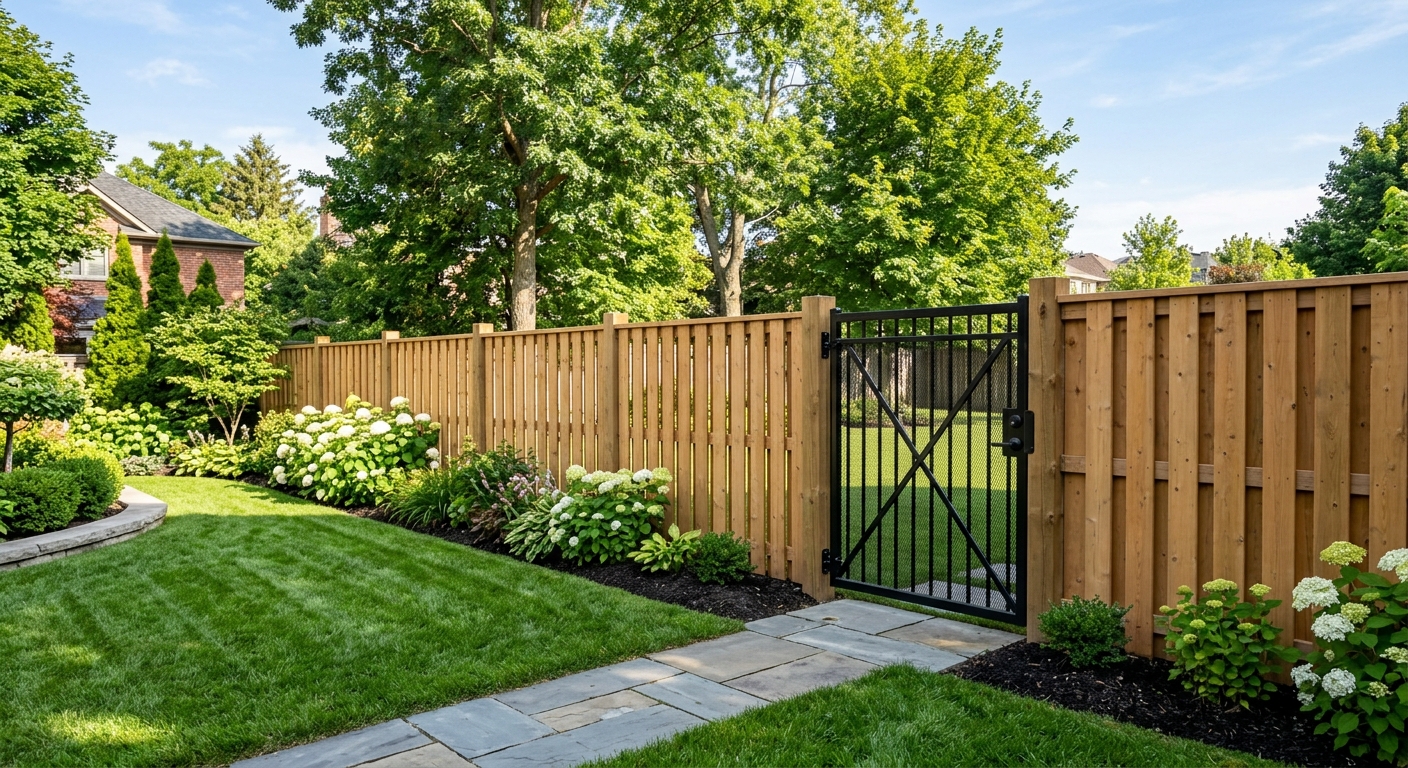
Fencing options and costs in Chetwynd
Chetwynd homeowners typically choose a fence based on privacy needs, wind resistance, and how much maintenance they’re willing to handle. With 2,302 people in town (Statistics Canada, 2021 Census) and roughly 63.6% of households owning their home, demand is steady—each single-detached property is a likely fencing project for yards, gardens, and livestock boundaries. About 57.8% of the housing stock is single-detached, so many installs are straightforward side-and-back layouts, but the Northeast BC Peace region climate still controls your final price.
In and around Chetwynd, cold snaps and deep frost mean contractor posts must be engineered to reduce movement. In the Peace region, frost penetration can commonly exceed 4 ft, so many builds use 4–5 ft post settings with belled footings and concrete to prevent seasonal heave. Strong wind exposure also matters: open sites can push fences like sails, so crews often tighten post spacing and choose heavier frameworks for solid privacy sections. That engineering time is part of why Northeast labour pricing runs slightly above the generic provincial range of about $60–90 per linear foot.
Trade demand is especially high in outlying residential pockets and rural streets where yards sit flatter and more exposed to winter wind—areas along the highway corridor where lots back onto open fields often see more frequent upgrades than sheltered lanes. With that context, the comparison below will help you line up material choices with expected per-foot budgets.
| Material |
Lifespan |
Maintenance |
Privacy Rating |
Price per Linear Foot |
| Pressure-treated pine (standard wood) |
12–18 years |
Stain or seal every 2–3 years; inspect posts after winter |
Medium–High (solid pickets) |
$80–$130 |
| Cedar (natural rot resistance) |
18–25 years |
Light stain/clearcoat every 2–4 years; occasional board replacement |
High (solid or close-spaced) |
$95–$145 |
| Vinyl / PVC (no-maintenance) |
20–30 years |
Rinse only; occasional hardware check |
Medium–High (solid privacy styles) |
$85–$140 |
| Chain-link (galvanized steel) |
25–35 years |
Minimal; re-tension and spot-touch coating if damaged |
Low (visual only) |
$55–$90 |
| Aluminum ornamental |
25–40 years |
Minimal; wash and check hinges/latches |
Low–Medium (open pickets) |
$95–$150 |
| Composite / recycled material |
20–30 years |
Low; periodic cleaning and hardware checks |
High (privacy panels) |
$110–$160 |
Prices are estimates only and vary by project scope, site access and material selection.
What affects the price of fencing in Chetwynd
In Chetwynd and across Northeast BC, two quotes for what looks like the “same” fence can differ by 30–50% because the hidden drivers are site conditions and engineering. In colder regions, crews spend more time planning post depth, aligning rails, and handling heavier materials in freezing temperatures. In milder parts of BC, contractors can often set posts shallower and work faster—so labour productivity is higher.
Frost line depth is the biggest technical variable. A common rule of thumb is that posts must sit roughly 4–6 inches below the design frost depth so the fence doesn’t heave as the ground freezes and thaws. In Peace region settings, that often means posts set 1.5–2.0 m deep (or more depending on soil and wind exposure), which increases material length and auger/excavator time. Concrete setting versus a lighter gravel pack can also shift the budget.
Wind exposure influences cost too. Prairie-style open yards typically require tighter post spacing and sometimes wider rails; solid privacy panels cost more to brace because wind loads are higher. That’s where the “looks cheaper” options can change: a wood privacy fence may land in the $80–$130 per linear foot band, while a chain-link fence may stay closer to the $55–$90 band but only if you don’t add additional screens or privacy slats.
Two local examples from Chetwynd that regularly move the price up: (1) replacing an old fence with concrete-set posts where the bases require extra excavation; and (2) installing in a yard with hard-packed soil where holes take longer. Costs can be lower when the run is short, access is easy for a skid-steer/excavator, and existing boundary markers are clear—reducing locate and rework time. Newer housing and well-defined property lines can still be a factor: many lots are developed with older survey expectations, but with homes built before 1981 making up 56.1% of dwellings (Statistics Canada, 2021 Census), older pin locations sometimes need extra verification.
| Price Factor |
Why It Matters |
Cost Impact |
| Fence length in linear feet |
Every additional foot adds materials, posts, rails, and labour |
High: primary driver |
| Post depth required |
Determines post length and hole depth to resist frost heave |
High: can change the whole spec |
| Post setting method |
Concrete vs. gravel pack vs. driven posts affects resistance and labour |
Medium–High: concrete increases labour/materials |
| Material choice |
Vinyl/cedar are premium; chain-link is typically cheaper per foot |
Medium: shifts you between bands (e.g., $55–$90 vs. $80–$140) |
| Gate count and type |
Gates add framing, hinges, latches, and sometimes reinforced posts |
Medium: each gate can materially raise costs |
| Grade and terrain |
Slopes require stepped sections, raked rails, and more cutting |
Medium: increases labour and waste |
| Old fence removal and disposal |
Demolition adds time; haul-away depends on what’s left in the ground |
Medium: removal can be a significant line item |
| Permit fees and survey / property line locate |
Verification reduces encroachment risk and rework |
Low–Medium: varies by site complexity |
Permits & regulations in British Columbia
In British Columbia, fence requirements can vary by municipality, but the permitting trigger is often tied to height. As a practical benchmark, fences above roughly 2.0 m (6.5 ft) at the rear and around 1.0–1.2 m (3–4 ft) at the front or corner commonly require a building permit in many BC communities. You still must respect property lines and any municipal setback bylaws that apply to your location in Chetwynd.
Before any digging, call for utility locates so you don’t hit buried services. In BC, this is typically done through BC 1 Call; you should request locates before post-hole excavation. Also, obtain a survey or at minimum verify your property pins before installing so you avoid encroachment disputes—especially on older lots where markers may have shifted or been obscured over time.
Shared fence ownership and responsibilities are governed by provincial line-fences legislation. If you’re building along a shared boundary, clarify in writing who supplies materials, who pays labour, and how future repairs are handled.
How to verify a contractor in Chetwynd: ask for their BC business registration details and request a certificate of insurance showing liability coverage that matches the scope. For coverage status, you’ll want documentation of workers’ compensation coverage (WCB/WSIB equivalents as applicable in BC) and clearance/confirmation letters when crews are working on-site. Contractors should also provide clear proof that they’re insured for excavation and fence installation activities.
Choosing the right fence material for Chetwynd
Choosing a fence material in Chetwynd is mostly about matching your priorities—privacy, low maintenance, and lifespan—to Northeast BC’s realities: deep frost, strong winds, and freeze-thaw cycles. Pressure-treated pine is the budget-friendly route, but it still needs periodic staining or sealing (often every 2–3 years) to slow grey weathering and keep boards from cupping over time. Cedar typically offers a better appearance and natural rot resistance, but it still benefits from maintenance to keep the finish looking consistent and to extend board life. Vinyl/PVC is the low-effort option for homeowners because it doesn’t need staining, but extreme cold can make some components more brittle, so the right hardware and correct installation matter.
Chain-link is usually the lowest cost and longest-lasting for structure, but it won’t give you privacy unless you add privacy screens or slats (which can increase wind load and cost). Aluminum ornamental is durable and won’t rust, making it a good mid-range ornamental choice—however, like chain-link, it’s more about aesthetics than privacy.
Concrete-set posts are often recommended for exposed Northeast BC sites because frost movement is real. While not every fence needs the same construction, deeper post settings with proper concrete/belled footings are commonly used where frost penetration and seasonal heave are expected. That foundation work can be the difference between a fence that stays tight after winter and one that leans.
For a concrete dollar example: if a chain-link run is quoted at roughly $55–$90 per linear foot, but you later add privacy panels/screening, the “final” spend can climb closer to the $80–$130 per linear foot range—so it may be more cost-effective to start with wood or vinyl privacy if your goal is full backyard screening.
| Material |
Cold Tolerance |
Lifespan |
Annual Maintenance |
Best For |
Price Band |
| Pressure-treated pine |
Good with correct post depth and sealing plan |
12–18 years |
Minor: check boards/hardware; typically stain/seal every 2–3 years |
Value-driven privacy |
$80–$130 |
| Cedar |
Very good; handles moisture swings better than many woods |
18–25 years |
Moderate: stain/clearcoat every 2–4 years |
Natural look with better rot resistance |
$95–$145 |
| Vinyl / PVC |
Good when installed for cold conditions and correct hardware |
20–30 years |
Low: rinse and inspect annually |
Low-maintenance privacy |
$85–$140 |
| Chain-link |
Excellent for cold; galvanized steel resists corrosion |
25–35 years |
Very low: spot-check tension and damage |
Security and long service life |
$55–$90 |
| Aluminum ornamental |
Excellent; no rust in winter moisture cycles |
25–40 years |
Low: wash and check gate hardware |
Curb appeal with durability |
$95–$150 |
| Composite / recycled |
Good; generally stable when installed on proper rails/posts |
20–30 years |
Low: cleaning; occasional hardware checks |
Privacy with minimal upkeep |
$110–$160 |
How to choose a fencing contractor in Chetwynd
When you hire in Chetwynd, verify coverage and licensing before signing. In British Columbia, contractors should be able to show current liability insurance (ask for a certificate of insurance listing the jobsite and coverage limits) and proof of workers’ compensation coverage for their workers (WCB/clearance documentation as applicable in BC). If a contractor can’t provide documentation on demand, that’s a red flag. For licensing details and business status, use official provincial business/licensing resources where applicable and request their insurance certificate directly—don’t rely on verbal confirmation.
Get 2–3 itemised, written quotes that break out labour and materials. You want a line for posts/footings (including depth and concrete use), rails, panels/pickets, hardware, gates, and removal/disposal. Avoid lump-sum quotes without a scope sheet, because what’s “included” can change the real per-foot cost significantly—especially where frost-depth engineering is required. Ask whether permits (if needed due to height) and property line locating/survey are included or excluded.
Warranty should be specific: separate workmanship warranty (how long they stand behind installation) versus manufacturer warranty (what covers material defects). Ask whether warranties are transferable if you sell your home. For payments, a safe schedule is typically no more than 10–15% upfront, with the remainder tied to milestones; hold back payment until completion and punch-list items are addressed. Request a start date and completion estimate in writing so winter scheduling doesn’t drift.
- Confirm liability insurance certificate and that it matches your project address.
- Request proof of workers’ compensation coverage for their crews.
- Get a written scope: post depth, concrete vs. gravel, and footing type.
- Ask for the exact gate hardware and latch type (not “basic hinges”).
- Ensure quotes list material grade and thickness (especially vinyl/aluminum components).
- Clarify disposal: old fence removal haul-away included or separate?
- Ask how they handle sloped yards (stepped vs. raked) to avoid misalignment.
- Verify property line approach: survey locate required or recommended?
- Check whether they will pull permits if your fence height triggers one.
- Demand an itemised breakdown for labour and materials, not only a per-foot total.
- Confirm warranty duration in writing for workmanship and materials.
- Use a payment schedule with a small deposit (10–15%) and holdback until final walkthrough.
Red flags I see locally: (1) quotes that specify short post depths inconsistent with deep frost requirements; (2) no written scope for concrete setting or footing type; (3) refusal to provide an insurance certificate or workers’ compensation proof; (4) “cheap” vinyl pricing with missing hardware specification; and (5) asking for a large upfront deposit (well above 10–15%) without a signed schedule and milestones.
Frequently asked questions — fencing in Chetwynd
Do I need a permit to build a fence in British Columbia?
In British Columbia, a building permit can be required depending on fence height and location (rear vs. front/corner), and municipalities often use thresholds around 2.0 m (6.5 ft) for rear and about 1.0–1.2 m (3–4 ft) for front or corner areas. In Chetwynd, your contractor should confirm the local requirement before digging, especially for tall privacy fences that may affect sightlines. If you’re unsure, ask for the permit process in writing and check whether your municipality requires a permit for your exact proposed height. Even when a permit isn’t needed, you still must respect property lines and setbacks, and you should do utility locates before any post-hole work.
How long does a wood fence last in Chetwynd?
Wood life in Chetwynd is strongly tied to post depth, concrete setting (where needed), and how regularly you maintain the surface. A pressure-treated pine fence commonly lasts around 12–18 years in Northeast BC conditions when it’s built for deep frost movement and inspected after winter. Cedar tends to last longer, often 18–25 years, because it naturally resists rot better—though it still benefits from periodic sealing or staining. If you’re building close to wind-exposed yards, the fence can be harder on panels and rails, so higher-grade framing and correct spacing can be worth the extra upfront cost. Plan maintenance so you don’t end up replacing boards early and losing the value of a $80–$130 per linear foot wood install.
Who owns and maintains a shared fence?
Shared boundary fences in British Columbia are governed by provincial line-fences rules, and the practical answer depends on where the fence sits along the boundary and how the original agreement was handled. In many cases, neighbours share responsibility for maintenance and reasonable repair costs, but you should confirm details in writing to avoid disputes—especially in older neighbourhoods where boundary markers may have been moved or are unclear. For homeowners in Chetwynd, I recommend confirming your property line (survey pins/locates) before replacing any shared section, and then discussing who supplies materials versus who pays for labour. If you’re getting quotes, ask the contractor to specify exactly which panels/posts are included so the cost share is accurate.
How do I find my property line before fencing?
Before installing a fence in Chetwynd, you should confirm your property line rather than relying on guesswork. The most reliable approach is to obtain a survey or verify the property pins and boundary markers on your lot. If pins are missing, worn, or unclear, ask your contractor if they require a locate/survey note before work begins. Also, call for utility locates before digging post holes so you don’t hit buried services. When properties were established long ago—remember many homes in the area were built before 1981 (Statistics Canada, 2021 Census)—markers can sometimes be harder to find, so taking the time upfront can prevent costly rework and encroachment concerns.
What's the most low-maintenance fence?
For most homeowners in Chetwynd, vinyl/PVC is usually the lowest-maintenance option: it doesn’t require staining and typically only needs an occasional rinse and hardware checks. Composite/recycled materials can also be low maintenance if you choose quality systems and proper installation. If you want a “set it and forget it” approach with the longest service life for structure, chain-link is also very low maintenance because it resists corrosion and usually only needs tension checks after damage. The trade-off is privacy: chain-link is visual-only unless you add screens. Budget-wise, you might see vinyl/PVC installed in the $85–$140 per linear foot range, while chain-link may run around $55–$90 per linear foot, so the “most low-maintenance” choice depends on whether privacy is a must-have.
How tall can my fence be in Chetwynd?
Fence height limits in British Columbia are often handled through municipal bylaws and permit thresholds, and the allowed height can differ between rear yards and front/corner areas. A common guideline used in BC is that rear fences around 2.0 m (6.5 ft) and front/corner fences around 1.0–1.2 m (3–4 ft) may trigger permit requirements—so even if a fence is allowed, you may need approval for higher privacy walls. In Chetwynd, the safest approach is to measure your proposed fence height, then confirm the rule that applies to your yard position with your contractor and the local permitting requirements. Also remember wind exposure: taller solid fences can increase load, and crews may need tighter post spacing or heavier framing to keep the fence standing.