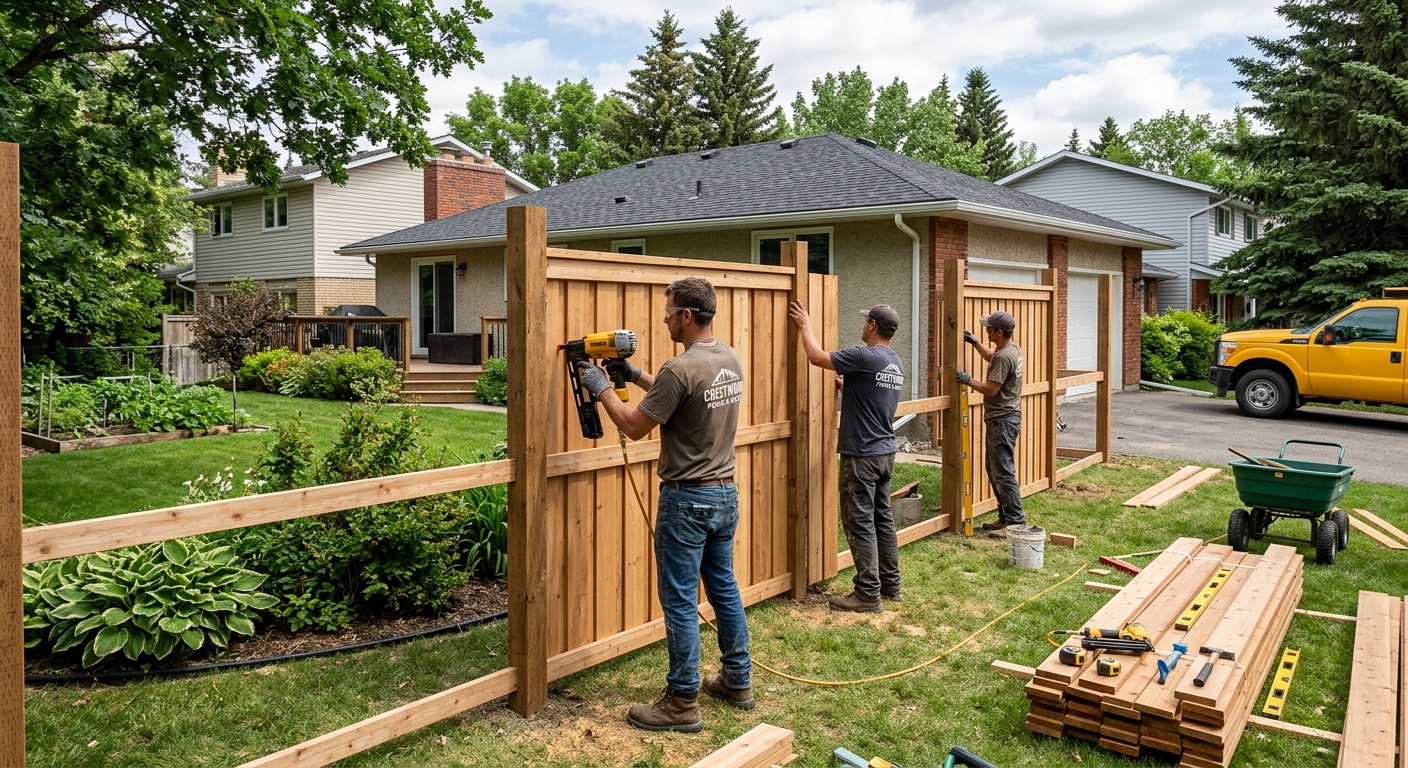
Fencing options and costs in Coquitlam Town Centre
In Coquitlam Town Centre, choosing a fence is often less about “what’s cheapest” and more about matching privacy, durability and maintenance to how Lower Mainland–Southwest yards actually perform. With a population of 24,282 (Statistics Canada, 2021 Census), the area has plenty of residential turnover and active upgrades—every new backyard project means new fence demand. Housing stock matters too: a large portion of local households live in detached properties, which typically brings more perimeter fencing and gates into the picture than multi-unit complexes, so contractor availability and pricing stay steady year-round. (Statistics Canada, 2021 Census)
Costs here are influenced by the Fraser Valley’s wetter soils and mild-but-not-trivial frost. Published guidance across Canada often points to about 3 ft as a minimum embedment, but in Coquitlam Town Centre contractors commonly set posts deeper than that to reduce frost heave, especially where clay or consistently damp ground is present. Wind exposure also plays a role: while BC is not Prairie-wide gusting, hillside lots and open lanes still push fence systems toward stronger corner posts and tighter, braced panel layouts—particularly for solid privacy styles.
In practice, you’ll see higher-per-foot pricing on privacy wood panels, vinyl/PVC that needs proper post sizing, and any project with slope or significant access constraints. Areas around the Coquitlam Centre and Lougheed Highway corridor are especially in demand for new installs because there are many active residential re-fencing projects and gate replacements.
Below is a realistic pricing snapshot to compare materials before you request an itemised quote.
| Material |
Lifespan |
Maintenance |
Privacy Rating |
Price per Linear Foot |
| Pressure-treated pine (standard wood) |
10–15 years |
Stain/seal every 2–3 years |
Medium–High (solid boards) |
$55 – $95 |
| Cedar (natural rot resistance) |
15–25 years |
Light staining every 3–5 years |
High (solid cedar panels) |
$70 – $105 |
| Vinyl / PVC (no-maintenance) |
20–30 years |
Rinse only; inspect annually |
High (solid privacy styles) |
$75 – $130 |
| Chain-link (galvanized steel) |
20–35 years |
Occasional cleaning; tension checks |
Low (see-through) |
$30 – $55 |
| Aluminum ornamental |
25–40 years |
Wash as needed; check hardware |
Low–Medium (open pickets) |
$90 – $170 |
| Composite / recycled material |
25–30 years |
Minimal; wash and inspect |
High (privacy boards) |
$95 – $155 |
Prices are estimates only and vary by project scope, site access and material selection.
What affects the price of fencing in Coquitlam Town Centre
Fencing quotes for the “same” backyard can land 30–50% apart across the Lower Mainland–Southwest and other parts of British Columbia because crews price for risk: soil conditions, frost-related post requirements, slope, and how much extra labour is needed for set-up and disposal. Even within the region, a job with wet ground or limited vehicle access can take longer than a dry-site install, and that labour time shows up directly in your per-linear-foot number. Contractors also differ in how aggressively they spec corner posts, gate posts and post depth for long-term stability, especially for privacy fences that take more wind load than open styles.
Post depth is a big driver because frost heave risk increases when posts are set too shallow. In many parts of Canada, minimum embedment is roughly 3 ft, and contractors adjust deeper as needed—often leaving posts about 4–6 inches below design frost depth to reduce movement during freeze–thaw cycles. In colder Ontario and Alberta, that can mean far deeper installs (commonly around 1.5–2.0 m), which raises material costs because you need longer posts, more concrete, and more labour. Coquitlam Town Centre is milder than those regions, but wet, heavier soils in the Fraser Valley often still push crews to deeper holes and concrete at key locations (corners, gates and privacy panels).
Two local examples that commonly raise cost in Coquitlam Town Centre are: (1) clay-rich or consistently damp backyard soil that demands deeper excavation and additional concrete for stability, and (2) sloped lots near shopping/arterial corridors where panels must be stepped or raked, increasing labour and waste. If you’re choosing between a budget wood install (often roughly in the $55–$95 range) and vinyl/PVC (typically $75–$130), these site factors help explain why the difference can grow beyond material-only pricing.
| Price Factor |
Why It Matters |
Cost Impact |
| Fence length in linear feet |
Most materials and labour scale directly with length |
High (primary cost driver) |
| Post depth required |
Frost protection determines hole depth and post size |
Medium–High (can add concrete and longer posts) |
| Post setting method |
Concrete vs. gravel pack vs. driven posts changes labour and risk tolerance |
Medium (concrete usually increases cost) |
| Material choice |
Vinyl/PVC and composites require more structure and hardware |
Medium–High (ranges from chain-link low-cost to vinyl mid/high) |
| Gate count and type |
Drive-through and double gates need stronger frames and hardware |
Medium–High (gates can cost disproportionately) |
| Grade and terrain |
Slopes require stepped/raked panels and extra layout time |
Medium (labour and material waste) |
| Old fence removal and disposal |
Demolition, haul-away, and time on site add cost |
Medium (especially if there’s concrete base) |
| Permit fees and survey / property line locate |
Administrative steps and verified boundaries reduce dispute risk |
Low–Medium (varies by project and complexity) |
Permits & regulations in British Columbia
In British Columbia, whether you need a building permit for a fence usually depends on height and location. As a practical rule of thumb, fences above a height threshold—commonly around 2.0 m (6.5 ft) at the rear and roughly 1.0–1.2 m (3–4 ft) at the front or corner—often trigger a permit requirement. Municipal setback bylaws and property line rules still apply regardless of permit status, so you should confirm the exact local thresholds for your lot in Coquitlam Town Centre before ordering materials.
Before any post hole is dug, call for utility locates using the appropriate province-wide service (and follow the marking instructions on site). While you don’t need to contact utility providers for every backyard renovation step, you do need to do it before excavation for fencing posts. Also, get a survey or at minimum locate your property pins and confirm line boundaries; this reduces costly rework if your old fence was set slightly off-line and the new install has to correct it.
Shared fence ownership is governed by provincial line-fences legislation, which affects how disputes and responsibilities are handled when you and a neighbour share a fence line.
Contractor verification (step-by-step for homeowners): ask for (1) proof of the contractor’s British Columbia business licence/registration details from the applicable online registry listing they provide, (2) a current certificate of insurance (liability) showing appropriate coverage, and (3) confirmation of required worker protection coverage (WSIB/WCB) for their workers. Then request that the insurance certificate clearly matches the legal company name and project address you’re hiring for.
Choosing the right fence material for Coquitlam Town Centre
In Coquitlam Town Centre, the best fence material is the one that fits your priorities—privacy, low maintenance, budget and lifespan—while tolerating Lower Mainland–Southwest wetness, wind and freeze–thaw cycles. Pressure-treated pine is usually the budget choice, but it needs periodic staining or sealing every 2–3 years to prevent grey weathering and premature fibre breakdown. Cedar offers better natural rot resistance and a warmer look, and you’ll typically get longer service life, but it still benefits from scheduled maintenance to keep boards looking even and to avoid surface checking.
Vinyl/PVC is popular for “set it and forget it” homeowners: it’s easy to rinse and generally low maintenance, but it must be installed with correct post sizing and proper tension so it can handle cold snaps without cracking or sagging. Chain-link is the lowest-cost practical option and tends to last a long time, but it won’t give meaningful privacy unless you add screening (which adds cost and can affect airflow/wind behaviour). Aluminum ornamental fencing resists rust and doesn’t rot, but it’s mainly decorative and security-focused rather than private.
For post-depth, Coquitlam Town Centre’s frost isn’t as punishing as colder provinces, but contractors still often set posts deeper than a bare minimum to reduce heaving—especially in wetter soils. Concrete-set posts are commonly used at corners, gate posts and privacy panel areas; that helps maintain alignment through wet seasons and freeze–thaw cycles. Wind and snow load matter most for solid privacy styles; open designs like chain-link usually require less reinforcement.
Example: if chain-link is fitting your needs, you might see pricing closer to $30–$55 per linear foot. Switching to vinyl privacy can raise the budget into the $75–$130 band, which is usually justified when you’re paying for real privacy and for a fence that won’t demand staining work every couple of years.
| Material |
Cold Tolerance |
Lifespan |
Annual Maintenance |
Best For |
Price Band |
| Pressure-treated pine |
Good with proper treatment and sealing |
10–15 years |
Inspect; light wash/spot touch-ups |
Budget privacy with planned upkeep |
$55 – $95 |
| Cedar |
Good; performs well in damp climates |
15–25 years |
Inspect; re-stain as needed every few years |
Natural look and longer service life |
$70 – $105 |
| Vinyl / PVC |
Very good when installed correctly |
20–30 years |
Rinse; inspect posts and hardware |
Low maintenance privacy |
$75 – $130 |
| Chain-link |
Good; steel frames handle freeze well |
20–35 years |
Clean; check tension and posts |
Security on a tighter budget |
$30 – $55 |
| Aluminum ornamental |
Excellent (no rust) |
25–40 years |
Wash; inspect hardware |
Security with a refined look |
$90 – $170 |
| Composite / recycled |
Good; designed for outdoor freeze–thaw |
25–30 years |
Minimal rinse and inspection |
Privacy with minimal maintenance |
$95 – $155 |
How to choose a fencing contractor in Coquitlam Town Centre
Hiring a fencing contractor in Coquitlam Town Centre is mostly about verifying the basics and then making sure the quote scope is truly apples-to-apples. First, confirm they provide proof of the right British Columbia business credentials (ask for their licence/registration details) and current liability insurance with a certificate that lists your project address and correct legal name. Next, verify workers’ protection coverage: ask for documentation showing their WSIB/WCB coverage (or equivalent coverage appropriate for workers) and ensure the coverage is current before work starts.
Then request 2–3 itemised written quotes—not just a lump sum. A strong quote breaks costs into line items such as materials (boards/pickets, rails, posts, hardware), labour, concrete/post setting, removal/disposal, gates, and layout/adjustments for slope. Read the inclusions and exclusions carefully: is permit/paperwork support included, is property line locating included or excluded, and is disposal of the old fence base included?
Warranty matters: confirm workmanship warranty length (often separate from product warranties) and ask whether manufacturer warranties are transferable to you as the homeowner. For payment, avoid large upfront sums—never pay more than 10–15% up front, and use a holdback until the job is complete and passes final inspection. Finally, get a written start date and an estimated completion timeline so schedule delays don’t turn into cost surprises.
- Ask for certificate of insurance and confirm it matches the legal company name on the quote.
- Verify workers’ protection coverage documentation before work begins.
- Request proof of British Columbia business credentials/registration details.
- Get 2–3 itemised quotes with separate labour and materials line items.
- Confirm post depth approach and where concrete is used (corners, gates, privacy panels).
- Check how the contractor handles slope: stepped vs. raked panels should be stated.
- Clarify fence height measurements and whether any sections exceed permitted thresholds.
- Ask who performs utility locates and confirm it’s done before excavation.
- Confirm disposal/haul-away of removed fencing and concrete base (if applicable).
- Make sure gates include frame reinforcement and the correct hardware.
- Get warranty details in writing: workmanship and manufacturer coverage.
- Use a payment schedule with a 10–15% maximum deposit and holdback until final completion.
In Coquitlam Town Centre, watch for these red flags: a quote with no itemised breakdown (just a total), refusal to provide insurance/coverage documents, vague promises like “standard depth” without frost/heave considerations, missing disposal details for old fencing, and any payment request that asks for most of the money up front.
Frequently asked questions — fencing in Coquitlam Town Centre
How do I handle a fence dispute with a neighbour in British Columbia?
If you’re in Coquitlam Town Centre and there’s a disagreement, start by gathering facts: confirm the property line (survey pins or a survey), measure the fence height and length, and document any existing alignment issues with photos. In British Columbia, shared fence responsibilities and dispute handling are tied to provincial line-fences legislation, so avoid “self-fixing” by moving the fence without a clear agreement. Your best first step is written communication: propose a resolution, ask the neighbour to agree on a location and style, and keep the process calm and factual. If you hired a contractor, ask them to provide a layout drawing and embedment plan showing where posts will be set relative to the line.
What fence style offers the best wind resistance in Coquitlam Town Centre?
In the Lower Mainland–Southwest, “best wind resistance” usually means a fence system built with appropriate posts, bracing and hardware, not just the material. Solid privacy fences can behave like wind panels, so they need stronger corner posts, correct rail spacing, and properly set gate posts—especially on lots that face open lanes or are more exposed to gusts. Open designs like chain-link are often more wind-permeable and can flex slightly without catching as much pressure. For many Coquitlam homeowners, a well-built wood privacy fence or vinyl privacy fence with reinforced posts is a strong choice for wind stability; pricing often falls into the typical wood ($55–$95) or vinyl ($75–$130) bands depending on height and layout.
How much does a fence cost in Coquitlam Town Centre?
Typical installed pricing in Coquitlam Town Centre depends on material, fence height, total linear feet, gate count, slope, and how wet the soil is where posts must be set. As a baseline, chain-link often lands around the $30–$55 range per linear foot, while wood is commonly mid-range at about $55–$95 per linear foot. Vinyl/PVC privacy fencing is usually higher—often $75–$130 per linear foot—because of material and structural requirements for long-lasting alignment. Aluminum ornamental can run highest (roughly $90–$170) due to fabrication and hardware. Request an itemised quote so you can see whether you’re paying extra for concrete setting, removal/disposal, or stepped/raked sections.
How deep should fence posts be for Coquitlam Town Centre's frost?
Coquitlam Town Centre experiences mild but real frost and frequent wet soil conditions, so contractors typically set posts deeper than a “bare minimum” to reduce heaving. Across much of Canada, minimum embedment is often referenced around 3 ft, and many Canadian contractors also aim for posts set roughly 4–6 inches below the design frost depth to limit movement. In practice for Lower Mainland–Southwest jobs, you’ll often see concrete at corners, gate posts and key privacy sections, with deeper holes than you might expect on a dry-site. Your contractor should explain their post-depth approach based on your local soil and the fence type, rather than using one number for every backyard.
Wood vs vinyl vs aluminum fence — which is best?
“Best” depends on your goal. Wood (pressure-treated or cedar) usually offers the strongest value for privacy at a mid-range price point, but it does require maintenance—staining/sealing every few years to reduce weathering and rot risk in BC’s damp climate. Vinyl/PVC is best if you want low maintenance and dependable privacy; it typically costs more (often $75–$130) but avoids the regular staining schedule. Aluminum is ideal for a clean, rust-resistant decorative look and security with minimal upkeep, but it doesn’t provide the same level of privacy as solid wood/vinyl. Many homeowners in Coquitlam Town Centre choose wood or vinyl for rear privacy and switch to aluminum/chain-link along front or side lines where visibility matters less.
Do I need a permit to build a fence in British Columbia?
In British Columbia, fences above certain height thresholds often require a building permit—commonly around 2.0 m (6.5 ft) at the rear and about 1.0–1.2 m (3–4 ft) at the front or corner, though exact rules can vary by municipal requirements and location on your lot. Even when a permit isn’t required, your fence still must respect property lines and local setback bylaws. Before you build in Coquitlam Town Centre, confirm your fence height and placement, and consider whether your plan affects corners/intersections or sightlines. Also remember to locate utilities before digging and avoid installing without knowing where your property line actually falls—this is where surveys or pin verification help prevent disputes and costly rework.