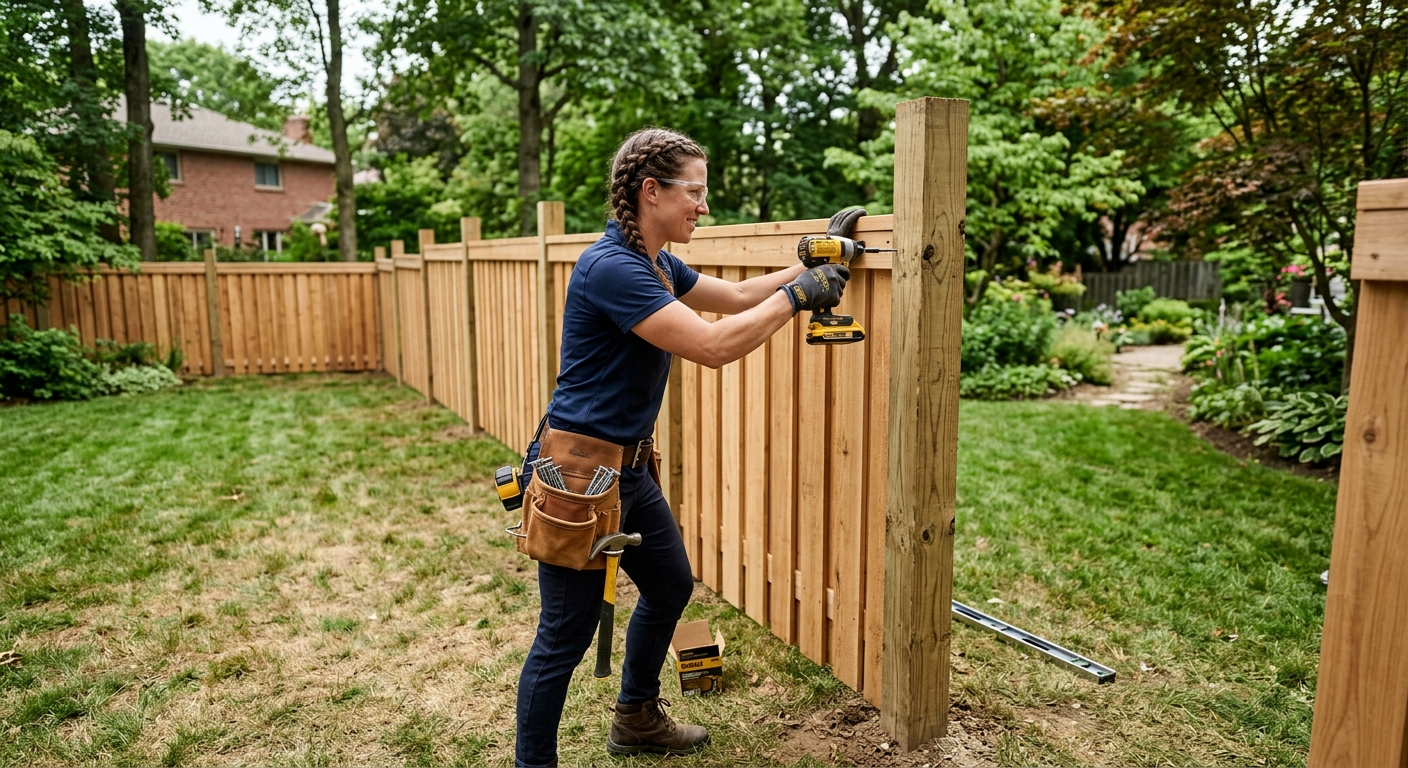
Fencing options and costs in Kitsilano
Kitsilano homeowners typically choose fencing based on privacy, maintenance, and how the ocean-influenced weather treats wood. With a population of 43,045 in 2021 (Statistics Canada, 2021 Census), the neighbourhood and surrounding Lower Mainland areas generate steady demand—especially on residential lots where fencing defines property boundaries and outdoor living spaces. Kitsilano’s housing mix includes many single-detached properties, and each detached lot is essentially a “potential fencing project,” which makes pricing sensitive to contractor availability during peak season.
In the Lower Mainland–Southwest, costs are shaped by mild but not trivial frost and frequent wind-driven rain. Even though coastal BC frost is generally shallower than colder provinces, crews still need to set posts below the design frost depth to reduce heaving, and wetter soils can mean deeper holes, more concrete, and extra labour—particularly on privacy panels and gate posts. Wind exposure also matters: you’ll see more emphasis on stronger bracing and properly spaced posts on taller fences near open streets and busier blocks, where gusts can rack lighter systems.
Trade demand is especially noticeable around West 4th Avenue and the Kitsilano waterfront corridor, where backyards and laneways are common and access can be tighter for deliveries. If your yard is near the Vanier Park / Jericho waterfront side, expect crews to plan around slope, drainage, and wind loading.
To compare common materials and what they cost per installation, see the ranges below.
| Material |
Lifespan |
Maintenance |
Privacy Rating |
Price per Linear Foot |
| Pressure-treated pine (standard wood) |
10–15 years |
Stain/seal every 2–3 years |
Good (solid boards) |
$55–$95 |
| Cedar (natural rot resistance) |
15–25 years |
Stain or clear coat every 2–4 years |
Very good (solid pickets/panels) |
$70–$115 |
| Vinyl / PVC (no-maintenance) |
20–30 years |
Rinse only; inspect annually for impact cracks |
Very good (solid styles) |
$75–$130 |
| Chain-link (galvanized steel) |
25–40 years |
Hose off; tension checks |
Low (visible gaps) |
$30–$55 |
| Aluminum ornamental |
25–40 years |
Wash seasonally |
Low to moderate |
$90–$170 |
| Composite / recycled material |
20–30 years |
Minimal; occasional wash |
Good (solid panels) |
$85–$140 |
Prices are estimates only and vary by project scope, site access and material selection.
What affects the price of fencing in Kitsilano
In Kitsilano and across the Lower Mainland–Southwest, two quotes for the “same” fence height can differ by 30–50% because the hidden drivers aren’t the height—they’re the ground conditions, wind resistance needs, and how the contractor builds the post-and-gate system. Labour availability also shifts during peak season, and different crews manage access (narrow lanes, vehicle drop-off distance, and landscaping protection) differently.
Start with frost and post embedment. In much of Canada, published guidance commonly places minimum post embedment around about 3 feet, and in cold Ontario and Alberta regions that can translate to deeper installs (often roughly 1.5–2.0 m) with concrete setting and longer posts—raising both material and labour. In coastal BC, the frost depth is shallower, but local crews still commonly set posts below the design frost to help prevent heaving. If your yard holds water (common in wetter Fraser Valley-influenced soils), contractors frequently dig deeper than “bare minimum” and use more concrete where posts carry heavy privacy loads.
Wind exposure changes panel design and bracing. On the Prairies, tighter spacing and heavier panels are common; in Kitsilano, you may not need prairie-level reinforcement, but tall boards and solid sections still rack under gusts, so corner and gate posts are often upsized and more concreted. Coastal BC’s wet climate accelerates wood rot if treatment and drainage details are wrong, which is why cedar and pressure-treated systems still need good hardware and proper post setting.
Concrete examples: a slope can push your crew toward stepped panels (extra labour, more framing), poor drainage may increase hole depth and concrete volume, and gate-heavy layouts (two large driveway gates, for example) require stronger posts and hardware. Budget accordingly: a chain-link run can land in the $30–$55 band, while a privacy-focused vinyl/PVC project often tracks the $75–$130 band because of stronger structural requirements and material cost.
| Price Factor |
Why It Matters |
Cost Impact |
| Fence length in linear feet — the primary cost driver |
Materials and labour scale directly with total run |
High (often the single biggest line item) |
| Post depth required — frost line determines post length and hole depth |
Deep holes reduce heaving and help stability |
Medium to high (more excavation + longer posts) |
| Post setting method — concrete vs. gravel pack vs. driven posts |
Concrete increases hold and durability on wet/soft soils |
Medium (concrete and additional time) |
| Material choice — vinyl vs. cedar vs. chain-link |
Higher-cost materials and different structural needs |
High (can shift the whole project band) |
| Gate count and type — walk-through vs. drive-through (double) |
Gates require heavier posts, hardware, and alignment |
Medium to high (hardware + labour) |
| Grade and terrain — sloped yards require stepped or raked panels |
Changes framing, layout time, and material waste |
Medium (more labour, more offcuts) |
| Old fence removal and disposal |
Demolition, hauling, and sometimes rework of footings |
Medium (varies widely by condition) |
| Permit fees and survey / property line locate |
Ensures compliant placement and avoids disputes |
Low to medium (small lines, big schedule impact) |
Permits & regulations in British Columbia
In British Columbia, fence rules are primarily about property line location and height limits set by your local municipality, and permits can come into play for taller installations. As a practical guideline many Vancouver-area homeowners run into: fences above a typical height threshold—often around 2.0 m (6.5 ft) for rear yards and roughly 1.0–1.2 m (3–4 ft) for front or corner areas—may require a building permit, depending on where the fence sits and how it relates to boulevards/streetscape. Check your specific municipal bylaw for the correct front/rear/corner interpretation.
Before you dig any post hole, arrange utility locates. In BC, you can use BC 1 Call to mark buried services so excavation doesn’t hit gas, hydro, or communication lines. Also, get a survey or locate your property pins (or have them located) so you’re not building even slightly onto a neighbour’s lot—disputes are common when an older fence “seems” to be in the right place.
Shared fence ownership is governed by provincial line-fences legislation, so keep documentation of who owns which sections and whether a fence is shared.
To verify your contractor in BC, ask for: (1) licence/registration details listed by the appropriate provincial registry for fencing/contracting (where applicable), (2) proof of general liability insurance with your name/property listed, and (3) confirmation of workers’ coverage (WSIB/WCB as required for the province and their workforce). Where to look: request a certificate of insurance (COI) and clearance letter directly from the contractor, and confirm dates and coverage limits match your project start window. Don’t rely on verbal confirmation.
Choosing the right fence material for Kitsilano
Choosing a fence in Kitsilano comes down to matching material to your priorities: privacy, low maintenance, budget, and how long you want to avoid major repairs. Kitsilano’s coastal-with-rainfall climate means wood must be built and finished for moisture exposure, and hardware must be corrosion-resistant. When posts are set below frost depth and the system is sealed correctly, the biggest long-term differentiator becomes whether you’re willing to maintain finishes.
Pressure-treated pine is usually the best entry price, but it typically needs staining or sealing every 2–3 years to prevent grey weathering and surface degradation in wet spells. Cedar offers better natural rot resistance and a more attractive grain; it often lasts longer than pine and still benefits from regular coating, especially on horizontal caps and cut ends. Vinyl/PVC gives the “set it and forget it” pitch, but extremely cold snaps (rare in Vancouver compared with the Prairies) can reveal impact stress—so you still want quality posts, proper fastening, and sensible gate alignment.
Chain-link is the lowest-cost option and can last decades, but it provides limited privacy unless you add slats, privacy screen fabric, or trellis options. Aluminum ornamental gives you a clean look and won’t rust, though it’s not a privacy fence by default. Composite/recycled materials can be a strong compromise—good appearance and minimal maintenance—with pricing typically above standard wood.
Concrete-setting requirements: in the Lower Mainland–Southwest, crews often set posts below the frost zone (frequently around a 3-foot embedment baseline, adjusted by site conditions). Concrete is more commonly used for corner posts, gate posts, and privacy fence lines in wetter soil—so even if you choose cedar or pressure-treated wood, you may still see concrete in the scope.
A quick dollar example: if you’re choosing between pressure-treated pine (often near the $55–$95 band) and vinyl/PVC (commonly $75–$130), the premium can be justified if you want to avoid repainting/staining cycles and you have a gate system that needs crisp alignment and long-term stability in damp conditions.
| Material |
Cold Tolerance |
Lifespan |
Annual Maintenance |
Best For |
Price Band |
| Pressure-treated pine |
Good in coastal BC temps; can weather in wet cycles |
10–15 years |
Inspect hardware; recoat/stain every 2–3 years |
Budget-focused yards that can handle periodic staining |
$55–$95 |
| Cedar |
Good; handles damp better than pine when built right |
15–25 years |
Inspect and stain/clear coat every 2–4 years |
Natural look with improved rot resistance |
$70–$115 |
| Vinyl / PVC |
Very good; may become brittle only under extreme impacts/cold snaps |
20–30 years |
Minimal; rinse and check for impact cracks |
Low-maintenance privacy and a clean finish |
$75–$130 |
| Chain-link |
Excellent; durable across coastal weather swings |
25–40 years |
Minimal; tension and post caps checks |
Security with visibility, pet containment, secondary barriers |
$30–$55 |
| Aluminum ornamental |
Excellent; no rust in wet coastal air |
25–40 years |
Minimal wash and inspection |
Attractive curb definition without corrosion issues |
$90–$170 |
| Composite / recycled |
Very good; stable in damp conditions |
20–30 years |
Low; wash occasionally |
Mixed-use yards wanting wood-like aesthetics with less upkeep |
$85–$140 |
How to choose a fencing contractor in Kitsilano
Choosing a fencing contractor in Kitsilano is mostly about verifying capability and comparing like-for-like scope. Start with licensing/coverage. Ask for proof of general liability insurance (COI) and confirm it’s active for your project dates. For workers, request evidence of WSIB/WCB coverage status (where applicable in BC operations through their provincial coverage arrangements). You should be able to see clear documents rather than a generic email. Then check: (1) the contractor’s business registration/credentials in the online registry they provide, (2) the COI certificate naming you as the certificate holder or listing your property, and (3) a clearance letter or equivalent proof that their workforce is covered.
Next, get 2–3 itemised written quotes—not lump sums. A proper quote should break out labour, materials (rails, pickets/panels, posts, hardware), and concrete/setting method. Read the exclusions: fence removal and haul-away, disposal of old wood, damage repair to adjacent landscaping, and whether a permit application (if required) is included. If you’re near a front/corner area where height rules can tighten, you don’t want surprises about permitting.
Warranty matters in both workmanship and products. Ask for the workmanship warranty length, whether it covers post-set failure, sagging panels, and gate alignment, and whether product warranties are manufacturer-backed. Also clarify if warranties are transferable to future owners if you sell.
For payment, never pay more than 10–15% upfront. Use a holdback until completion and final walkthrough. Finally, request start date and completion estimate in writing—coastal scheduling can shift due to weather windows, delivery lead times, and access planning.
- Ask for itemised labour and materials (posts, panels/pickets, rails, hardware).
- Confirm the post embedment plan and whether concrete will be used at corners/gates.
- Get written details on gate types, hinges, latches, and alignment adjustments.
- Verify whether fence removal and disposal are included or billed separately.
- Request utility locate confirmation before digging (BC 1 Call markers).
- Confirm how they handle slopes (stepped vs. raked vs. panel adjustments).
- Ask who pulls any required permit and what’s included in the scope.
- Check warranty terms: workmanship start date, coverage boundaries, exclusions.
- Request COI and proof of workers’ coverage (WSIB/WCB) before work begins.
- Review the payment schedule; keep a holdback until completion.
- Ask for start/completion dates and who you contact for schedule changes.
- Look at similar local installs/photos, ideally in Vancouver/Kitsilano-like lots.
In Kitsilano, red flags I often see include: quotes that don’t specify post depth or setting method, “cash only” or missing insurance paperwork, no clarification on gate hardware quality, vague scope around fence removal/disposal, and a warranty that covers materials but not workmanship (or that’s missing entirely).
Frequently asked questions — fencing in Kitsilano
How do I find my property line before fencing?
Before you install a fence in Kitsilano or anywhere across BC, confirm the exact property line rather than relying on the “old fence looks right” approach. The best method is to use a survey or have your property pins located so you can measure from a known reference. Many disputes come from small offsets that become obvious once a new, straighter fence is built. If you don’t have pins visible, ask a surveyor or a locate service to identify them. Then, when you meet your contractor, have them mark the proposed layout on-site and confirm setbacks for your front/corner/rear yard. This is especially important if you’re planning a taller fence near a street-facing boundary where height rules can differ.
What's the most low-maintenance fence?
For low maintenance in British Columbia, vinyl/PVC is usually the easiest day-to-day option because it doesn’t require staining and typically needs only periodic rinsing. Aluminum ornamental can also be very low maintenance since it won’t rust in wet coastal air, though it won’t give privacy unless you choose a solid design. If you want the lowest cost with long life, chain-link also requires little—mostly tension checks and rinsing—just without privacy. The trade-off is privacy: chain-link generally offers low privacy, while vinyl/PVC privacy styles can be “very good.” In pricing terms, many homeowners see vinyl/PVC installed ranges around $75–$130, while chain-link often comes in around $30–$55.
How tall can my fence be in Kitsilano?
In Kitsilano (Vancouver area), the practical answer is: it depends on location on your lot—rear yard versus front/corner—and whether it crosses permit thresholds. As a common guideline used by many BC municipalities, fences around 2.0 m (6.5 ft) in the rear yard may require a permit once you get above typical limits, while front/corner yard fences are often lower (often roughly 1.0–1.2 m). But exact limits and the permit trigger can vary by municipal bylaw and fence placement relative to the street. Before ordering materials, ask your contractor to confirm the height category and whether you need a permit for your specific location, then document it in writing so the final install is compliant.
Should fence posts be set in concrete here?
In coastal BC like Kitsilano, concrete isn’t always required for every post in every soil condition, but it’s very commonly used where strength matters most—especially corner posts, terminal posts, and gate posts. The reason is stability under wind-driven rain and racking forces; a wet or soft site can cause weaker footing systems to shift over time. Frost protection also matters: contractors still set posts below the design frost depth to reduce heaving, and where soils hold water, crews often dig deeper and choose concrete for more consistent hold. If you want a wood privacy fence, concrete is often included in the scope even when the fence material is cedar or pressure-treated pine because the structural posts carry most of the stress.
What's the best fence for privacy?
For privacy in Kitsilano, “best” usually means solid boards/panels with appropriate spacing and strong post-and-gate framing. Vinyl/PVC privacy styles are popular when homeowners want low maintenance, and cedar or pressure-treated pine can deliver excellent privacy at a lower material cost but typically require periodic finishing. In pricing terms, privacy-oriented wood projects commonly fall near the $55–$95 band, while vinyl/PVC privacy systems often land around $75–$130 depending on height, post reinforcement, and gate complexity. Also consider wind: solid fences need sturdy corner posts, correct rail fastening, and good gate hardware so the system doesn’t rack during gusts.
How do I compare fencing quotes?
Comparing quotes is about aligning scope, not just picking the lowest number. Ask for itemised breakdowns: materials, labour, post embedment depth, setting method (concrete vs. gravel pack), gate hardware, and whether removal/disposal is included. Confirm whether the quote includes utilities locates, property line marking/locates, and any permit work if required by BC municipal height rules. Compare warranties separately for workmanship and materials, and check payment schedules—reputable contractors typically keep upfront payments limited (often 10–15%) and use a holdback until completion. Finally, verify insurance and workers’ coverage documents before awarding. If one quote is far lower but vague on embedment and concrete setting, it may cost more later through shifting, sagging, or early repairs.