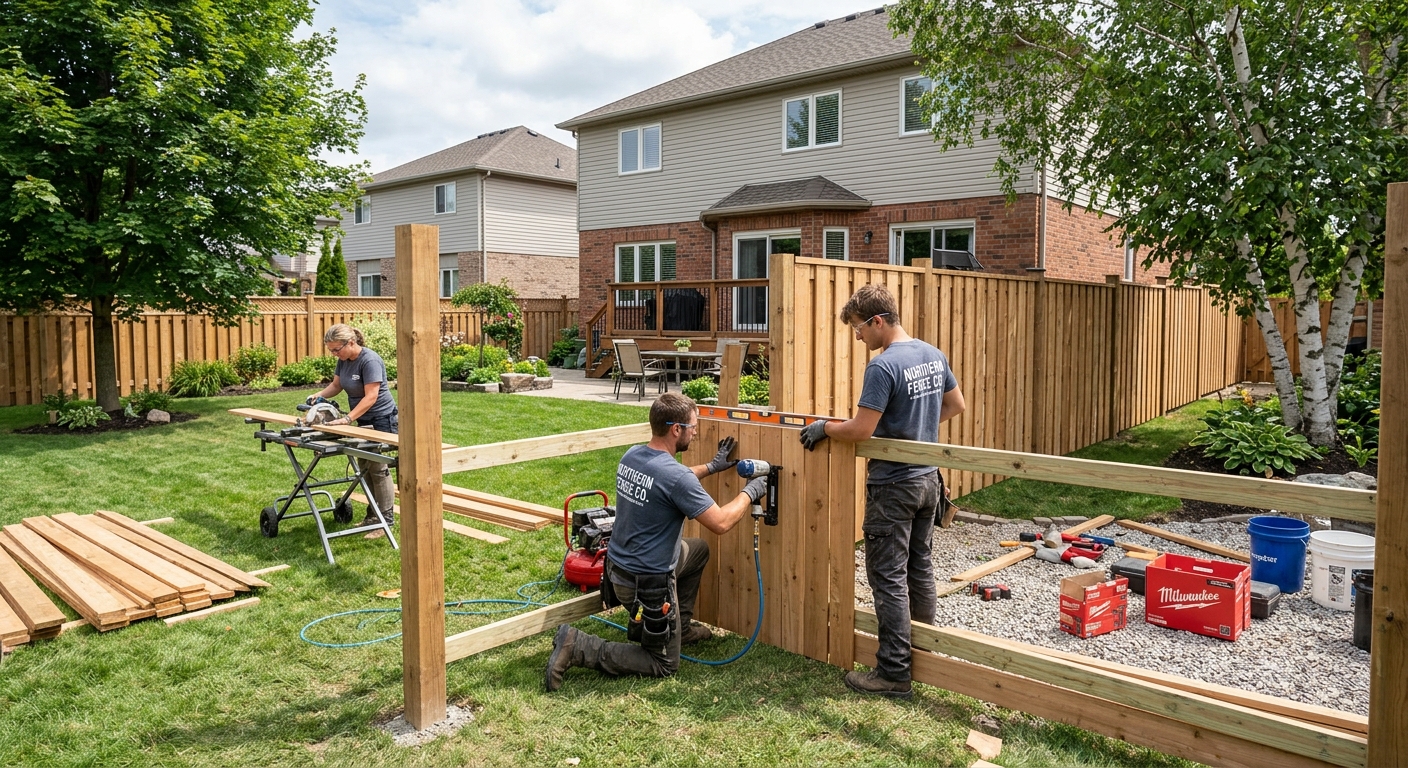
Fencing options and costs in Port McNeill
In Port McNeill, the right fence starts with matching the look you want to what Vancouver Island and the Coast actually does to materials. With a population of 2,356 and about 710 homeowner households (69.6% of households own), there’s a steady base of detached-property owners who tend to upgrade or replace aging boundary fencing. That’s especially relevant here because 62.3% of homes were built before 1981—older lots often have shorter fence runs, shifting lines, and original posts that may be rotted or too shallow for today’s installation standards.
Coastal BC also changes the cost picture. The frost line is relatively shallow (commonly around 45–60 cm), but contractors still bury posts below effective frost movement—often around 75–90 cm in typical residential work—to reduce heaving and long-term leaning. Frequent wind off the Strait of Georgia and Juan de Fuca Strait can push up labour for alignment and fastening, particularly for solid privacy panels that act like sails. Wet winters further drive materials and hardware choices: galvanized or powder-coated components and quality vinyl are more forgiving than untreated steel.
In Port McNeill, trade demand is often highest along older neighbourhood blocks near the waterfront and in established residential pockets where lots are narrower and access is tighter—meaning more time spent digging, setting, and finishing straight fence lines. Once you know your material direction, comparing prices becomes straightforward—see the table below.
| Material |
Lifespan |
Maintenance |
Privacy Rating |
Price per Linear Foot |
| Pressure-treated pine (standard wood) |
10–15 years |
Stain or seal every 2–3 years to slow grey weathering; check fasteners annually |
Good (solid boards) |
$12 – $18 |
| Cedar (natural rot resistance) |
15–25 years |
Light staining/sealing every 2–4 years; clean debris from gaps |
Good (solid boards) |
$16 – $24 |
| Vinyl / PVC (no-maintenance) |
25–35 years |
Occasional rinse; inspect for cracks after extreme cold and strong wind seasons |
Very good (solid privacy styles) |
$18 – $28 |
| Chain-link (galvanized steel) |
20–30 years |
Wash and inspect tension hardware every few years |
Low (open visibility) |
$10 – $14 |
| Aluminum ornamental |
25–40 years |
Minimal cleaning; check gate hinges and latch alignment |
Low to medium (decorative pickets) |
$20 – $33 |
| Composite / recycled material |
25–35 years |
Low; periodic washing and fastener checks |
Very good (solid composite panels) |
$22 – $35 |
Prices are estimates only and vary by project scope, site access and material selection.
What affects the price of fencing in Port McNeill
Even for “the same” fence, quotes in Port McNeill can vary by 30–50% across Vancouver Island and Coast because the scope drivers are rarely identical. Contractors price for what the site actually demands: ground conditions, wind exposure and layout complexity. Materials also sit in different labour mixes—vinyl and aluminum have higher material cost but often faster installs when the line is simple, while pressure-treated or cedar can take more time for careful fastening, straightening and weathering-resistant finishing.
A major factor is frost movement. Vancouver Island’s frost depth is often estimated around 45–60 cm, but to prevent heaving and long-term leaning, posts are commonly set about 4–6 inches below design frost depth, which typically lands around 75–90 cm of burial in residential work. That means longer posts, deeper holes and more excavation labour. In wetter, clay-rich pockets or where soils are disturbed, concrete-set footings become common—raising both material and disposal costs.
Wind exposure changes panel performance. Solid privacy fences catch more wind than open styles, so you may see closer post spacing, stronger rails, heavier fasteners and more bracing—raising the install cost compared with a chain-link run. For example, a 60-linear-foot cedar privacy section often comes out in a higher labour band than a comparable chain-link perimeter, while a vinyl privacy fence can push the budget further due to higher material rates but may reduce rework in wet seasons.
Local examples in Port McNeill that commonly raise cost include: (1) yards with slopes where panels must be stepped and rails re-levelled; (2) tight access near side yards where hauling spoils and setting lines takes longer; and (3) gate openings where alignment and hardware installation are labour-intensive. With many homes built before 1981, it’s also common to encounter older, undersized posts—replacement and disposal can add several hundred dollars quickly depending on how much is removed. For budgeting, many owners compare the wood band (often roughly $55–$85 for labour, plus materials) against vinyl/PVC (often roughly $70–$110 labour rates in this region), then adjust for length, gates and post-setting method.
| Price Factor |
Why It Matters |
Cost Impact |
| Fence length in linear feet |
Most costs scale directly with run length, including posts, rails, and labour hours |
$1,000 – $6,000 |
| Post depth required |
Frost movement drives hole depth and the length of posts needed to stay stable |
$300 – $2,000 |
| Post setting method |
Concrete-set posts require extra excavation, concrete, and cleanup versus gravel packs or driven posts |
$400 – $2,500 |
| Material choice |
Vinyl/cedar/aluminum have different material costs and different labour intensity |
$500 – $5,000 |
| Gate count and type |
Walk-through gates are simpler; double-drive gates need heavier framing and hardware |
$300 – $4,000 |
| Grade and terrain |
Slope often requires stepped panels, raked rails, and more careful layout time |
$250 – $2,000 |
| Old fence removal and disposal |
Rotting boards, concrete footings and mixed materials can increase dump/haul time |
$400 – $2,500 |
| Permit fees and survey / property line locate |
Some higher fences and corner situations trigger additional administrative work |
$0 – $1,200 |
Permits & regulations in British Columbia
In British Columbia, fence rules are tied to height and placement relative to property lines and municipal setbacks. As a homeowner in Port McNeill, you’ll commonly run into building-permit requirements when a fence exceeds the typical thresholds of about 2.0 m (6.5 ft) at the rear and roughly 1.0–1.2 m (3–4 ft) at the front or on a corner. Even when a permit is not required, your fence still must respect property lines and local setback bylaws.
Before any post holes are dug, call for utility locates through the appropriate provincial one-call service (e.g., BC 1 Call). Utility mark-outs prevent expensive line strikes. Next, verify the exact boundary: if you don’t already have reliable survey pins, get a locate or survey so the fence doesn’t encroach on a neighbour’s land.
Shared fence responsibilities are handled through provincial line-fences legislation, so it’s smart to confirm whether you’re building a new shared fence, replacing an existing one, or working on one side only.
Licence and coverage checks: to verify a contractor in BC, ask for (1) proof of business registration/licensing information as applicable in the province, (2) a current certificate of liability insurance showing adequate limits for fencing work, and (3) proof of WSIB/WCB coverage (or a clearance letter/confirmation where applicable). You should see document dates, the jobsite address on COI where possible, and named insured details that match the company on the quote. If they can’t provide it, that’s a major red flag.
Choosing the right fence material for Port McNeill
Choosing a fence in Port McNeill is mostly about trade-offs between privacy, low maintenance, budget, and how materials behave through coastal wet winters and wind. Pressure-treated pine is the budget-friendly option, but it typically requires staining or sealing every 2–3 years to slow grey weathering and protect end grain. Cedar offers natural rot resistance and a nicer appearance, but it still benefits from periodic maintenance to maintain colour and prevent surface checking. Vinyl/PVC is widely chosen for low maintenance: you rinse it and move on, but in severe cold and high wind, boards can become brittle if the system isn’t installed to allow proper expansion and bracing.
Chain-link is usually the lowest-cost long-term solution and tends to handle moisture well with galvanized steel, but it won’t provide privacy unless you add a privacy screen or plant barrier. Aluminum ornamental looks sharp, resists rust, and holds up in coastal air, but it’s not ideal if your goal is a fully private backyard. Composite or recycled materials can provide solid privacy with low maintenance, though the upfront cost is typically the highest of the “no staining” options.
For post-depth planning on Vancouver Island and the Coast, frost movement still matters. Even with moderate coastal frost, typical residential builds set posts around 75–90 cm deep, and concrete-set posts are a smart choice for taller fences, heavy gates, saturated soils, or where you’ve disturbed clay or wet ground. Wind and snow loads matter more for solid privacy styles; solid panels need sturdier rails and often closer post spacing than open styles.
Cost justification example: if a pressure-treated pine privacy fence comes in around the wood band (often roughly $55–$85 in regional labour pricing plus material), and cedar costs noticeably more, spending the extra can be justified when you want a longer lifespan and better natural look without constant touch-ups. If you’re trying to avoid ongoing staining, vinyl privacy can be worth the higher upfront investment, especially on longer runs where maintenance labour would otherwise add up over time.
| Material |
Cold Tolerance |
Lifespan |
Annual Maintenance |
Best For |
Price Band |
| Pressure-treated pine |
Good (with proper sealing and fastener care) |
10–15 years |
Low to moderate: check hardware; stain/seal every 2–3 years |
Lowest upfront cost with acceptable maintenance |
$55 – $85 |
| Cedar |
Good |
15–25 years |
Low to moderate: stain/seal every 2–4 years |
Better appearance and natural rot resistance |
$70 – $100 |
| Vinyl / PVC |
Moderate to good (requires correct installation for expansion) |
25–35 years |
Very low: rinse and occasional inspection |
Low-maintenance privacy in wet coastal air |
$70 – $110 |
| Chain-link |
Excellent (galvanized coating) |
20–30 years |
Very low: tension and hardware checks every few years |
Security with visibility (pets, perimeters) |
$35 – $60 |
| Aluminum ornamental |
Excellent |
25–40 years |
Very low: keep latch/gate hardware aligned |
Street-front curb appeal without rust |
$80 – $140 |
| Composite / recycled |
Good (varies by brand; proper spacing needed) |
25–35 years |
Low: wash and inspect posts/fasteners |
Solid privacy with minimal upkeep |
$90 – $150 |
How to choose a fencing contractor in Port McNeill
Choosing a contractor in Port McNeill comes down to verifying coverage, getting apples-to-apples quotes, and making sure the scope matches your yard’s conditions. Start by confirming British Columbia business compliance and asking for certificates of liability insurance plus proof of WSIB/WCB coverage (or the applicable clearance confirmation). To check each: look at the insurance certificate for policy limits, effective/expiry dates, and that the named insured matches the company you’re hiring; verify the WSIB/WCB documentation is current; and confirm the company name and address on the paperwork match the quote and contract.
Then request 2–3 itemised written quotes—not a single lump sum. You want a breakdown for labour and materials (posts, rails, panels, gate hardware, concrete/footings, fasteners) and line-by-line allowances for disposal and site prep. Carefully read what’s excluded: many quotes exclude excavation spoil hauling, old fence removal, permit administration, surveying/locate costs, or adjustments for slopes. If permit pulling is needed for your fence height at the rear or near a corner, make sure it’s clearly included or clearly excluded.
Warranty matters on work as well as materials. Ask for the workmanship warranty length (post-setting and alignment), and the manufacturer warranty on materials. Also ask whether the product warranty is transferable if you sell the home. Payment should be controlled: never pay more than 10–15% upfront; hold back a portion until the fence is fully completed, gates work correctly, and cleanup is finished. Get a written start date and a completion estimate, since coastal rain can stretch timelines—good contractors schedule and communicate proactively.
- Ask for proof of current liability insurance and WSIB/WCB clearance/coverage before work starts.
- Verify the quote is itemised (labour vs materials) and matches your measured fence line length.
- Confirm how posts are set: concrete footings vs gravel pack vs driven posts.
- Ask what depth they install for frost movement in this region (typical residential work targets ~75–90 cm).
- Confirm gate hardware type and frame bracing for wind exposure.
- Require a site walk for accurate layout, especially on slopes and in tight access side yards.
- Check disposal is included if you have old fencing to remove.
- Ask whether they will locate utilities before digging and document mark-outs.
- Ensure the contract includes cleanup, sweep-up, and hauling to the correct disposal location.
- Clarify if permits are needed based on your fence height and placement.
- Confirm workmanship warranty coverage in writing and what it excludes.
- Use a payment schedule: keep 80–90% back until completion and gate testing.
Concrete red flags we see in Port McNeill include: contractors who won’t show insurance/WSIB/WCB documentation, quotes that skip old fence removal details (then charge change orders), vague “we’ll handle permits” language with no responsibility stated, no written post-setting method or depth, and requests for large upfront payments beyond 10–15%.
Frequently asked questions — fencing in Port McNeill
What's the best fence for privacy?
For privacy in Port McNeill, a solid privacy fence with closely spaced boards is usually the top choice—cedar or vinyl privacy styles both perform well in coastal BC moisture when installed with proper post depth and good fasteners. Cedar gives a natural look and rot resistance, and vinyl/PVC offers low-maintenance ownership for many homeowners who don’t want to stain. If you’re comparing budgets, vinyl privacy often sits in the higher regional band (commonly around $70 – $110 labour pricing plus materials), while pressure-treated pine typically comes in lower (often roughly $55 – $85 in the regional range). The “best” depends on whether you want to maintain wood regularly or prefer an all-in solution that’s easier to live with year-round.
How do I compare fencing quotes?
Start by comparing quotes that list the same scope: fence length, number of corners, gate count, post spacing, and the post-setting method. In Port McNeill, make sure each quote addresses frost movement with a realistic post burial plan (often ~75–90 cm residential installation) and confirms whether concrete footings are used. Also check whether the quote includes removal and disposal of your old fence and whether it includes utility locates and cleanup. Compare like-for-like materials: vinyl thickness/colour system, cedar grade, and whether chain-link is galvanized. Finally, ensure pricing uses itemised line entries—not just totals—so you can see what drives differences of 30–50% between contractors. If one quote is far lower, it may be omitting concrete-set posts, gates, or disposal.
How long does fence installation take in Port McNeill?
Timelines in Port McNeill depend on length, access, and ground conditions. A straightforward straight run with standard posts and one walk-through gate can sometimes be completed in a couple of days, while longer perimeter fences, multiple corners, slope adjustments, and double-drive gates typically add time for layout, bracing, and gate alignment. Post-setting is also affected by site soil—wet areas and clay-rich pockets may require concrete footings, which adds set-up and cleanup time. Coastal rain can slow digging and finishing, so good contractors schedule with weather in mind. A realistic completion range for many residential projects is a few working days up to about two weeks for larger, gated layouts, especially when old fence removal is included.
Can I install a fence on a slope in Port McNeill?
Yes, but you’ll usually pay a bit more and you should expect a more careful layout. In sloped yards around Port McNeill, contractors typically use stepped panels or raked rails so the top line looks straight while the posts are still set at stable depths. This means more measuring, more cuts, and additional time for alignment. The other practical concern is that slope often changes soil conditions from one end of the fence to the other, which can affect whether concrete-set posts are recommended. If you’re getting quotes, ask explicitly how each contractor handles slopes and whether they’ll provide a clear plan for panel height changes so you can avoid surprises at installation time.
What is the most weather-resistant fence for Port McNeill's climate?
Weather resistance in Port McNeill is largely about moisture, wind, and frost movement around posts. Vinyl/PVC and galvanized chain-link tend to resist coastal corrosion better than untreated steel hardware, and they’re generally forgiving in wet winters. Cedar can also be highly weather-resistant when maintained and installed correctly, while pressure-treated pine is durable but needs periodic staining/sealing to prevent premature grey weathering and wear at fastener points. For maximum weather resilience, the “system” matters: correct post depth to prevent heaving, solid rails, and corrosion-resistant hardware. If you want a ballpark for budgeting, many homeowners choose mid-to-higher bands like vinyl/PVC (often $70 – $110 in the regional range) when they want long service life with low upkeep.
How do I prevent wood fence rot in Port McNeill?
Rot prevention is about keeping water away from the wood and using installation practices that don’t trap moisture. In Port McNeill, start with using pressure-treated pine or cedar and insist on quality fasteners and proper rail design that limits standing water. Ensure posts are set deep enough to stay stable through frost movement (commonly ~75–90 cm residential installation) and ask whether concrete footings are recommended for your soil type. Concrete footings help reduce soil contact and heaving, especially in wet or clay-rich areas. Also plan for maintenance: stain or seal on a schedule (pressure-treated often needs attention every 2–3 years), and keep vegetation trimmed so air circulates around boards. Good installation plus periodic touch-ups is what prevents rot rather than relying on the material alone.