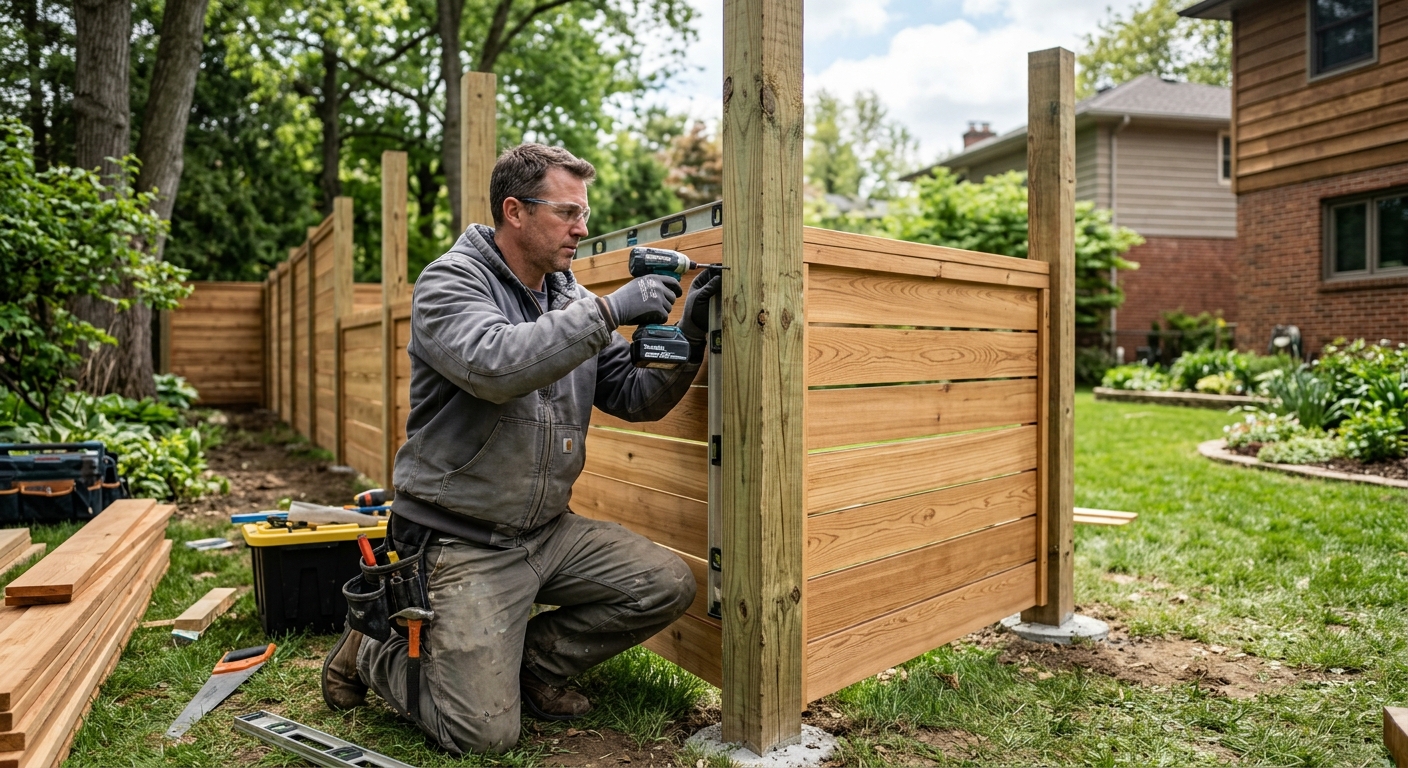
Fencing options and costs in Aldergrove
Aldergrove homeowners typically start their fence search with one goal—more privacy, safer pets, or a cleaner boundary—and then quickly compare material types against local pricing. With a population of 12,363 (Statistics Canada, 2021 Census), Aldergrove still has enough steady housing turnover that fencing work stays year-round, but you’ll notice seasonal scheduling around wet ground conditions. Just as importantly, the mix of residential lots creates consistent demand for backyard boundaries; for many properties, a fence upgrade is one of the more visible “curb and comfort” improvements, especially in established pockets like Matsqui Village where lots are frequently reworked as landscaping matures.
In the Lower Mainland–Southwest, costs are shaped by mild but persistent frost and frequent rain. Even though the “air” feels gentle compared with Ontario and Alberta, posts still need to be set below the local frost depth to limit heaving. In wetter Fraser Valley soils around Aldergrove, that often means deeper holes, more concrete for corner posts and gates, and more labour to manage muddy auger conditions. Wind exposure also matters: open areas and tree-line gaps can increase lateral load, so contractors may tighten post spacing or recommend reinforced panels for solid wood or vinyl privacy fencing.
Chain-link usually comes in as the lowest-cost installed option, while wood is mid-range and vinyl/PVC climbs due to material and structural requirements. Aluminum ornamental tends to be the priciest for fabrication, especially when you want consistent spacing and clean gate alignment. Use the comparison below as a starting point, then refine the price by your fence length, height, and site access before you book a measurement.
| Material |
Lifespan |
Maintenance |
Privacy Rating |
Price per Linear Foot |
| Pressure-treated pine (standard wood) |
10–15 years |
Stain/seal every 2–3 years |
High (solid boards) |
$55–$95 |
| Cedar (natural rot resistance) |
15–25 years |
Light staining every 2–4 years |
High (solid boards) |
$70–$120 |
| Vinyl / PVC (no-maintenance) |
20–30 years |
Occasional wash; inspect hardware |
High (privacy panels) |
$75–$130 |
| Chain-link (galvanized steel) |
25–35 years |
Low; rinse and check tension |
Low–medium (with privacy slats) |
$30–$55 |
| Aluminum ornamental |
25–40 years |
Low; wash and check for fit |
Low–medium |
$90–$170 |
| Composite / recycled |
20–30 years |
Low; wash and inspect posts |
High (solid panels) |
$85–$150 |
Prices are estimates only and vary by project scope, site access and material selection.
What affects the price of fencing in Aldergrove
Fence quotes for the “same” height can vary by 30–50% across the Lower Mainland–Southwest and other parts of British Columbia because the real price drivers are hidden in the site conditions. A 6 ft (1.8 m) run on a flat, well-drained lot can be straightforward, while the same length on a sloped yard with wet soil can mean deeper post holes, more concrete, extra labour for setting level, and more time on layout and cleanup. Contractor availability also plays a role: when the ground is too wet to auger cleanly, crews slow down, and rush scheduling can move the budget.
One of the biggest drivers is how frost heaving is prevented. Local practice commonly sets posts so they land below the design frost depth—often meaning deeper holes than people expect. In cold Canadian regions, the difference can be dramatic; Ontario and Alberta examples typically see posts going about 1.5–2.0 m into the ground, which raises costs because you need longer posts and more concrete setting. While Aldergrove’s frost impacts are generally less extreme than the Prairies, contractors still commonly go deeper than the “bare minimum” and use concrete for privacy panels, corner posts, and gate posts. Wind exposure is another variable: more lateral load can push you toward tighter spacing and heavier framing, especially for solid wood and vinyl privacy.
Concrete examples that often affect Aldergrove pricing include: (1) wetter Fraser Valley soils requiring deeper, more stable holes (more concrete and slower drilling), (2) corner and gate posts being fully concrete-set even when line posts might use a different approach, and (3) muddy access or narrow lanes where material staging takes longer. For budget context, a chain-link run often lands around the $30–$55 range in this region, while a privacy wood or vinyl project commonly climbs into the $55–$130 band depending on solid-panel construction and gate work.
| Price Factor |
Why It Matters |
Cost Impact |
| Fence length in linear feet |
Most hardware and labour scale directly with length. |
High impact (primary driver) |
| Post depth required |
Frost protection dictates hole depth and post length. |
Medium–high impact |
| Post setting method |
Concrete vs. gravel pack vs. driven posts changes material and labour. |
High impact |
| Material choice |
Vinyl, cedar, and chain-link have different material and framing needs. |
Medium–high impact |
| Gate count and type |
Double-drive gates require stronger posts, bigger framing, and alignment work. |
High impact |
| Grade and terrain |
Slopes require stepped or raked panels and extra layout time. |
Medium impact |
| Old fence removal and disposal |
Hauling, sorting, and demolition labour add time and dump fees. |
Medium impact |
| Permit fees and survey / property line locate |
Documents reduce the risk of encroachment disputes. |
Low–medium impact (can vary widely) |
Permits & regulations in British Columbia
In British Columbia, fencing rules typically come from municipal bylaws plus provincial line-fence principles. As a practical threshold, fences above a height limit—often around 2.0 m (6.5 ft) at the rear and about 1.0–1.2 m (3–4 ft) at the front or corner—may require a building permit. Even when a permit isn’t triggered, you still must respect property lines and any municipal setback requirements, especially at corners where sightlines matter.
Before digging any post holes, you should always arrange utility locates through the appropriate provincial call system. In British Columbia, that means BC 1 Call (utility locate request) so crews know where power, telecom, and buried services run. Also consider getting a survey or at least locating your property pins before installation; this reduces the chance you build on a neighbour’s land and helps in boundary disputes.
Shared fence ownership—who pays and who can maintain what—falls under provincial line-fences legislation. Typically, neighbours may share responsibilities for a boundary fence if it’s agreed or established as a shared structure.
To verify a contractor’s compliance in Aldergrove, ask for: (1) their certificate of liability insurance showing they carry adequate coverage for the work, (2) documentation of workers’ compensation coverage (or the correct clearance for your contractor type), and (3) confirmation of their business registration and any applicable contractor licence details through relevant online registries. Keep a copy of the insurance certificate and any clearance letter with your contract.
Choosing the right fence material for Aldergrove
Choosing a fence material in Aldergrove is mostly about matching your priorities—privacy, low maintenance, budget, and lifespan—to Fraser Valley conditions. Pressure-treated pine is the budget-friendly route, but in our damp cycles it typically needs staining or sealing every 2–3 years to avoid grey weathering and early surface breakdown. Cedar looks great longer and naturally resists rot, but it still benefits from periodic maintenance to keep colour and prevent warping where panels stay wet. Vinyl/PVC is genuinely low maintenance and handles rot well, yet in cold snaps it can become brittle at cut ends unless installed correctly; proper post depth and hardware alignment matter.
Chain-link is the lowest cost and can last a long time, but privacy is limited unless you add slats or privacy mesh—so it’s best when visibility isn’t a concern. Aluminum ornamental won’t rust and resists wet weather, but it’s primarily for appearance and boundary definition, not privacy.
For post depth, Lower Mainland–Southwest frost considerations are milder than farther inland, but you still set below the frost-impacted zone to prevent heaving. In practice, that often means deeper holes than a homeowner might assume, and concrete-set posts are commonly used for corner posts, gate posts, and sometimes privacy line posts. Wind and snow load are also considerations: even in mild BC weather, gusts and heavy wet snow can stress weak framing, especially on solid panels and wider gate spans.
Here’s a concrete budgeting example: if your privacy goal pushes you from chain-link to wood or vinyl, you might move from the roughly $30–$55 range into the $55–$130 band. That jump is often justified because you’re paying for solid infill, heavier posts, and more framing that stands up to wind and damp grading around Aldergrove lots.
| Material |
Cold Tolerance |
Lifespan |
Annual Maintenance |
Best For |
Price Band |
| Pressure-treated pine |
Good with proper sealing and hardware fit |
10–15 years |
Quick inspection; plan stain every 2–3 years |
Budget privacy with standard upkeep |
$55–$95 |
| Cedar |
Good; stable boards if installed off wet contact |
15–25 years |
Inspect and stain lightly every 2–4 years |
Natural look with better rot resistance |
$70–$120 |
| Vinyl / PVC |
Very good; brittle at extremes if poorly handled |
20–30 years |
Occasional wash and hardware checks |
Low maintenance privacy |
$75–$130 |
| Chain-link |
Good; steel remains stable in wet cycles |
25–35 years |
Low; rinse and check tension |
Security and pet containment with minimal privacy |
$30–$55 |
| Aluminum ornamental |
Very good; powder-coated and non-rusting |
25–40 years |
Low; wash and inspect fittings |
Decorative boundaries and long-term durability |
$90–$170 |
| Composite / recycled |
Good; stable if installed with correct clearance |
20–30 years |
Low; occasional wash and inspection |
Solid privacy with minimal maintenance |
$85–$150 |
How to choose a fencing contractor in Aldergrove
In Aldergrove and across British Columbia, a good fencing contractor should be able to show proof of compliance before they dig the first hole. Verify workers’ compensation coverage first (commonly called WSIB/WCB in conversations): ask for their current clearance/coverage documentation so you’re not left holding the risk if someone is injured on-site. Next, check liability insurance—ask for a certificate of insurance naming you as the certificate holder where appropriate (or at least confirming the policy is active and adequate for fencing work). Finally, confirm their business details and any applicable contractor registration so you’re dealing with a real, accountable operation.
Then get 2–3 written, itemised quotes instead of lump sums. I recommend you request a labour + materials breakdown that clearly lists: post type, post spacing, embedment depth assumptions, concrete usage (or whether line posts use a different method), gate hardware, rail style, and finish materials. Make sure the scope includes what you consider “must-haves”: permit pull (if required), utility locate allowance, and disposal of old fencing. If they do not include removal, you may be paying extra later for hauling and dump fees.
For warranty, ask for two pieces: workmanship warranty (how long they stand behind installation) and manufacturer warranty (how long the material system is covered). Also ask whether the warranty is transferable if you sell your home. Payment schedule should be conservative—never more than about 10–15% upfront, with a holdback until the job is complete and you’ve inspected the fence for line/level and hardware alignment. Get a start date and completion estimate in writing, with weather-related contingencies noted for wet soil and frost delays.
- Ask for concrete set details at corners and gates (and whether line posts use concrete or gravel pack).
- Confirm post depth assumptions for the frost-impacted season.
- Require an itemised quote with quantities (posts, rails, panels, brackets, and gate hardware).
- Check whether disposal and site cleanup are included.
- Ask who handles permit applications if your fence height triggers one.
- Verify utility locates are arranged before digging.
- Request proof of liability insurance and confirm policy dates cover your project window.
- Confirm workers’ compensation clearance/coverage for the contractor and any subcontractors.
- Review the warranty terms in writing (workmanship vs. product).
- Clarify the schedule and include a weather delay plan for wet ground.
- Confirm they have a plan for slopes (stepped vs. raked sections) and tight transitions at corners.
- Make sure gate type is specified (single vs. double) and hardware matches the fence style.
Specific red flags I see too often in Aldergrove: vague “we’ll handle permits” wording with no cost or responsibility listed; refusing to provide a certificate of liability insurance or workers’ compensation clearance; quotes that don’t state post depth, spacing, or concrete use; payment terms demanding large upfront deposits (beyond 10–15%); and no written timeline or scope exclusions for removal/disposal and site cleanup.
Frequently asked questions — fencing in Aldergrove
How do I handle a fence dispute with a neighbour in British Columbia?
Fence disputes in British Columbia usually come down to property lines, agreed fence location, and maintenance responsibilities. Start by documenting what’s physically present (photos, measurements from your property pins if you have them, and any prior correspondence). If you’re unsure where the boundary runs, schedule a survey or request a property-line locate so you’re not guessing. If a fence is a shared boundary structure, provincial line-fences legislation governs shared responsibilities, but the exact approach can depend on local circumstances and how the fence was established. Keep discussions respectful and in writing, and involve your contractor only after you know the boundary. If needed, consult a professional for boundary advice before spending money on relocation or repairs.
What fence style offers the best wind resistance in Aldergrove?
In Aldergrove’s Lower Mainland–Southwest conditions, wind resistance is largely about panel stiffness and the framing/post system, not just “thickness.” For the strongest performance, ask for reinforced posts (often concrete-set at corners and gate points) and solid-panel privacy with properly braced rails. That said, solid fences can act like sails in gusts, so proper spacing and heavier hardware matter. If you want strong wind behaviour with less “sail effect,” semi-privacy designs with evenly framed rails can reduce wind load while still providing boundary control. Regardless of style, the key is accurate layout on slope and strong gate hardware. A well-built privacy fence that lands in the $55–$130 range typically uses more framing than chain-link, which is why it tends to resist wind better when installed with correct embedment.
How much does a fence cost in Aldergrove?
For an ordinary residential fence in Aldergrove, installed costs typically fall within the regional price bands: chain-link is often about $30–$55 per linear foot, wood is commonly $55–$95 per linear foot, and vinyl/PVC frequently lands around $75–$130 per linear foot depending on height, privacy panel design, and gate complexity. Final pricing can move up when you have wet or heavy soils that require deeper post holes and more concrete setting, or when you need disposal of an old fence. Since Aldergrove is part of the Lower Mainland–Southwest—mild but not trivial frost and frequent moisture—projects often require careful post embedment even when it doesn’t “feel winter.” If you want a quick budget target, measure your linear feet, estimate how many gates you’re adding, and plan for stronger corner/gate post construction.
How deep should fence posts be for Aldergrove's frost?
Even in British Columbia’s milder climate, posts must be set below the frost-impacted zone to limit heaving. In practice, that often means deeper holes than the simplistic “one-third of height” rule people use online. Contractors typically set posts so they land below the design frost depth; a common approach is to aim for roughly 4–6 inches below the design frost depth and then confirm embedment depth based on local conditions. In wetter Fraser Valley soils, you’ll usually see deeper holes for stability and more concrete setting—especially at corner posts and gates. The exact depth depends on your fence height, soil type, and whether the grade slopes, but expecting deeper-than-minimum embedment helps you avoid leaning panels after freeze-thaw cycles.
Wood vs vinyl vs aluminum fence — which is best?
“Best” depends on your priority. Wood (pressure-treated pine or cedar) offers a good balance of appearance and cost, and wood privacy fences are commonly in the $55–$95 range for pressure-treated and higher for cedar. Wood does require ongoing maintenance—staining/sealing every few years—to handle damp weather cycles in Aldergrove. Vinyl/PVC is usually the lowest-maintenance path after install and often sits around $75–$130 for privacy styles; just ensure the installer uses proper post depth and hardware alignment so it performs well in cold snaps. Aluminum ornamental is typically the priciest (often $90–$170) and is best for decorative boundary definition, not full privacy. If you need privacy and low upkeep, vinyl often wins; if you want a classic look and can maintain it, cedar is a strong choice.
Do I need a permit to build a fence in British Columbia?
In British Columbia, permits can apply depending on fence height, location, and local bylaws. A common rule of thumb is that fences above about 2.0 m (6.5 ft) at the rear and roughly 1.0–1.2 m (3–4 ft) at the front or corners may require a building permit. Regardless of permit requirements, you must follow property-line rules and any municipal setback requirements, particularly near intersections where sightlines matter. Before digging, arrange utility locates (BC 1 Call) and verify your property line using pins or a survey to avoid encroachment disputes. For practical homeowner confidence in Aldergrove, ask your contractor to specify in writing whether a permit is required for your exact fence height and placement and who is responsible for the application.