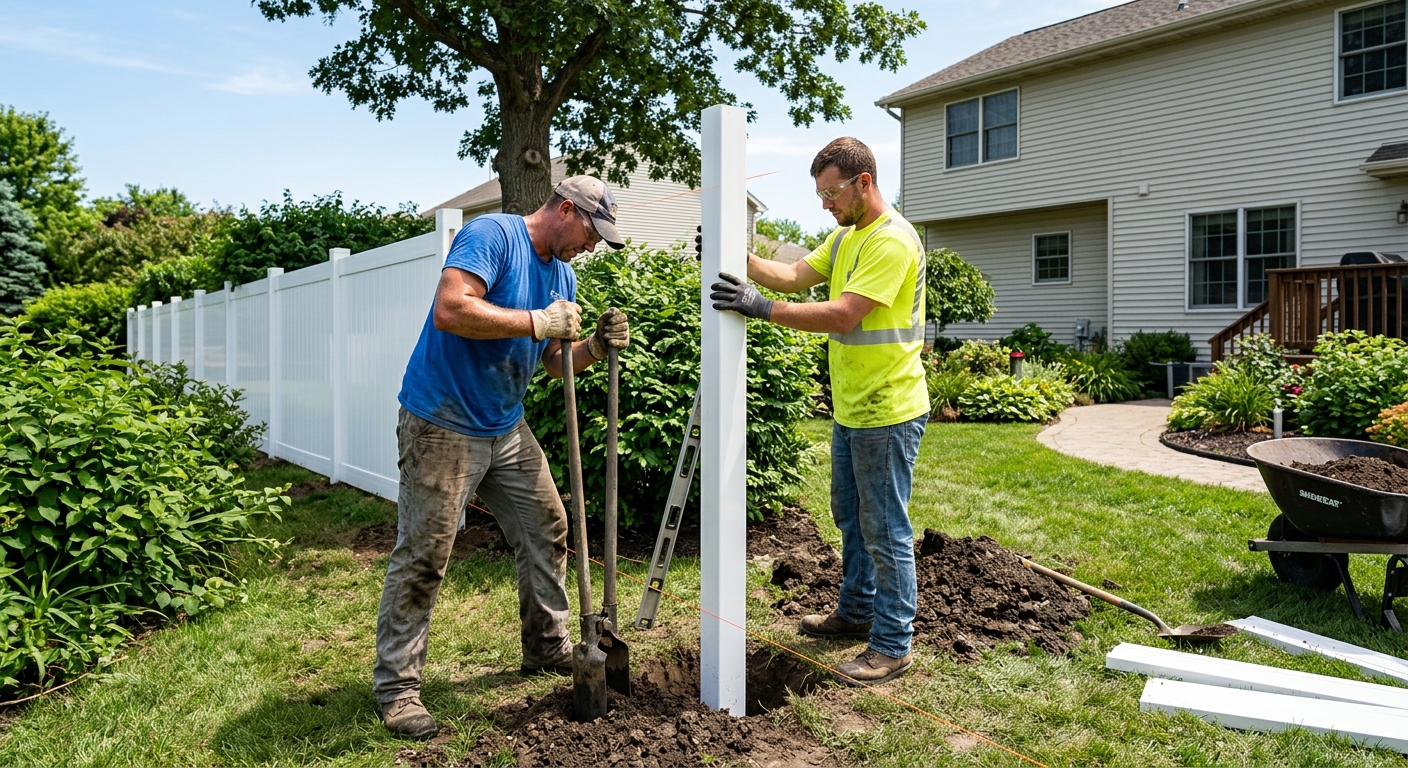
Fencing options and costs in Popkum
Popkum homeowners typically start their fencing search by deciding how much privacy they want and how hands-on they’re willing to be. With Popkum’s population at 1,710 (Statistics Canada, 2021 Census), the local contractor market is smaller than in the big hubs, so availability can affect turnaround times. Demand also tracks closely with detached home ownership patterns in the Lower Mainland–Southwest—each detached property is effectively a “fence project” when boundary updates or yard upgrades come up.
In the Lower Mainland–Southwest, pricing is shaped by a mild but wet climate that still delivers frost and wind. Posts often need to be set below local frost risk to limit heaving, especially where soils stay saturated; that means deeper holes and more labour than a purely “coastal” assumption. Fraser Valley–type soil conditions can also increase concrete use for privacy panels, corner posts, and gate hardware. On top of that, wind exposure influences how crews size posts and choose tighter spacing for solid privacy styles, which can raise installed costs even when the linear footage looks straightforward.
Trade demand is especially steady around Popkum’s residential pockets where yards are larger and boundary upgrades are common—many homeowners are also in the Abbotsford-area commuting zone, so contractors frequently see projects clustered by neighbourhood season. If you’re planning a new fence or replacing an older one, the easiest way to compare is to look at material performance first, then match it to your budget and expected maintenance.
Use the table below as a practical starting point for typical installed costs in Popkum and the surrounding Lower Mainland–Southwest area, then refine with measurements, access, and finish choices.
| Material |
Lifespan |
Maintenance |
Privacy Rating |
Price per Linear Foot |
| Pressure-treated pine (standard wood) |
10–15 years |
Stain/paint every 2–3 years; inspect for loose pickets |
6/10 |
$55 – $95 |
| Cedar (natural rot resistance) |
15–25 years |
Light staining/brightening every 3–4 years; occasional panel repairs |
8/10 |
$70 – $115 |
| Vinyl / PVC (no-maintenance) |
20–30 years |
Rinse annually; replace only damaged sections |
9/10 |
$75 – $130 |
| Chain-link (galvanized steel) |
25–40 years |
Occasional tightening; rust-watch only at damaged coating points |
2/10 |
$30 – $55 |
| Aluminum ornamental |
25–40 years |
Wash as needed; inspect for coating chips |
3/10 |
$90 – $170 |
| Composite / recycled material |
20–30 years |
Low maintenance; clean annually; rare panel/screw replacement |
8/10 |
$95 – $155 |
Prices are estimates only and vary by project scope, site access and material selection.
What affects the price of fencing in Popkum
In Popkum, two quotes for what looks like the “same fence” can land 30–50% apart because Lower Mainland–Southwest jobs aren’t priced by material alone—they’re priced by how many difficult steps your crew must do on your specific site. Across British Columbia, the biggest swing factors are labour intensity (digging, setting, aligning on uneven ground), hardware (especially gates), and the amount of concrete required for stable post bases in wet soil.
Frost risk still matters in this region even when winters feel mild. Published guidance commonly puts minimum embedment around 3 feet in much of Canada, and in practice contractors often set posts about 4–6 inches below the local design frost risk to reduce heaving. In cold Ontario and Alberta, posts can end up roughly 1.5–2.0 m deep, which drives longer posts, more concrete, and higher material labour. Popkum isn’t as severe as those inland areas, but wetter Fraser Valley soils frequently mean deeper holes still require more concrete setting for corner posts, privacy sections, and gate posts.
Wind exposure also pushes design choices. While the Prairies often require tighter spacing and heavier frames, Lower Mainland–Southwest sites still see gusts that can loosen underbuilt panels. Coastal wetness accelerates wood wear if the wrong treatment is used, so cedar/pressure-treated options can cost more upfront when crews choose proper fasteners and coatings.
Concrete examples: (1) A straight, flat yard in easy access conditions may land near the wood band of $55 – $95 per foot, while (2) a privacy fence with two gates on sloped ground can push you toward the vinyl band of $75 – $130 per foot because of extra framing, stronger posts, and hardware. (3) Removing an older fence that’s concreted into the ground typically increases labour and disposal time, raising the overall project by several line-items even if total footage stays the same.
| Price Factor |
Why It Matters |
Cost Impact |
| Fence length in linear feet |
Most materials and nearly all labour scale with footage |
High |
| Post depth required |
Frost risk drives hole depth and longer posts |
High |
| Post setting method |
Concrete bases cost more than gravel packs and remove uncertainty |
Medium to High |
| Material choice |
Vinyl/PVC and cedar generally require higher material costs and sturdier framing |
Medium to High |
| Gate count and type |
Drive-through double gates require heavier hardware and bracing |
High |
| Grade and terrain |
Slopes require stepped construction or raked rails |
Medium |
| Old fence removal and disposal |
Hauling, demolition time, and hidden fasteners add labour |
Medium |
| Permit fees and survey / property line locate |
Locates and paperwork reduce dispute risk but add administrative time |
Low to Medium |
Permits & regulations in British Columbia
In British Columbia, fence height and location determine whether you typically need a building permit. As a rule of thumb, fences above a threshold—commonly around 2.0 m (6.5 ft) at the rear and roughly 1.0–1.2 m (3–4 ft) at the front or corner—often trigger a permit requirement. Even when a permit isn’t needed, all fences must respect property lines and municipal setback bylaws, and you can still be required to adjust if the fence encroaches.
Before anyone digs post holes, utility locates are mandatory: call BC 1 Call (or the relevant provincial utility locate process) so buried services are marked. If you don’t know the exact property line, obtain a survey or a property pin locate before installing—this is one of the most common sources of boundary disputes in residential backyards.
Shared fence ownership is handled under provincial line-fences legislation, so it’s wise to confirm who owns or maintains which portion if you’re working along a shared boundary.
Licence and insurance checks (how to verify, step-by-step): ask the contractor for (1) a valid British Columbia business/contractor licence reference where applicable for their trade, (2) a certificate of liability insurance showing adequate coverage and your address listed as the job site, and (3) proof of workers’ compensation coverage (WSBC/WCB). You can verify the insurance certificate details directly with the document provided, and you can confirm workers’ compensation status through the appropriate provincial registry/clearance process. For fencing contractors, I also recommend requesting a clearance letter or confirmation number and keeping it with your quote paperwork.
Choosing the right fence material for Popkum
Choosing the right fence material in Popkum is mostly about matching your priorities—privacy, low maintenance, budget, and lifespan—to the local reality: mild winters with wet soil, frost risk, and wind exposure. Pressure-treated pine is usually the budget-friendly option, but in a damp climate it needs staining or painting every 2–3 years to avoid grey weathering and faster surface breakdown. Cedar gives a nicer look and has natural rot resistance, but it still benefits from periodic maintenance to keep appearance and extend service life.
Vinyl/PVC is often the “set it and forget it” choice: minimal annual care (a rinse and quick inspection) and strong privacy when you choose the right panel style. The trade-off is higher upfront cost—especially for properly braced sections and gate hardware. In extreme cold snaps, vinyl can become less forgiving if it’s not installed with the correct expansion allowances, so the installer’s technique matters. Chain-link is the lowest-cost path and can last decades, but it offers limited privacy unless you plan on adding screening plants or privacy slats. Aluminum ornamental fencing is corrosion-resistant and mid-to-high priced, but it won’t fully block views the way solid privacy panels do.
Post depth: while Lower Mainland embedment needs are often shallower than inland cold regions, posts still typically need to sit below frost heaving risk. Concrete-setting is common for corner posts, gate posts, and privacy panels because Fraser Valley–type wet soils can soften around less-stable base methods. Wind and rain drive attention to bracing, rail stiffness, and fasteners—details that can move a job up or down within the local price bands.
Example: if a standard wood privacy install quotes in the $55 – $95 per foot range but your area has frequent wet-yard footing and you’re adding a drive gate, the incremental cost to vinyl within the $75 – $130 per foot range can be justified—mainly by fewer repairs and less maintenance after the first few wet seasons.
| Material |
Cold Tolerance |
Lifespan |
Annual Maintenance |
Best For |
Price Band |
| Pressure-treated pine |
Good with proper treatment and fastener type |
10–15 years |
2–3 year staining cycle (plus quick seasonal checks) |
Budget-focused privacy and straightforward installs |
$55 – $95 |
| Cedar |
Good; performs well in damp coastal conditions with care |
15–25 years |
Light staining/brightening every 3–4 years |
Premium look with natural rot resistance |
$70 – $115 |
| Vinyl / PVC |
Very good; relies on proper installation allowances |
20–30 years |
Rinse/inspect; no staining |
Low-maintenance privacy in wet climates |
$75 – $130 |
| Chain-link |
Good; galvanized coating handles cold well |
25–40 years |
Tighten/patch if damaged; minimal routine care |
Security, pet containment, and budget projects |
$30 – $55 |
| Aluminum ornamental |
Excellent; non-rusting materials |
25–40 years |
Wash/inspect coating |
Attractive curb definition with low rust risk |
$90 – $170 |
| Composite / recycled |
Good; consistent panels resist moisture better than cheap wood |
20–30 years |
Low; annual cleaning and hardware checks |
Privacy with reduced maintenance |
$95 – $155 |
How to choose a fencing contractor in Popkum
When you hire a fencing contractor in Popkum, don’t just look at the price band—verify the basics in British Columbia so you’re protected if something goes wrong. First, ask for their licence details (as applicable for their trade/operating requirements), and confirm they carry general liability insurance with a current certificate of insurance that lists the job site address. Next, verify workers’ compensation coverage (WSBC/WCB) by requesting either proof documents or a clearance letter/confirmation number; you can also check the provided details through the provincial registry process that corresponds to workers’ compensation coverage.
Get 2–3 itemised written quotes, not a single “lump sum.” A good fencing quote separates labour and materials and lists quantities: fence length, number of posts, post depth assumptions, concrete quantity if used, rail/panel type, and gate count with hardware. Confirm what’s included: permit pull responsibility (if applicable), utility locate fees, property line locate/survey allowance, fence removal/disposal, and whether grading/stepped panel construction is priced. If the proposal doesn’t specify those line items, it’s hard to compare fairly.
Warranty matters: ask for both (1) workmanship warranty length for installation and alignment, and (2) manufacturer warranty on materials (and whether the warranty is transferable if you sell the home). Payment scheduling should be conservative—typically no more than 10–15% upfront, with holdback until the work is substantially complete and you’ve confirmed gate operation, level alignment, and final clean-up. Finally, request a start date and completion timeline in writing so you can plan around weather windows and material lead times.
- Confirm British Columbia licence/operating status and request proof with your quote.
- Ask for a current certificate of liability insurance and verify coverage limits.
- Request WSBC/WCB proof or a clearance letter/confirmation number.
- Get itemised quantities: posts, rails, panels, fasteners, concrete, and hardware.
- Ensure post depth and setting method are written into the scope (not “as required”).
- Check whether permits are included or whether you’re responsible for them.
- Confirm disposal/removal of your old fence is included (and how it’s handled).
- Verify grading solutions: stepped vs. raked sections on slopes.
- Confirm gate type (single vs. double) and hardware specification (hinges/latches).
- Ask about warranty duration for workmanship and manufacturer coverage terms.
- Use a payment schedule with no more than 10–15% upfront and a holdback on completion.
- Request a written start date, estimated timeline, and weather contingency plan.
Red flags I commonly see with fencing contractors in Popkum: quotes that omit post depth and concrete assumptions; “cheap” gate pricing that doesn’t specify hardware or bracing; vague scope language like “materials may vary” without substitutions; no written workmanship warranty; and requests for large upfront payments (well beyond 10–15%), especially when the schedule is already weather-sensitive.
Frequently asked questions — fencing in Popkum
How tall can my fence be in Popkum?
In Popkum and across British Columbia, fence height rules are tied to where the fence sits (front/corner vs. rear) and whether the height crosses a typical permit threshold. As a practical guideline, rear fences above about 2.0 m (6.5 ft) and front/corner fences around 1.0–1.2 m (3–4 ft) often require a building permit, and local setback bylaws still apply. Even when a permit isn’t required, the fence must stay within your property lines and any municipal requirements for visibility. If you’re planning a tall privacy fence, ask your contractor to specify whether they will manage the permit process and document the intended height and location in the contract.
Should fence posts be set in concrete here?
For many Popkum projects, concrete is recommended for stability because wet soils plus frost heaving risk can shift posts over time if they’re only gravel-set—especially for corner posts, privacy sections, and gate posts. Lower Mainland–Southwest installs often still aim to set posts below frost-risk depth; while it may not be as extreme as inland provinces, deeper holes and more concrete use are common where soil stays saturated. If you’re building a chain-link security fence with tension-only sections, some contractors use less concrete. But for solid wood, vinyl privacy panels, and double gates, concrete setting reduces movement and helps the fence stay plumb after rainy seasons. Expect pricing to align with the wood or vinyl bands (for example $55 – $95 for many wood installs and $75 – $130 for vinyl), with concrete and gates being part of why.
What's the best fence for privacy?
In Popkum’s Lower Mainland–Southwest climate, the best privacy fencing is usually a solid-panel style: vinyl/PVC privacy, cedar, or pressure-treated pine with close spacing. Vinyl is popular when homeowners want low maintenance in wet weather—most annual work is just a rinse and inspection, and it fits well with privacy panel designs. Cedar offers a premium look and natural rot resistance but still typically needs periodic staining to keep it looking sharp. Pressure-treated pine can be the most budget-friendly approach, but it’s more maintenance-heavy in damp conditions. If you have gates and wind exposure, prioritize sturdier posts and bracing. For budgeting, privacy vinyl often lands within $75 – $130 per linear foot installed, while wood privacy typically falls closer to $55 – $95 depending on board/panel style and how much concrete setting and hardware your job needs.
How do I compare fencing quotes?
Compare quotes like-for-like by checking line items, not just total price. In British Columbia, two contractors can both claim “installed fencing” but differ on post depth assumptions, concrete quantity, gate hardware, and whether slope grading is included. Ask for an itemised breakdown: labour, materials, number of posts, post setting method (concrete vs. gravel pack), and whether disposal/removal of the old fence is included. Ensure the quote specifies fence height, panel spacing/coverage for privacy, and how steep grades will be handled (stepped vs. raked). Also verify permits are included if required by the height/location rules. If one quote is significantly lower than the local band for wood ($55 – $95) or vinyl ($75 – $130), dig into what’s missing—often it’s hardware, embedment depth, or disposal.
How long does fence installation take in Popkum?
Installation time in Popkum usually depends on footage, soil conditions, and the number of gates and slope changes. A straightforward chain-link run on a flat, accessible yard can go quickly, while solid privacy fencing with many posts, concrete setting, and stepped/raked sections takes longer because each post hole, alignment step, and gate hardware install adds labour. Wet soil can also slow excavation and concrete work during rainy stretches, even if the region is relatively mild. As a general homeowner planning approach, expect a multi-day schedule for most residential replacements, and coordinate with your contractor on a written start date. If your old fence removal is included, that can add time—especially if posts are concreted or welded into place. Always ask your contractor to include a completion estimate in writing, not just a “we’ll be done soon” timeline.
Can I install a fence on a slope in Popkum?
Yes—sloped yards are common in the Lower Mainland–Southwest, and fencing can be installed successfully in Popkum. The key is choosing the right construction method: stepped panels (individual levels following the grade) or raked rails (following the slope smoothly). Which method is best depends on the material and your desired final look; solid privacy styles and gate openings need careful framing so the fence stays level/plumb where it matters for latch alignment. Slope construction also affects labour and materials because it can increase the number of cuts and require additional bracing or stronger posts at transitions. Make sure your quote explicitly mentions how the slope will be handled and how post depths will be set—this ties back to frost-risk embedment and prevents gaps or movement after freeze-thaw cycles in a wet climate.