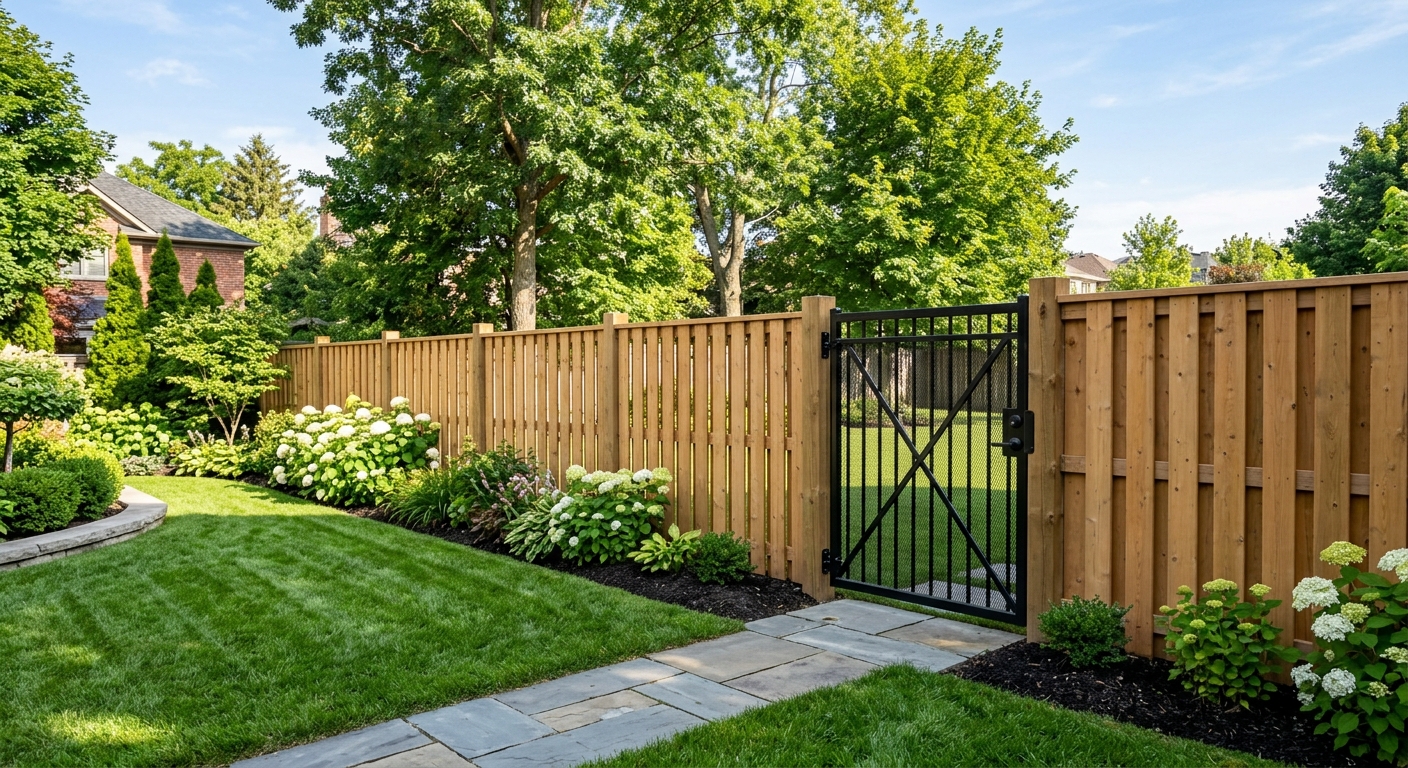
Fencing options and costs in Lions Bay
Lions Bay homeowners typically start with the basics: what will look right, hold up in our coastal weather, and fit the budget. With 95.0% of dwellings in the community being single-detached homes (Statistics Canada, 2021 Census), there’s a steady demand for perimeter fencing—especially along side yards and back property lines. Ownership is also high: 88.1% of households own (Statistics Canada, 2021 Census), which usually means more long-term, invest-in-the-yard projects and fewer quick-turn upgrades.
In the Lower Mainland–Southwest, pricing is shaped by mild but not trivial frost-and-wind conditions. Even though our coastal winters are warmer than much of Canada, posts still need to be set below the effective frost depth to reduce heaving and keep fence lines straight. Wet Fraser Valley–type soils can also mean deeper holes and more concrete for privacy panels, corner posts, and gates. Add coastal wind exposure and the requirement for stronger bracing, and you’ll see why “same fence, different lot” can change the quote.
Contractor availability is generally good in nearby working areas like West Vancouver–adjacent corridors, so you can often get competitive pricing if your site access is straightforward and your fence height and finish grade are clear. If you’re on a steeper lane or have irregular drainage near the roadway, you should expect more labour for raked/stepped sections and longer install time. Use the comparison table below to anchor your budgeting before you ask for itemised estimates.
| Material |
Lifespan |
Maintenance |
Privacy Rating |
Price per Linear Foot |
| Pressure-treated pine (standard wood) |
10–20 years |
Stain/seal every 2–3 years; fastener checks |
Medium to high (solid/close board layouts) |
$18–$35 |
| Cedar (natural rot resistance) |
15–25 years |
Seal or stain every 2–3 years; occasional board replacement |
High (solid boards) |
$22–$42 |
| Vinyl / PVC (no-maintenance) |
20–30 years |
Rinse as needed; inspect for impact damage |
High (solid privacy styles) |
$28–$55 |
| Chain-link (galvanized steel) |
20–35 years |
Occasional tightening; repaint only if needed |
Low (see-through) |
$12–$25 |
| Aluminum ornamental |
25–40 years |
Minimal; wash down; inspect hardware |
Low to medium (decorative spacing) |
$25–$60 |
| Composite / recycled material |
20–30 years |
Low; periodic cleaning; check panel alignment |
Medium to high (solid composites) |
$30–$65 |
Prices are estimates only and vary by project scope, site access and material selection.
What affects the price of fencing in Lions Bay
In Lions Bay and across the Lower Mainland–Southwest, two quotes for what looks like the same fence can still swing by 30–50%. The main reason is that fencing is labour-heavy and highly dependent on site conditions—length, grading, post placement, and how difficult the ground is to excavate. A company quoting only from a street-facing photo often misses the realities of wet soil, access constraints, and how your lot’s slope changes panel layout. Also, contractor availability varies by season and by how many crews are working at once in nearby communities with similar waterfront/coastal exposure.
Frost and post depth are a big cost driver, even here. While much of Canada requires deeper embedment, frost depth still dictates how far below grade posts must be set to prevent heaving. A practical rule contractors follow is placing posts about 4–6 inches below the design frost depth; that often translates into deeper holes and longer posts than homeowners expect. Where colder regions (Ontario/Alberta) typically push post embedment closer to 1.5–2.0 m, coastal BC is generally shallower—but crews still often go deeper than the bare minimum and use concrete for corner posts, privacy sections, and gate hardware. That’s where your install price grows.
Local examples that raise cost in Lions Bay include: excavating through saturated/wet soil near drainage swales (more time and concrete); removing an old fence anchored in concrete footings (extra labour and disposal); and building stepped sections on sloped yards so the fence stays level visually. Conversely, you can lower costs if your run is straight, soil is easier to dig, access is wide enough for a small auger, and you choose chain-link as the base line. For context, many projects land in the wood range of $55–$95 per linear foot equivalent (installed as a typical band reference), while vinyl/PVC usually sits higher at $75–$130, largely because of material and stronger structural requirements for privacy styles.
Because many Lions Bay homes were built earlier—65.3% of dwellings are older than 1981 (Statistics Canada, 2021 Census)—you’ll also see more mature landscaping, older boundary markers, and sometimes aged fencing hardware that complicates removals and layout.
| Price Factor |
Why It Matters |
Cost Impact |
| Fence length in linear feet |
Main driver of materials, posts, rails and labour hours |
High (often 50–70% of total) |
| Post depth required |
Frost/heave risk controls how deep holes must be excavated |
Medium to high (longer posts + deeper digging + more concrete) |
| Post setting method |
Concrete set vs gravel pack vs driven posts changes labour and material |
High for gates/corners; medium for long runs |
| Material choice |
Strength, bracing needs, and component cost vary widely by material |
Medium to very high (vinyl and composite typically cost more than wood/chain-link) |
| Gate count and type |
Double drive-through gates need heavier frames, hinges and reinforcement |
High (often the single biggest add-on) |
| Grade and terrain |
Slopes require raked/stepped panels and extra layout time |
Medium (more time + more cut components) |
| Old fence removal and disposal |
Demolition, hauling and potential concrete footings add labour |
Medium to high depending on condition |
| Permit fees and survey / property line locate |
Some taller fences require permitting; accurate locating prevents rework |
Low to medium (can become medium if a survey is needed) |
Permits & regulations in British Columbia
In British Columbia, fence rules are typically governed by municipal bylaw, but the common permitting trigger is height: fences above a threshold—often around 2.0 m (6.5 ft) at the rear and 1.0–1.2 m (3–4 ft) at the front or corner—may require a building permit depending on your lot and location. Regardless of permit requirements, you still must respect property lines and local setback rules. If you install first and find out later that the fence is beyond the allowed location, you may end up paying to correct it—so it’s worth verifying early.
Before you dig any post hole, arrange utility locates so you don’t hit buried services. Use the appropriate province-wide utility locate process (commonly via BC 1 Call in BC). For boundary accuracy, get a survey or property line locate (at minimum, verify pin locations) before installing. Shared fence ownership rules are handled under provincial line-fence legislation; when a fence is truly shared, your approach to repairs/replacement should align with neighbours and documentation.
What typically requires a permit: installing a fence above the height thresholds (and any project that increases height/material footprint beyond what your municipality treats as exempt). What typically does NOT require a permit: in-kind replacements of an existing fence that stay within the allowed height limits and do not extend into setback areas.
To verify your Lions Bay fencing contractor in BC, ask for (1) their BC business details and licence/registration (check their listing in the relevant online business registry), (2) a current certificate of insurance showing general liability, and (3) proof they’re properly covered for worker protection under Workers’ Compensation (in BC this is WCB/coverage status). Request the most current clearance/coverage documentation and ensure the certificate includes the project location or general service area.
Choosing the right fence material for Lions Bay
Choosing a fence in Lions Bay is mostly about matching material to how you live outdoors. If your priority is privacy and clean lines, you’ll usually end up with cedar, wood with tight spacing, vinyl/PVC privacy panels, or a composite board system. Our Lower Mainland–Southwest climate is mild, but it’s also wet enough that untreated wood can weather quickly, especially at ground contact and on wind-driven splash lines.
Pressure-treated pine is the budget-friendly route, but it typically needs staining or sealing every 2–3 years to avoid grey weathering and to protect fasteners. Cedar offers better natural rot resistance and a warmer look, yet it still benefits from periodic sealing to maintain appearance and prevent surface checking. Vinyl/PVC is the most “set it and forget it” option—low maintenance and strong resistance to rot—but in extreme cold snaps it can become more brittle than wood, so you want proper installation details and properly designed reinforcement. Chain-link is the lowest-cost and longest-life option, but it won’t give privacy unless paired with slats or planting. Aluminum ornamental is attractive and won’t rust, but it provides minimal privacy.
About post depth: even in coastal BC, crews generally still set posts below the effective frost zone to reduce heaving. In many yards, concrete setting is common for corner posts, gate posts and privacy runs because it improves long-term alignment in wetter soils and around heavy hardware. Whether you choose it across the entire run depends on the soil, slope, and how the contractor builds bracing.
Here’s where the price difference is often justified: if a mid-range wood privacy build lands in the wood band (commonly referenced as $55–$95), switching to vinyl/PVC privacy can rise into roughly $75–$130. If you’re planning to stay and want minimal upkeep, that extra upfront cost can be easier to justify than repeated staining on cedar or pine—especially when damp conditions make maintenance more frequent.
| Material |
Cold Tolerance |
Lifespan |
Annual Maintenance |
Best For |
Price Band |
| Pressure-treated pine |
Good (with proper treatment and sealing) |
10–20 years |
Plan 1 minor inspection + re-stain every 2–3 years |
Budget-friendly privacy |
$55–$95 |
| Cedar |
Good (natural resistance; still needs upkeep) |
15–25 years |
Inspect and seal as needed (often every 2–3 years) |
Appearance + rot resistance |
$65–$105 |
| Vinyl / PVC |
Very good (avoid poor installation details) |
20–30 years |
Occasional rinse; check for impact damage |
Low-maintenance privacy |
$75–$130 |
| Chain-link |
Very good (galvanized steel) |
20–35 years |
Occasional tightening; limited follow-up |
Security with minimal cost |
$30–$55 |
| Aluminum ornamental |
Very good |
25–40 years |
Minimal washing + hardware checks |
Street-facing curb appeal |
$90–$170 |
| Composite / recycled |
Good (follow manufacturer specs for fasteners) |
20–30 years |
Low; clean and inspect alignment |
Long-term look with minimal upkeep |
$80–$150 |
How to choose a fencing contractor in Lions Bay
When you’re hiring a fencing contractor in British Columbia, verify three things before you sign: (1) proper business standing/licensing for the work they’re performing, (2) liability insurance, and (3) worker coverage under WCB/WCB BC (BC’s workers’ compensation system). Start by asking for certificates before the site visit. For insurance, you should receive a valid certificate of insurance naming the coverage type and showing current dates; for workers’ compensation, ask for clearance/coverage documentation that matches the company you’re contracting. If anything is out of date, delayed, or missing, treat it as a serious red flag.
Next, get 2–3 itemised written quotes. You want a breakdown that separates labour (excavation, setting posts, framing, panel installation) and materials (posts, rails, fasteners, concrete, gates, hardware). Ask what’s included for permit processing, disposal of old fencing, and any surveying/property line locate costs. Many cost discrepancies come from exclusions like “removal not included” or “concrete only at corners.” Make sure the scope matches across quotes so you’re comparing apples to apples—not different levels of work.
Warranty matters for workmanship and materials. Ask: what is the workmanship warranty length, is the product warranty provided by the manufacturer, and is it transferable to future owners? For payment, don’t accept a schedule with large upfront money—generally keep the upfront portion around 10–15%, and hold back remaining funds until key milestones are completed and the final line is confirmed level and secure. Finally, get a firm start date and a completion estimate in writing, since wet soil can delay excavation and panel setting during rain events.
- Ask for and verify their BC business details before they start.
- Request a current certificate of general liability insurance.
- Confirm WCB coverage status with clearance documentation.
- Get 2–3 quotes with a labour/material breakdown (not a single lump sum).
- Make scope explicit: removal/disposal included or excluded?
- Confirm whether permits (if required) and survey/property line locate are included.
- Ask how posts are set (concrete at corners/gates? full run? gravel pack?)
- Check panel type: spacing for privacy, gate reinforcement, and bracing on wind-exposed runs.
- Ensure the quote includes hardware type (hinges/latches, gate frames, fasteners).
- Clarify warranty: workmanship length, product warranty length, and transferability.
- Use a payment schedule that keeps upfront at about 10–15% and holds back until completion.
- Get an install timeline and weather contingency plan in writing.
Red flags to watch for in Lions Bay: (1) “Permit not needed” claims without checking height/setback; (2) missing insurance or no WCB coverage proof; (3) quotes that don’t specify post depth, setting method, or gate reinforcement; (4) asking for large deposits (much more than 10–15%); and (5) vague warranties that only cover materials and not workmanship.
Frequently asked questions — fencing in Lions Bay
What's the most low-maintenance fence?
In Lions Bay and across the Lower Mainland–Southwest, vinyl/PVC is usually the most low-maintenance choice. It won’t rot like wood in our wet coastal conditions, and it typically doesn’t need annual coating—most homeowners simply rinse off grime and check for any impact damage after storms. If you want a cheaper, still durable option, chain-link is also low-maintenance (galvanized steel), though it provides little privacy without slats or plants. For a cost anchor, many installed vinyl/PVC projects fall in the broader region range of $75–$130 per typical linear-foot band reference, while wood privacy builds often reference $55–$95. The “best” low-maintenance answer usually depends on whether you need privacy: if yes, vinyl or cedar with a maintenance plan tends to win.
How tall can my fence be in Lions Bay?
Height limits in British Columbia are set by municipal bylaw, and Lions Bay homeowners should check local rules for rear vs front/corner areas. As a practical guideline used across many BC municipalities, fences above about 2.0 m (6.5 ft) at the rear and 1.0–1.2 m (3–4 ft) at the front or corner may trigger a building permit. Even if a permit is not required, the fence still must remain within property lines and meet any setback requirements. The safest approach is to have your contractor measure the run, confirm your lot lines (or have a locate done), then verify height relative to your grade and setbacks before materials are ordered. This avoids the most common rework: rebuilding a section that turns out to be over the allowed height or in the wrong place.
Should fence posts be set in concrete here?
Often, yes—at least where it matters most. In Lions Bay’s coastal BC conditions, frost risk still means posts should be set below the effective frost zone to reduce heaving, and wet soils frequently make excavation harder. Many contractors therefore set corner posts, line-end posts, and gate posts in concrete for stability and alignment, even if they use a different method for mid-run posts. In some yards with favourable drainage and straightforward soil, contractors may use a gravel pack method for portions of the run; however, for heavier privacy panels and any gate hardware, concrete setting is commonly used. Because materials and labour differ, concrete setting usually changes your quote—one reason fence prices can vary by 30–50% between similar-looking projects. Ask for the quote to specify the setting method for each post type.
What's the best fence for privacy?
For privacy in Lions Bay, you typically want a solid or near-solid configuration: tight-spacing wood (like cedar or pressure-treated pine), vinyl/PVC privacy panels, or composite privacy boards. Chain-link by itself won’t screen views well, and aluminum ornamentals are usually low privacy due to open pickets. If you’re comparing budget, many wood privacy installs land around $55–$95 per linear-foot reference (installed), while vinyl/PVC privacy commonly runs higher at about $75–$130 because of material costs and structural reinforcement. Cedar sits between in cost in many projects because it’s a premium wood, but it offers a natural look and strong rot resistance. In coastal wind and wet conditions, privacy fences also need solid bracing and correct post embedment to stay straight over seasons, not just “pretty boards.”
How do I compare fencing quotes?
Start by lining up scope details, not just the final total. In British Columbia, quotes vary because of post setting (concrete vs gravel pack), whether gate frames are reinforced, how corners are built, and whether old fence removal/disposal is included. Ask every contractor for an itemised breakdown: labour vs materials, the number of posts, estimated post depth, and the setting method by post type. Confirm whether permits are included if the fence height crosses common thresholds (often around 2.0 m rear and 1.0–1.2 m front/corner). Also check warranty terms: workmanship coverage length and manufacturer warranty for the material system. Finally, compare payment schedules and timeline commitments. If two bids differ by a lot, it’s usually because one includes concrete setting at gates/corners, disposal, or better-spec hardware that the other left out.
How long does fence installation take in Lions Bay?
Most residential fencing installs in Lions Bay take anywhere from a couple of days to about a week, depending on length, access, slope, and how much demolition is involved. Straight runs on flat yards with easy access and no complicated grading can be faster, especially if materials are available and the site is accessible to equipment for digging. Weather also matters: wet ground after rain can slow excavation and post alignment work. Longer projects with multiple gates or privacy panels typically take more time because gate frames require careful setting and bracing. If you’re replacing an older fence, removal and disposal can add time—sometimes half a day to a full day depending on whether old posts are concrete-set. The best way to avoid delays is to get a written start date, completion estimate, and a plan for wet days from your contractor.