Fencing options and costs in Lakeshore Village
Lakeshore Village is a close-knit community of about 6,620 residents (Statistics Canada, 2021 Census), and in neighbourhood pockets like the Lakeshore Road corridor, fencing demand is especially visible as homeowners refresh backyards for privacy, pets and seasonal entertaining. While every street is different, most properties here are “fence-ready” lots—there’s typically a clear need for boundary lines, gate access and noise reduction. In a market like Toronto’s, that demand is steady because fencing contractors serve lots of detached homes across the broader economic region, which means availability is generally good in peak season.
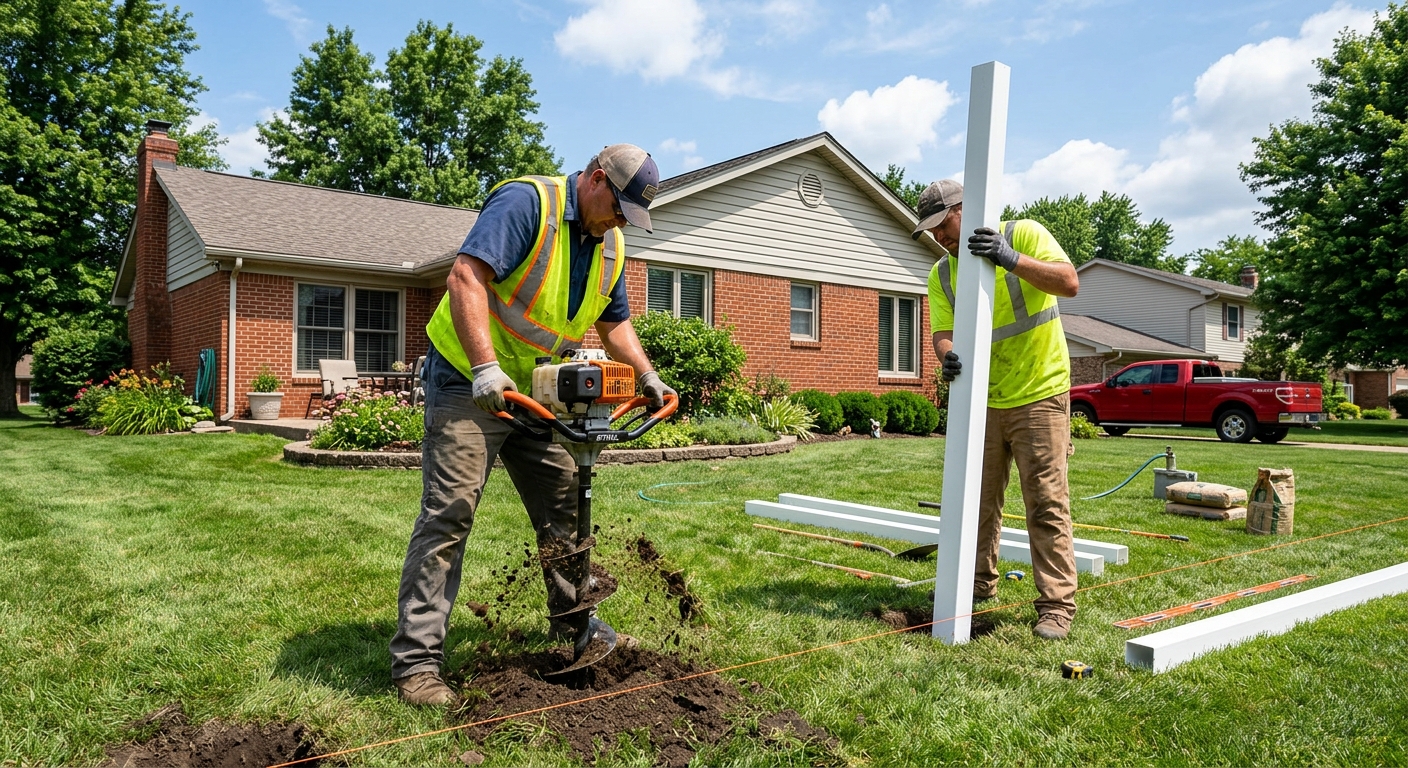
Cost in Toronto-area fencing is shaped heavily by climate and local installation practice. In Southern Ontario, the frost line is commonly treated as about 42"–48", so fence posts for taller privacy fences often need to be set deeper (commonly around 3.5–4 ft) with concrete to resist frost heave and movement. Add mixed soils and freeze–thaw cycles, and you’ll see more labour time for digging, post alignment and hardware than homeowners may expect.
Material choice also drives price swings: vinyl and aluminum cost more upfront but can reduce long-term upkeep; wood is usually cheaper to start but needs maintenance to keep it looking sharp. Chain-link is typically the most budget-friendly way to secure a yard, while composite can land mid-to-premium depending on style and colour. With those variables in mind, the table below gives a realistic comparison of common materials used in the Lakeshore Village area, then we’ll break down the biggest price drivers.
| Material |
Lifespan |
Maintenance |
Privacy Rating |
Price per Linear Foot |
| Pressure-treated pine (standard wood) |
10–15 years |
Stain/seal every 2–3 years |
High (solid or board-on-board) |
$65–$120 |
| Cedar (natural rot resistance) |
15–25 years |
Light sealing/staining every 2–4 years |
High (solid or board-on-board) |
$75–$130 |
| Vinyl / PVC (no-maintenance) |
25–30 years |
Rinse only; inspect fasteners |
High (solid privacy styles) |
$75–$130 |
| Chain-link (galvanized steel) |
20–30 years |
Occasional rinse; tighten hardware |
Low–Medium (privacy slats needed) |
$45–$85 |
| Aluminum ornamental |
25–40 years |
Wash; touch up hardware as needed |
Low–Medium (decorative) |
$90–$160 |
| Composite / recycled material |
20–30 years |
Minimal; occasional cleaning |
High (privacy boards) |
$100–$170 |
Prices are estimates only and vary by project scope, site access and material selection.
What affects the price of fencing in Lakeshore Village
Even when two homeowners in the Toronto economic region request the “same” fence, bids can differ by roughly 30–50% because contractors price risk and labour differently. A big reason is that Toronto-area fences are rarely just “put panels up and go”—the climate demands proper post depth, straight runs, correct spacing, and hardware that can resist seasonal movement. In practice, frost depth and soil conditions affect how much concrete, how long a crew spends setting posts, and whether a contractor upgrades footing sizes for stability.
For Southern Ontario, the frost line is commonly taken at about 42"–48", and the practical rule of thumb is to set posts about 4–6 inches below the design frost depth. That typically means posts need roughly 1.5–2.0 m into the ground for many installations. In Lakeshore Village, mixed soils and clay pockets can make the difference between “tolerable” and “expensive later” — so most contractors recommend concrete-set posts for 6–8 ft privacy fences. That labour time increases, and ready-mix/concrete supply costs can swing the final number, even when material price stays stable.
Wind and panel style matter too. While the GTA doesn’t face Prairies-style open-field winds, tall solid fences can still rack during storms, especially near corners and exposed stretches along main roads. In those areas, you’ll see contractors tighten post spacing and use heavier rails. By contrast, a chain-link run with fewer wind-stress panels can remain closer to the lower price bands. To connect costs to real decisions: if you’re budgeting around the $45–$85 chain-link range, you may avoid the added concrete time by opting for a lighter secure fence; but if you’re aiming for privacy in the $75–$130 vinyl band, plan for concrete-set posts, stronger rails and more time aligning posts through freeze–thaw cycles.
Concrete examples in the Lakeshore Village context: (1) a backyard with clay-heavy soil can require deeper, wider holes so the post doesn’t lift during winter, adding both excavation time and concrete; (2) a sloped lot along a typical rear property line often needs stepped or raked panel installs, which increases labour and sometimes adds extra posts or rails.
| Price Factor |
Why It Matters |
Cost Impact |
| Fence length in linear feet |
Materials and labour scale directly with length. |
High (usually the biggest swing) |
| Post depth required |
Frost line determines hole depth and post length. |
Medium–High (more concrete + longer posts) |
| Post setting method |
Concrete-set posts resist frost heave better than gravel/drive. |
Medium (can raise costs noticeably for tall privacy) |
| Material choice |
Vinyl/cedar and ornamental metal have higher unit costs. |
Medium–High (drives the base price band) |
| Gate count and type |
Double gates require heavier frames and stronger hardware. |
High (gates are labour- and hardware-intensive) |
| Grade and terrain |
Slopes require racking/stepping, extra layout time and trimming. |
Medium (labour + potential rework) |
| Old fence removal and disposal |
Hauling and dump fees add time and cost; buried posts add difficulty. |
Medium (often overlooked in initial calls) |
| Permit fees and survey / property line locate |
Some heights trigger permitting and line-locates reduce disputes. |
Low–Medium (project-dependent) |
Permits & regulations in Ontario
In Ontario, permits and approvals can apply to taller fences. As a practical homeowner guideline, fences above a height threshold—commonly around 2.0 m (6.5 ft) at the rear and about 1.0–1.2 m (3–4 ft) near the front or corner—may require a building permit depending on the municipality’s rules and the fence location on your lot. Regardless of height, you must respect property lines and municipal setback bylaws; your fence can’t encroach onto neighbouring land.
Before any post holes are dug, you should always call for utility locates through Ontario One Call to mark buried services. This is essential even if you “know” where lines run—Toronto-area landscapes change and older service maps can be incomplete. Next, confirm your property line using your survey (or a property pin locate) to avoid placing posts partly over the line, which often leads to disputes and costly rework.
Shared fence ownership and line-fence responsibilities are governed by provincial line-fences legislation, so if you’re replacing a boundary fence, clarify who is responsible for what before work begins.
What typically requires a permit: rear fences around 2.0 m (6.5 ft) or more, and any situation where the fence height/placement triggers local thresholds. What typically does NOT: low fences below common front/corner thresholds, like short garden borders, though rules vary by location on the lot—your contractor should confirm based on your exact plan.
To verify a contractor in Lakeshore Village, check (1) their Ontario licence status through the appropriate online business/licence registry pages, (2) their certificate of insurance showing adequate liability coverage for property and jobsite risk, and (3) their WSIB coverage documentation (and WCB clearance letter where applicable). Ask for certificates dated for the current work period and ensure the insured business name matches the quote contract.
Choosing the right fence material for Lakeshore Village
Choosing a fence in Lakeshore Village is mostly about matching your priorities—privacy, upkeep, lifespan and budget—to what Southern Ontario weather does to materials. With freeze–thaw cycles and a frost line commonly treated around 42"–48", the real difference often isn’t only the picket or panel type; it’s the post system. For 6–8 ft privacy fences, concrete-set posts are the standard approach because they reduce movement and frost heave. A lighter fence can look fine for a year or two, then drift as the ground expands and contracts.
Pressure-treated pine is usually the budget starting point, but it needs staining or sealing every 2–3 years to prevent greying and fast wear at the edges. Cedar costs more upfront yet naturally resists rot and often weathers more gracefully, though it still benefits from periodic sealing. Vinyl/PVC is appealing for low maintenance—no staining—but in extreme cold it can become brittle, and you still need proper fasteners and a stable post base to avoid loose sections. Chain-link is the lowest-cost, longest-life security option, but it offers limited privacy unless you add slats or privacy mesh. Aluminum is rust-resistant and looks crisp for ornamental boundaries, but it’s mid-range to higher and won’t give solid privacy. Composite/recycled boards can deliver strong privacy and minimal upkeep, though pricing depends heavily on brand and colour.
For a simple price-justification example: if your choice is between chain-link around the $45–$85 band versus a vinyl privacy fence around $75–$130, the difference can be worth it if you need year-round privacy during busy summer months and you want panels that don’t require annual staining. In wind-exposed segments near corners or main-road alignments, solid panels should be built with correct post spacing and heavier rails to resist racking.
Bottom line: if you’re aiming for long-term stability through Ontario winters, prioritise correct post depth and concrete setting first, then select the material that best matches your willingness to maintain and your privacy needs.
| Material |
Cold Tolerance |
Lifespan |
Annual Maintenance |
Best For |
Price Band |
| Pressure-treated pine |
Good when properly sealed and installed on solid footings |
10–15 years |
Inspection + touch-ups; stain/seal every 2–3 years |
Budget-friendly privacy with a willingness to maintain |
$65–$120 |
| Cedar |
Good; tolerates moisture and rot better than standard pine |
15–25 years |
Light sealing/staining as needed (typically every 2–4 years) |
Natural look privacy with better long-term appearance |
$75–$130 |
| Vinyl / PVC |
Good in Ontario when posts and hardware are correctly installed |
25–30 years |
Rinse/clean; inspect fasteners after winter |
Low maintenance privacy and clean curb appeal |
$75–$130 |
| Chain-link |
Excellent; galvanized steel holds up in freeze–thaw |
20–30 years |
Minimal; occasional rinse and hardware checks |
Security on a budget and long-term durability |
$45–$85 |
| Aluminum ornamental |
Very good; non-rusting with proper hardware |
25–40 years |
Wash and spot-check hardware |
Attractive front/side boundaries with moderate visibility |
$90–$160 |
| Composite / recycled |
Good; performance depends on board quality and installation system |
20–30 years |
Low; occasional cleaning and hardware checks |
Privacy with minimal upkeep and modern colours |
$100–$170 |
How to choose a fencing contractor in Lakeshore Village
Choosing the right fence contractor in Lakeshore Village is about verifying coverage and clarity, not just getting the lowest line price. Start by confirming the contractor can legally operate in Ontario for this type of work. Ask for proof of liability insurance (certificate of insurance naming the correct legal business and showing jobsite coverage). For worker protection, ensure they carry WSIB coverage; if they’re required to provide a clearance letter or related compliance document, ask for the most current paperwork before work starts. Don’t accept “it’s through a subcontractor” without seeing the actual coverage documents—your property and your project timeline depend on it.
Next, request 2–3 itemised written quotes rather than lump sums. A proper quote breaks labour and materials separately, specifies post size and spacing, explains post setting method (concrete-set depth appropriate for Ontario frost conditions), lists rails and hardware, and identifies gate construction details (hinges, latch type, and whether a double gate uses a heavier frame). Confirm whether the quote includes permit pull (when required), utility locate scheduling/marking coordination, and disposal of the old fence.
For warranty, ask two questions: what is the workmanship warranty length and what is the manufacturer warranty for materials? Also ask whether warranties are transferable to future owners—this can matter if you sell soon. In payment scheduling, never pay more than about 10–15% upfront; hold back a reasonable portion until the full scope is complete and final walkthrough is done. Finally, insist on a written start date and a completion estimate so you can plan around weather and access constraints.
- Ask for post depth and concrete setting details, not just “concrete included.”
- Confirm panel style and how they handle corner and fence-line transitions.
- Verify gate hardware specs (latch type, hinges, and whether it’s rated for tall/heavy gates).
- Request a layout plan showing fence line location and how they’ll confirm property pins.
- Ensure the quote states what’s included/excluded (demo, disposal, hauling, new soil/settlement fill).
- Check that the crew will do utility locates through Ontario One Call before digging.
- Confirm whether they handle weather delays and how they protect materials.
- Look for an itemised materials list: lumber grade/type, hardware brands where possible, and rail sizes.
- Ask how they prevent water pooling at post bottoms (common for wood and cedar).
- Confirm warranty terms for workmanship and separate manufacturer material coverage.
- Review the contract for scope changes: how extras are priced and approved.
- Confirm payment schedule and retainage (avoid large upfront payments).
Red flags I see in Lakeshore Village: contractors who won’t put post depth and spacing in writing, quotes that exclude permit responsibility when height thresholds may apply, “cash-only” arrangements with no insurance certificate, vague warranty language (“lifetime” without workmanship wording), and crews starting without documenting property line verification or utility locates.
Frequently asked questions — fencing in Lakeshore Village
Should I repair or replace my old fence in Lakeshore Village?
In Lakeshore Village, I usually recommend repairing when the posts are still solid, the fence is only suffering from surface issues like warped boards or missing pickets, and the bottom rails haven’t rotted through. If posts wobble, lean, or have been lifted by freeze–thaw movement (common around clay pockets), replacement is often the better long-term value. A quick indicator is how many post bases have cracks or movement after winter: if you’re fixing multiple posts, it’s usually not economical to keep chasing repairs. Budget-wise, repairs can still be a fraction of a full replacement, but once you’re near full-length labour and new hardware anyway, many homeowners move into the standard installation price bands—often around $65–$120 for pressure-treated wood or $75–$130 for vinyl depending on height and style.
How do I handle a fence dispute with a neighbour in Ontario?
Fence disputes are very common in Ontario because even a small encroachment can become a big problem once the fence is built. Start by gathering the facts: your property pins/survey, any prior boundary agreement, and photos of the existing line. Then measure from fixed references (corner of the house, boundary markers) rather than guessing from fences alone. Ontario also has line-fence rules under provincial legislation, so if it’s truly a shared boundary fence, you may need to discuss ownership responsibilities. I suggest documenting everything in writing (emails are fine) and staying calm about intent—you’re aiming for a shared solution, not a personal fight. If a contractor’s layout differs from the pins, stop work immediately and clarify before posts are set in concrete. Ultimately, most resolutions come down to re-locating to the correct property line or agreeing on a shared fence arrangement.
What fence style offers the best wind resistance in Lakeshore Village?
For wind resistance in Southern Ontario, the key is how the fence panels present wind load and how the posts are secured. In Lakeshore Village, we don’t get the extreme open-field conditions of the Prairies, but tall solid privacy fences can still rack during storms. The most wind-stable approach is usually a properly constructed privacy fence with heavier rails, correct post spacing (commonly tighter for taller solid sections) and concrete-set posts set below frost depth requirements. If you want flexibility in heavy weather, a picket-style or semi-private design can sometimes reduce wind pressure compared to fully solid panels, but it depends on spacing and the height you choose. For homeowners concerned about storms and seasonal movement, choosing a stable base system and reinforced hardware often matters more than “which look” you pick.
How much does a fence cost in Lakeshore Village?
Fence cost in Lakeshore Village depends mainly on linear footage, fence height, post setting method (especially concrete-set posts for privacy), gate count and whether you’re removing the old fence. As a realistic guide for the Toronto economic region, wood installation commonly lands around $65–$120 per linear foot, vinyl/PVC often around $75–$130, chain-link around $45–$85, and aluminum/metal around $90–$160. Those ranges assume standard access and typical layout. If your property has slope requiring stepped panels, limited side access, or an older fence with difficult buried posts, your installed total will trend toward the higher end. The best way to tighten the estimate is an itemised quote that includes post depth, concrete setting, and hardware specs.
How deep should fence posts be for Lakeshore Village's frost?
For Lakeshore Village and the wider Southern Ontario climate, frost is commonly treated at about 42"–48". To reduce frost heave, posts are typically set about 4–6 inches below the design frost depth—often translating to roughly 3.5–4 ft (about 1.5–2.0 m) of depth for many fence installations, especially 6–8 ft privacy fences. That’s why concrete-set posts are recommended more often than driven posts: the concrete anchoring and hole sizing help the post stay stable through winter expansion and thaw. Exact depth can vary based on site conditions and the contractor’s method, so ask your installer to state the intended post length, hole depth, and whether concrete is used. If you’re comparing quotes, make sure they’re comparing the same post depth, not just the same fence style.
Wood vs vinyl vs aluminum fence — which is best?
The “best” material in Lakeshore Village comes down to your priorities. Wood (like pressure-treated pine) is usually the best budget start, but it requires staining/sealing about every 2–3 years to prevent grey weathering and edge breakdown. Cedar is more attractive and naturally resists rot better, but it still needs periodic care. Vinyl/PVC is often the easiest for homeowners who want low maintenance; you typically rinse it and inspect fasteners after winter, but it needs correct installation and hardware to avoid movement. Aluminum is durable and rust-resistant with minimal upkeep, but it’s usually ornamental, so it won’t provide the same privacy level as a solid wood or vinyl fence. Price-wise, wood tends to align with the $65–$120 band, vinyl around $75–$130, and aluminum commonly higher around $90–$160. If privacy is your top goal, vinyl or wood/cypress-style boards usually win; if curb appeal and longevity without upkeep matter most, aluminum is a strong option.